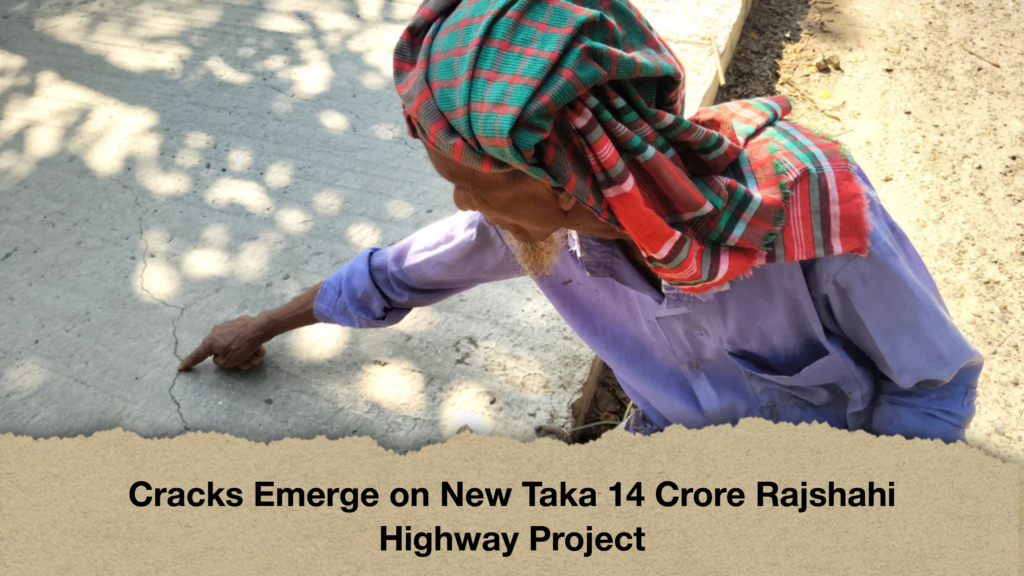
Residents across Poba and Tanore upazilas in Rajshahi had long anticipated a durable road after years of navigating severe potholes. However, a major rehabilitation project intended to transform regional transit has drawn heavy criticism just months into construction, as cracks and structural sinking have appeared across newly poured concrete sections.
The overhaul falls under the “Baya-Kashim Bazar-Tanore Road Rehabilitation (Widening and Strengthening)” project, implemented by the Local Government Engineering Department (LGED). With a contract value of roughly Taka 14 crore, the scheme covers more than nine kilometres of roadway stretching from Poba towards Tanore. Work officially commenced on 9 May, with a scheduled completion deadline set for 12 March 2027.
Trouble surfaced along an estimated half-kilometre stretch in the Baksara-Naodapara area, where reinforced cement concrete (RCC) casting was recently laid. A physical inspection on Thursday, 17 September, revealed distinct fractures along the concrete surface alongside areas where the roadbed had visibly subsided under weight. Construction work in the cracked zones has been halted, though operations continue on other sections of the project.
Local residents and community leaders have voiced sharp concerns regarding workmanship and supervisory oversight. Former ward councillor Nazmul Huda Molla stated that excavation pits were inadequately compacted, noting that rollers were not operated properly prior to casting. He added that the concrete mixture suffered from an excessive proportion of sand over aggregate, compromising structural integrity. Other villagers reported that concrete was poured over uncleaned subsoil without the use of proper mechanical compactors or vibrators to settle the material.
Addressing the structural failures, contractor Mohammad Yunus Ali of M/S Jewel Electronics offered a different explanation, claiming that newly poured concrete requires at least 28 days of cure time completely free from traffic. Given the corridor’s strategic importance, heavy vehicles continued to travel over the fresh concrete, inflicting premature damage. He added that his firm had initially raised concerns regarding the poor quality of the local soil, but officials instructed work to proceed regardless.
Poba Upazila Engineer Mohammad Ali defended the construction materials used, attributing the structural failure to the region’s underlying “organic soil.” This type of earth loses its bearing capacity when exposed to moisture, causing the surface to yield under load. Unusually heavy rainfall and unmanaged heavy traffic further accelerated the degradation.
In response to the early damage, the engineering office has submitted a proposal to revise the structural design. The recommended modifications call for a three-inch plain cement concrete base beneath a 12-inch reinforced concrete layer featuring double-layered rebar mats and specialized corner reinforcement bars. Senior LGED engineers and project directors have conducted field assessments to evaluate the revised engineering requirements.
While the contract remains active and opportunities exist to repair defective sections before completion, local communities maintain that long-term durability must take precedence over mere speed of delivery.