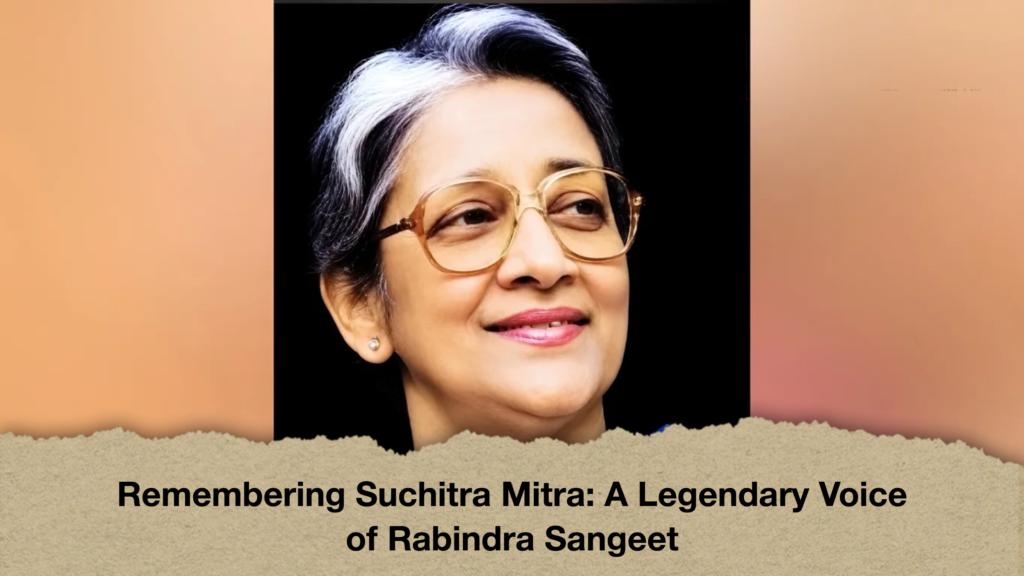
The cultural landscape of Rabindra Sangeet lost one of its most luminous figures with the passing of Suchitra Mitra, a pioneering singer, dedicated educator, and cultural icon whose resonant voice transformed Rabindranath Tagore’s compositions into a powerful medium for love, resistance, and liberation. During the tumultuous days of the 1971 Bangladesh Liberation War, her impassioned renditions of Tagore’s music—most notably “Amar Sonar Bangla”—served as a profound source of inspiration, forging a deep spiritual bond with the freedom-seeking people of Bengal.
Born on 19 September 1924 in Gujhandi, Bihar, during the British colonial period, Suchitra was the daughter of renowned author Saurindramohan Mukherjee, placing her in close proximity to literary and artistic luminaries from an early age. Her innate passion for music blossomed early, leading her to take preliminary lessons under Pankaj Mullick before earning a scholarship to Santiniketan’s Sangit Bhavana. There, under the tutelage of esteemed mentors such as Indira Devi Chaudhurani, Shantidev Ghosh, and Sailajaranjan Majumdar, her artistic foundation matured. Santiniketan’s natural environment and profound philosophical ethos deeply shaped her interpretation of Tagore’s works, anchoring her lifelong commitment to maintaining the absolute purity of musical notation, rhythm, and lyrical intent.
Mitra’s artistic identity transcended mere vocal performance; she viewed music as an expression of human consciousness and social solidarity. This conviction was reflected in her long-standing association with the Indian People’s Theatre Association (IPTA), through which she used mass songs and cultural activism to connect with ordinary citizens. Expanding her artistic reach, she lent her voice as a playback singer to various films and stepped in front of the camera for notable cinematic projects, including Uma Prasad Moitra’s Liberation War-themed film ‘Joy Bangla’ and Mrinal Sen’s critically acclaimed ‘Padatik’.
Beyond her performances, she dedicated decades to academic mentorship, serving as a professor and head of the Rabindra Sangeet department at Rabindra Bharati University until 1984. Through her teaching, published essays, and a late-career initiative to compile an exhaustive information repository on Rabindra Sangeet, she ensured that future generations understood the historical depth and poetic philosophy underpinning Tagore’s repertoire.
Her monumental contributions to arts and culture earned her numerous accolades, including the prestigious Padma Shri award from the Government of India in 1974, the Sangeet Natak Akademi Award in 1986, and the Desikottama from Visva-Bharati University. In 2001, she was appointed Sheriff of Kolkata, cementing her status as a revered figure in civic and cultural life.
Suchitra Mitra passed away on 3 January 2011 at the age of eighty-six after a prolonged illness in Kolkata. Though her physical presence departed, her legacy endures through recorded performances, scholarly texts, and the countless students she guided, continuing to resonate across borders and generations as an enduring symbol of artistic integrity and human freedom.