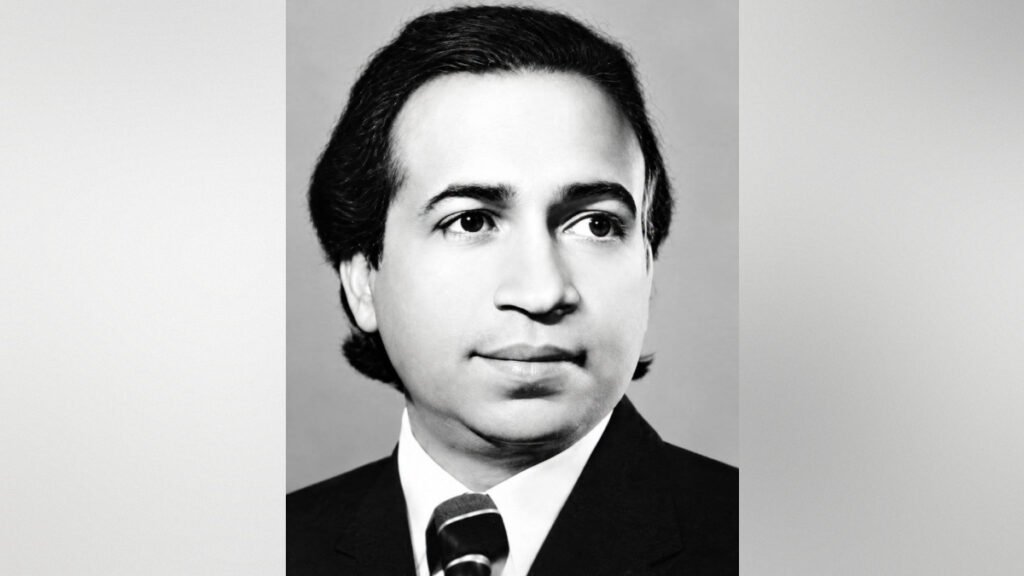
Bangladesh’s dance tradition has been shaped by artists who devoted their lives to performance, teaching and experimentation. Among them, dance maestro Gowhar Jamil occupies a distinctive place. Through his choreography, dance dramas, teaching and institutional initiatives, he contributed significantly to the growth of modern dance practice in the country. His artistic approach brought together classical training and elements of Bengal’s folk culture, giving his work a strong connection with the lives and experiences of ordinary people.
Born in 1925 in Sirajdikhan village of the Bikrampur Pargana, Jamil belonged to the prominent Nath family. His family name was Ganesh Chandra Nath. His interest in dance began when he was a child. At the age of eight, he watched renowned dancer Kelu Nayar perform ‘Shikari Nritya’. The performance left a lasting impression on him and inspired his ambition to become a dancer. What began as a childhood fascination gradually developed into a lifelong commitment to the performing arts.
Jamil spent many years learning from leading artists and teachers. From 1935 to 1954, he received dance training from Bhaskar Dev, Pandit Ravi Shankar, Uday Shankar and Bulbul Chowdhury. His education continued later in India. In 1962, he trained in Bharatanatyam under Maruthappa Pillai and in Kathak under Ramnarayan Mishra. Exposure to several classical traditions, combined with his familiarity with indigenous dance forms, helped shape the distinctive character of his artistic work.
He also recognised the need to build institutions that could support the development of dance beyond individual performances. In 1950, he established the cultural organisation Kala Bhavan. In 1959, he founded Jago Art Centre. These institutions provided opportunities for dance education and artistic practice and helped create a setting in which emerging performers could develop their abilities. His role as a teacher was therefore closely connected with his wider efforts to strengthen the country’s cultural infrastructure.
As a choreographer and dance-drama writer, Jamil explored ways of combining movement with narrative, history and human emotion. His notable dance dramas included ‘Samanya Kshati’, ‘Anarkali’, ‘Bichar’, ‘Kanchanmala’, ‘Itihasher Ekti Pata’ and ‘Chhiyattorer Monnontor’. These works reflected his interest in using dance to communicate stories and themes that extended beyond purely aesthetic performance.
The culture and everyday life of Bengal were central to much of his choreography. Rural communities, nature, working people and ordinary human emotions appeared repeatedly in his creative works. Among his notable short dance pieces were ‘Jele Nritya’ or ‘Polo’, ‘Santhal’, ‘Garo’, ‘Morong’, ‘Gramya Mela’, ‘Gypsy’, ‘Dhopa’, ‘Sukhi Jora’, ‘Tea Garden’ and ‘Matrusneho’. Through these productions, Jamil brought aspects of local life and folk traditions into the formal setting of stage performance.
His career also took him beyond the country. He participated in international cultural festivals and performed in Russia, China, Hong Kong, the Middle East and the United Kingdom, among other places. Such appearances provided an opportunity to present dance rooted in Bengal’s cultural traditions to international audiences. During a visit to the United States, he also visited several music and dance institutions, allowing him to observe different approaches to international artistic practice.
Jamil’s contribution was not limited to dance and choreography. He also worked as a dance director in films and appeared in several productions as an actor. ‘Moner Moto Bou’, ‘Pagla Raja’ and ‘Bela Shesher Gaan’ are among the films associated with his acting career. His involvement in cinema demonstrated the breadth of his engagement with the performing arts.
His personal life was closely linked with the cultural world as well. After converting his religion in 1952, he married renowned dancer and film actress Rowshan Jamil. The couple remained prominent figures in the country’s cultural life, with both making their own contributions to dance and cinema. They had one daughter, Kanta Jamil.
On 21 September 1980, Gowhar Jamil died in a road accident. He was 55. His sudden death brought an abrupt end to the career of an artist who had spent decades working to develop dance as a serious and expressive art form.
His contribution received official recognition after his death. The Government of Bangladesh awarded him the Ekushey Padak posthumously in 1981 for his contribution to the arts. In 2001, Bangladesh Post issued a postage stamp bearing his name as a tribute to his memory.
Jamil’s legacy extends beyond the performances that survive in the country’s cultural record. His work as a choreographer demonstrated how classical techniques could be combined with folk traditions and themes drawn from Bengali life. His efforts in dance education and institution-building also helped create opportunities for future generations of performers.
Although he died more than four decades ago, Gowhar Jamil continues to occupy an important place in the history of Bangladesh’s performing arts. His dance dramas, choreographic works, teaching and cultural initiatives remain part of the story of how dance developed into a recognised and enduring form of artistic expression in the country.
On the anniversary of his death, the contribution of this pioneering dance maestro is remembered with respect.