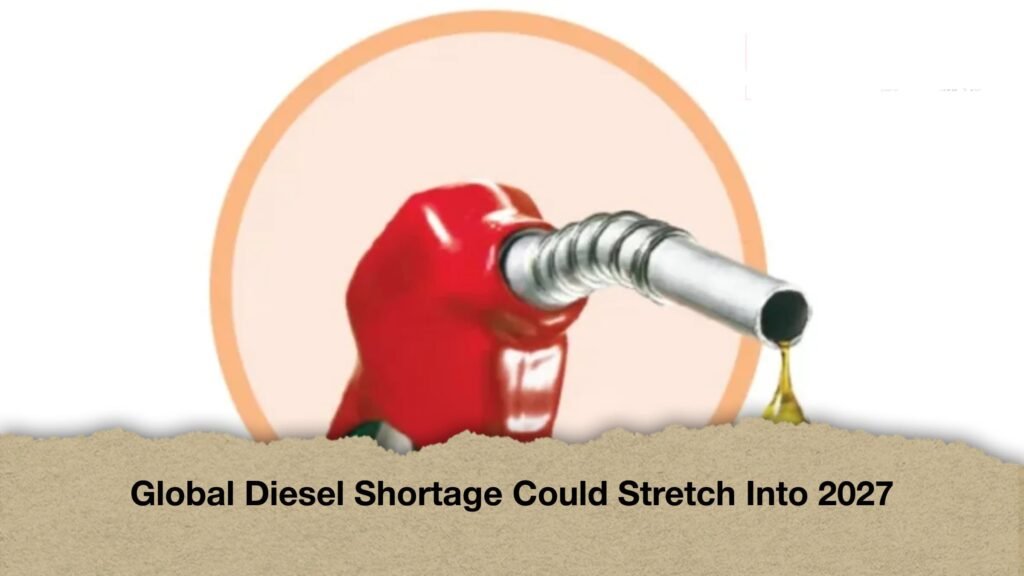
The global diesel market is facing a deepening supply squeeze, with little indication that conditions will return to normal in the near term. Conflicts involving Iran and Ukraine have disrupted fuel supply chains, particularly from the Middle East and Russia, while diesel inventories in several major markets have fallen to historically low levels.
Industry participants and analysts now expect the pressure to persist into 2027, with tight supplies and elevated prices continuing to affect agriculture, manufacturing and heavy transport. A Reuters report said the disruption has already pushed diesel prices to record levels in several markets.
Supply disruptions tighten the market
The current diesel shortage is being driven by several factors at the same time. Conflict-related damage and disruption have reduced supplies from important producing and refining regions, while restrictions on Russian fuel exports have further limited the availability of diesel on international markets.
The resulting shortfall has come at a difficult time for inventories. In the United States, total diesel inventories fell to 107.9 million barrels by 11 September, the lowest level for that point in the year since records began in 1982, according to the US Energy Information Administration.
The situation is not confined to the United States. Diesel inventories at the Amsterdam-Rotterdam-Antwerp trading and storage hub were 16% below their five-year average in July. In Singapore, another major Asian fuel-trading centre, distillate inventories have also remained below the 2025 average.
As available stocks decline, even a relatively modest disruption can have a pronounced effect on prices. Traders and fuel suppliers have less of a buffer to draw on when deliveries are delayed or refinery output falls.
US diesel prices exceed $6 a gallon
The impact is particularly visible in the United States, where retail diesel prices surpassed $6 a gallon this month for the first time. The increase has placed additional pressure on farmers, trucking companies and other businesses that depend heavily on diesel-powered vehicles and machinery.
Diesel plays a central role in the US freight economy. Heavy trucks use it extensively to move goods between farms, factories, distribution centres and shops. Agriculture also depends on diesel for machinery used in planting, harvesting and other field operations.
Higher fuel prices therefore have effects beyond the filling station. When transport costs rise, businesses may face higher expenses for moving raw materials and finished products. Some of those costs can eventually be reflected in the prices paid by consumers.
The strain is being compounded by constraints in the refining sector. Reuters reported that US refineries are operating at very high utilisation rates, leaving limited scope to increase diesel output quickly. The country has also not seen a new major refinery built in roughly five decades, making rapid expansion of refining capacity difficult.
Storage market sends another warning
A striking sign of the shortage is emerging in the fuel-storage market. Rather than competing for additional storage space, some refiners and traders in North America are allowing diesel-storage leases to expire because there is not enough fuel available to fill the tanks.
According to storage broker The Tank Tiger, diesel storage capacity available for lease in North America and the Caribbean rose to about 13 million barrels for October, up from 11 million barrels in June. The increase reflects weak demand for storage at a time when physical diesel supplies are already tight.
The situation is unusual because fuel companies normally use storage facilities to build inventories and protect themselves against supply interruptions. When companies are unwilling to renew those leases because they have little fuel to store, it suggests that the shortage is affecting not only deliveries but also inventory-building strategies.
Economic effects could spread further
Diesel is closely linked to the wider economy because it powers much of the machinery and transport infrastructure used to produce and distribute goods.
Farmers face higher operating costs when diesel becomes more expensive. Freight operators must spend more to run their fleets, while manufacturers can face higher costs for moving raw materials and finished products. Construction and other industries that depend on heavy machinery can also be affected.
The impact can eventually reach consumers. Higher transport and production costs may feed into the prices of food, manufactured goods and other products. This makes a prolonged diesel shortage a broader economic concern rather than simply an energy-market problem.
The pressure is already being felt by some US businesses. Reuters reported that companies are adopting measures such as using smaller vehicles, grouping deliveries and avoiding unnecessary journeys to reduce the impact of rising fuel costs.
Shortage may continue through much of 2027
The US Energy Information Administration expects distillate fuel inventories, which include diesel, to fall below 100 million barrels in September and remain below the five-year low through the end of 2026 and most of 2027.
That forecast does not mean prices will necessarily rise continuously. There are signs that additional supplies could provide some relief. China has increased diesel exports in recent months, while exceptionally strong refining margins are encouraging refineries to maximise production.
Yet the market remains vulnerable to further shocks. An escalation of the conflicts involving Iran or Russia and Ukraine, or an unexpected major refinery outage, could reduce supplies again and trigger another surge in prices.
The outlook will therefore depend heavily on how quickly disrupted supply chains recover and whether refiners can rebuild depleted inventories. Until that happens, diesel markets are likely to remain sensitive to geopolitical developments, refinery outages and changes in international trade flows.
For the global economy, the concern goes well beyond the price of fuel itself. A prolonged diesel shortage could keep pressure on transport, agriculture and industrial production, while adding to costs across supply chains. With inventories already depleted in several key markets, the effects of the current squeeze could remain visible well into 2027.