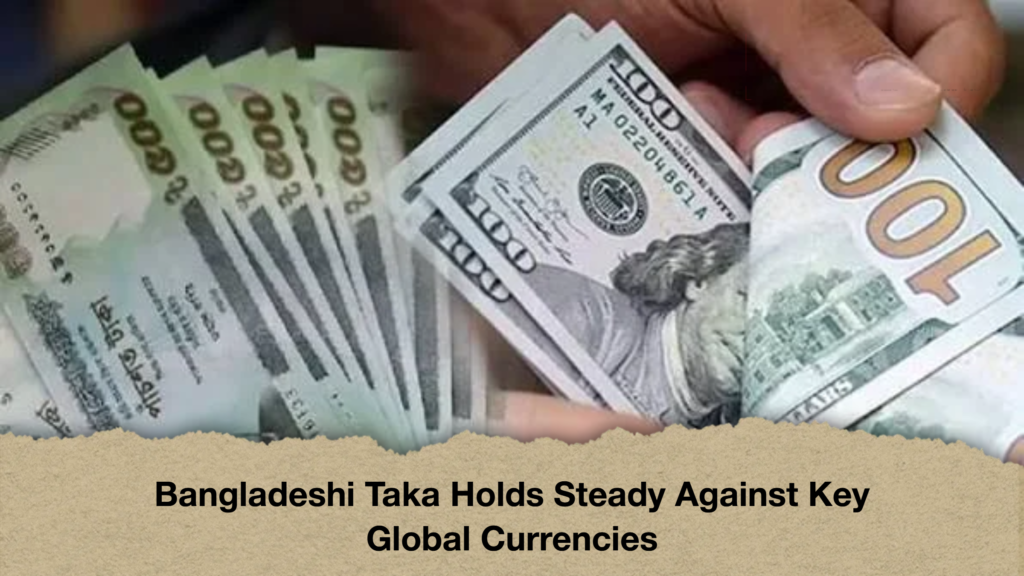
Foreign exchange rates across Bangladesh registered measured fluctuations on 26 September 2026, offering crucial pricing benchmarks for international trade, foreign education, medical travel, and inbound remittances.
Data released for the session shows the US Dollar—the primary anchor currency for the nation’s import-export settlements—trading at 123.15 Taka for buying and 123.22 Taka for selling. The narrow seven-poisha spread between purchase and sales rates highlights relative stability in interbank dollar supply.
Among European currencies, the British Pound Sterling retains the highest valuation against the local currency, standing at a purchase price of 163.01 Taka and a selling price of 163.24 Taka. The Euro registered a buying rate of 140.14 Taka against a selling figure of 140.30 Taka.
Regional currencies vital to bilateral commerce and personal travel showed consistent performance. The Indian Rupee posted identical buying and selling rates at 1.29 Taka. The Chinese Yuan, vital for industrial raw material imports, traded at 18.35 Taka buying and 18.37 Taka selling, while the Japanese Yen held flat across both counters at 0.78 Taka.
Across the Asia-Pacific corridor, the Singapore Dollar was priced at 96.19 Taka buying and 96.30 Taka selling. The Australian Dollar traded at 86.65 Taka for purchases and 86.79 Taka for sales.
In foreign exchange trading, the distinction between buying and selling rates reflects operational margins applied by financial institutions. Banks acquire foreign currency at the purchase rate and sell it to consumers at the sales rate, generating a small margin. For instance, the spread stands at 23 poisha for the Pound, 16 poisha for the Euro, 14 poisha for the Australian Dollar, 11 poisha for the Singapore Dollar, and two poisha for the Yuan.
Even minor point variations can materially alter costs during large commercial transactions, tuition fee payments, or remittance transfers. While these figures serve as official indicators for 26 September, final transaction rates at commercial banks and authorised money changers may vary slightly depending on market liquidity and settlement types.