Bodies are being recovered from canals, lakes, pavements, areas beside hospitals, abandoned buildings and other isolated locations across the capital, often with little information to establish who the deceased were. In some cases, investigators find signs of injury. In others, prolonged decomposition destroys crucial evidence that could help identify the person.
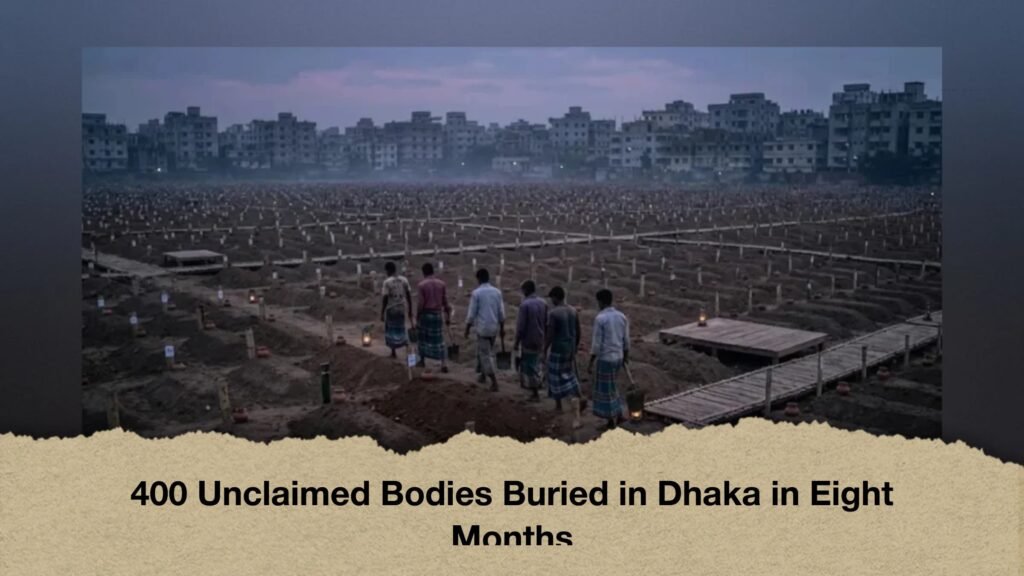
According to figures from Anjuman Mufidul Islam, 400 unclaimed bodies were buried or otherwise given their final rites in Dhaka during the first eight months of this year. The figure has drawn attention to the recurring recovery of unidentified bodies in different parts of the capital, although it should not be interpreted as the total number of unidentified bodies recovered during the period.
A recent case in Jurain illustrates the difficulties investigators face. Last Friday, police recovered the partially decomposed body of a boy believed to be around 16 from an abandoned public toilet beneath the Jurain Railway Bridge in Shyampur.
The body had decomposed severely, with bones visible around the head. An injury was also found on the forehead. Police believe the teenager may have died between 15 and 20 days before the body was discovered.
As his identity could not be established, the body was sent to the morgue at Dhaka Medical College Hospital for a post-mortem examination. Shyampur police station officer-in-charge Nazrul Islam said the Criminal Investigation Department (CID) could not collect fingerprints because of the extent of decomposition.
Police have also conducted publicity campaigns in the surrounding area in an effort to identify the teenager. So far, however, no one has provided information about him.
Unidentified and unclaimed are not the same
The Jurain case is not an isolated incident. Several unidentified bodies have been recovered from different parts of Dhaka this year, although there is no comprehensive government statistic publicly available covering the entire capital.
Figures based on published news reports indicate that at least 11 cases involving unidentified bodies have emerged in the Shahbagh police station area alone this year.
There is, however, an important distinction between an unidentified body and an unclaimed body. A deceased person is initially recorded as unidentified when their identity is not known at the time of recovery. Police then attempt to establish the identity and locate relatives.
If those efforts fail and the necessary legal procedures are completed, the body may eventually be treated as unclaimed and arrangements made for burial or another appropriate final rite.
For that reason, the 400 bodies handled by Anjuman Mufidul Islam should not be regarded as the total number of unidentified bodies recovered in Dhaka during the first eight months of the year.
400 bodies handled between January and August
Anjuman Mufidul Islam’s figures show that 400 unclaimed bodies were given final rites between January and August. Of these, 326 were buried at Rayerbazar Cemetery and 74 at Jurain Cemetery.
The monthly figures were 30 in January, 59 in February, 52 in March, 46 in April, 56 in May, 67 in June, 42 in July and 48 in August.
The organisation therefore handled an average of around 50 unclaimed bodies a month during the eight-month period.
Police officials, however, do not regard these figures as direct evidence that the number of unidentified bodies in Dhaka is increasing.
Dhaka Metropolitan Police Commissioner Mosleh Uddin Ahmed said he did not have detailed information about the reported number of unclaimed bodies. DMP Additional Deputy Commissioner (Media) Md Akter Hossain also said police had no information confirming an increase in unclaimed bodies and that the issue required further analysis.
Officials associated with Anjuman Mufidul Islam said no body is buried as unclaimed by the organisation without police authorisation.
Decomposition complicates identification
The condition of a body can have a major bearing on an investigation. When a body is recovered relatively soon after death, investigators may be able to use fingerprints, National Identity Card information, mobile phones, clothing and other personal belongings to establish identity.
The situation becomes much more difficult after several days or weeks. Decomposition can destroy fingerprints and alter physical features, removing some of the most accessible means of identification.
Investigators may then have to rely on DNA testing, CCTV footage, missing-person records and descriptions provided by relatives. Such evidence is not necessarily available in every case.
The Jurain teenager’s case highlights one of these difficulties. With fingerprints unavailable because of decomposition, investigators must rely on other evidence to establish who he was and how he came to be in the abandoned toilet.
A wider social and investigative concern
Sociologist Dr Touhidul Haque, an associate professor at the University of Dhaka’s Institute of Social Welfare and Research, said cases involving unidentified bodies should not be viewed solely from a law-enforcement perspective.
He said weakening family and social ties, homelessness, isolation and loss of contact between individuals and their families could also be connected to some cases involving people whose identities remain unknown.
At the same time, investigators need to establish whether a death involved a criminal act or homicide, he said. Each case therefore requires attention to both the circumstances of death and the possibility of establishing the deceased person’s identity.
Haque called for stronger technological capacity within the police for identifying unidentified bodies. He also stressed the need for better coordination among databases of missing people, hospitals, local administrations and law-enforcement agencies.
The 400 unclaimed bodies recorded by Anjuman Mufidul Islam offer an indication of the number of people whose identities remained unresolved after the relevant process. They do not, however, provide a complete picture of all unidentified bodies recovered in Dhaka.
A consolidated official record covering recoveries, identification efforts and bodies ultimately classified as unclaimed would provide a clearer picture of the scale and pattern of the issue across the capital.