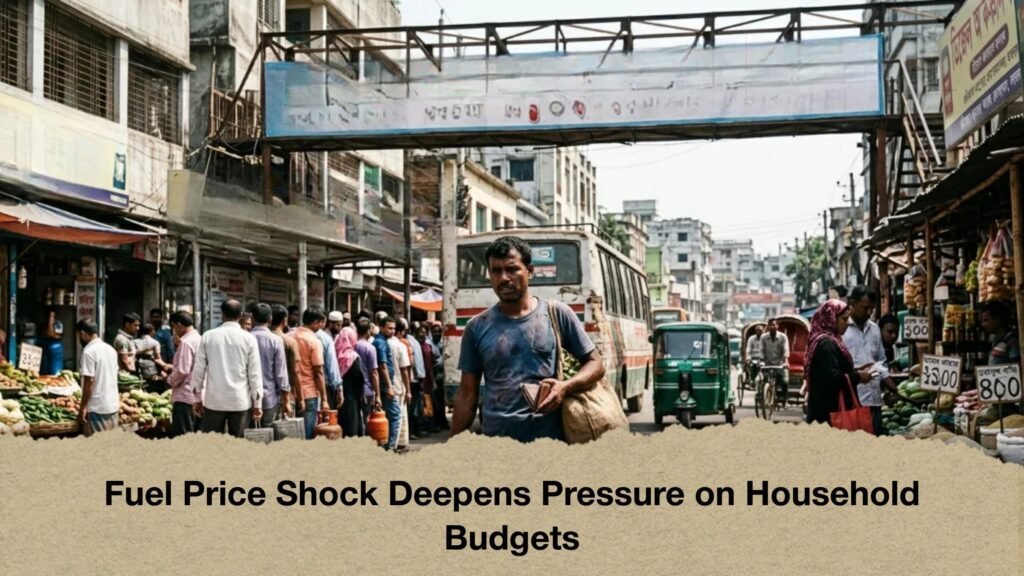
The latest increase in fuel prices is adding another layer of pressure to an economy already struggling with high living costs. The rise is being felt well beyond petrol stations, with transport fares, agricultural expenses, freight charges and industrial operating costs all coming under strain.
Following the latest adjustment, diesel is being sold at Tk135 per litre, kerosene at Tk155, petrol at Tk160 and octane at Tk165. Each of the four fuels saw a Tk20 increase per litre. The impact began to emerge almost immediately, particularly in the transport sector.
For households, the concern is straightforward: when the cost of moving people and goods rises, the additional expense rarely remains confined to transport operators. It tends to travel through the supply chain and eventually reach consumers through higher prices for goods and services.
Transport costs rise first
The government has already raised bus fares following the increase in fuel prices. For long-distance buses, the fare has risen from Tk2.23 to Tk2.40 per kilometre, while fares in Dhaka and Chattogram metropolitan areas have increased from Tk2.53 to Tk2.70 per kilometre.
The 17-paisa increase may appear modest on paper, but its cumulative effect is significant for people who travel by bus every day. For low- and fixed-income households, even a relatively small increase in daily commuting costs can translate into a substantial monthly expense.
The pressure is also being felt in freight transport. Diesel-dependent vehicles such as trucks, covered vans, buses and launches face higher operating costs. Transport operators are seeking higher charges on some routes, arguing that they cannot absorb the additional fuel expense themselves.
If freight rates rise, the consequences extend far beyond the transport industry. A product may incur additional costs when moving from a factory or farm to a wholesale market, then from the wholesaler to a retailer and finally to the consumer.
That creates a chain reaction.
Farmers face higher production costs
Agriculture is another sector particularly exposed to diesel prices. Diesel is widely used for irrigation, land preparation, harvesting, threshing and transporting agricultural produce.
The impact is especially significant for boro rice, which depends heavily on irrigation. Higher diesel prices therefore mean higher irrigation and production costs for farmers.
According to estimates cited in the original report, farmers’ annual fuel expenditure could rise by more than Tk2,000 crore following the latest price adjustment.
The consequences could move in either direction. If farmers cannot secure higher prices for their produce, their margins may shrink. If they do receive higher prices, consumers could eventually face more expensive food.
This is why fuel prices have an influence that extends well beyond the energy sector.
Industry faces another cost burden
Manufacturers have also been dealing with high production costs, energy supply difficulties, expensive credit and weak domestic demand. The latest fuel increase adds another burden.
Industries such as garments, textiles, cement, steel and ceramics use fuel directly or indirectly in production and distribution. Factories also incur fuel-related costs through their own transport, generators, machinery and the movement of finished goods.
Businesses now face a difficult choice. If they raise product prices to compensate for higher operating costs, inflationary pressure could intensify. If they absorb the increase, profit margins may narrow, potentially affecting investment capacity.
The timing is particularly sensitive because businesses are already operating in an environment where financing costs and demand remain important concerns.
Is raising prices the only option?
The government has argued that the latest adjustment was driven by the worsening international energy situation, particularly instability in the Middle East. Higher insurance premiums and shipping costs have also increased the cost of importing fuel.
Energy State Minister Anindya Islam Amit said the government had no alternative but to adjust domestic fuel prices in response to the changing international market.
Business leaders and economists, however, have raised a broader question: how much can be done to reduce costs elsewhere before passing the entire burden on to consumers?
Mohammad Fazlul Hoque, administrator of the Federation of Bangladesh Chambers of Commerce and Industry, has argued that fuel price increases should not automatically be treated as the only solution. Reducing waste, system losses and inefficiencies in fuel supply and distribution could also be considered.
The tax structure surrounding imported fuel has emerged as another area of debate. If part of the tax burden were temporarily reduced during periods of exceptional international price pressure, the immediate increase faced by consumers could potentially be moderated. Such a move, however, would also have implications for government revenue.
BPC’s finances under scrutiny
The financial position of Bangladesh Petroleum Corporation, the state-owned fuel importer and distributor, is also central to the debate.
BPC has made substantial profits over long periods, although it has also faced significant losses when international fuel prices rise and domestic prices are not adjusted quickly enough. The organisation’s financial management, deposits, operating expenses and spending priorities have periodically attracted scrutiny.
The original report cites an analysis showing that BPC earned roughly Tk52,000 crore in profit over 11 years. It also refers to profits recorded during the most recent financial year.
Such figures have prompted questions about whether BPC’s accumulated resources, financial investments and operating costs can play a greater role in cushioning consumers during periods of international price volatility.
The issue is not simply whether BPC makes a profit or loss in a particular year. Its financial resilience, the timing of price adjustments and the structure of taxes and subsidies all affect the final price paid by consumers.
The burden falls hardest on lower-income families
The impact of rising fuel and food prices is rarely distributed evenly across society.
A higher-income household may be able to absorb an additional few hundred taka in monthly transport or food expenses without significantly changing its spending pattern. For a day labourer, garment worker, small trader or low-paid employee, the same increase can mean cutting expenditure elsewhere.
Families may reduce savings, postpone healthcare, spend less on education or rely more heavily on borrowing. If this continues for an extended period, living standards can deteriorate even when nominal incomes remain unchanged.
That makes inflation more than an economic indicator. It becomes a daily household problem.
Tax policy and fuel pricing need closer scrutiny
The structure of taxes and duties on fuel has therefore become an important part of the discussion. Industry representatives cited in the report estimate that taxes and duties account for a substantial portion of the price of imported diesel.
A change introduced in June 2025 also altered the basis on which BPC’s taxes and duties are calculated, moving from a tariff-value system towards the invoice value. Under an invoice-based system, the tax burden can increase as the import price rises.
This creates an important policy dilemma. Reducing taxes could ease pressure on consumers and businesses, but it would also reduce government revenue. Maintaining the existing structure, meanwhile, could amplify the effect of international price increases on the domestic market.
There is no simple solution.
A wider test for economic management
The latest fuel adjustment comes at a time when people are already facing higher costs for food, transport, education, healthcare and other essential services. The government therefore faces the challenge of managing not only the immediate fuel crisis but also its secondary effects throughout the economy.
Measures to improve market monitoring, reduce unnecessary costs, strengthen supply chains and curb excessive margins could become increasingly important. So too could greater transparency in the management of the country’s energy institutions.
The central issue is ultimately the distribution of the burden. International fuel prices are largely beyond Bangladesh’s control, but the way those external shocks are absorbed is a matter of domestic economic policy.
For ordinary households, the distinction matters little when the result is the same: a more expensive bus journey, a higher food bill and a tighter monthly budget.
The latest fuel price increase has therefore become more than an energy-sector decision. It is a test of how effectively the wider economy can absorb an external shock without placing a disproportionate burden on people whose incomes leave them with the least room to adjust.