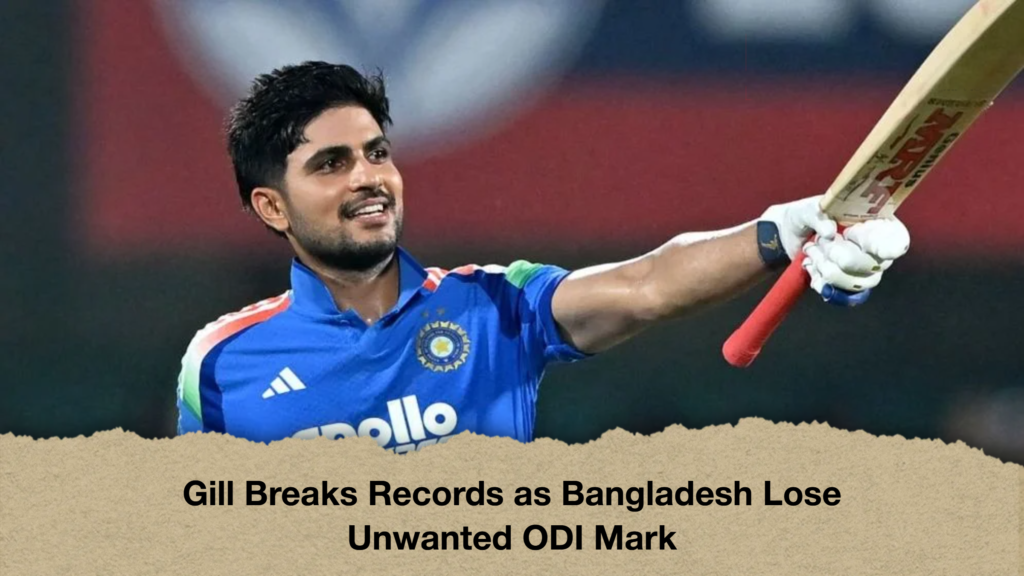
India captain Shubman Gill produced a breathtaking batting display in Guwahati on Wednesday, smashing an unbeaten 223 from 133 balls against West Indies in the second ODI. His innings included a double century from just 117 deliveries, making it the fastest 200 in men’s ODI cricket.
The performance also brought an end to a record that had been associated with Bangladesh since 2022. Until Gill’s innings, the fastest ODI double century belonged to India’s Ishan Kishan, who reached the landmark in 126 balls against Bangladesh in Chattogram on 10 December 2022. Gill surpassed that mark by nine deliveries.
The significance of the new record went beyond the speed of Gill’s scoring. His 223 not out also became the highest individual score in an ODI run chase, taking him past Australia’s Glenn Maxwell. Maxwell had previously held the record with an unbeaten 201 against Afghanistan during the 2023 World Cup.
Gill’s latest double century was the second of his ODI career. He had previously scored 208 against New Zealand in 2023. With another 200-plus score now added to his record, Gill has become only the second Indian batter after Rohit Sharma to register multiple ODI double centuries.
The innings did not begin with Gill dominating the attack. Rohit Sharma took the initiative early, putting the West Indies bowlers under pressure with aggressive strokeplay. He reached his half-century from 37 balls, punishing loose deliveries while rotating the strike whenever the bowlers managed to tighten their line.
Gill initially played the supporting role. Once he had settled in, however, the India captain shifted gears. He was particularly effective against the pace attack, repeatedly finding gaps and using precise timing to send the ball to the boundary.
His century arrived from only 62 balls. Gill reached three figures by hitting Alzarri Joseph through the leg side for four. From there, the scoring rate accelerated sharply.
India crossed 200 in the 22nd over, while Gill continued to move through the gears. By the time India reached 250 after 25 overs, he had made 142 from 82 deliveries. He then brought up his 150 from only 89 balls, setting another landmark as the fastest 150 by an Indian batter in ODI cricket.
The acceleration continued. At 29.1 overs, Gill struck Vitel Lawes for four to take India past 300. He had reached 171 from 98 balls and 175 from 102, maintaining a remarkable scoring rate while continuing to rotate the strike effectively.
After Virat Kohli was dismissed for 29, Ruturaj Gaikwad joined Gill at the crease. The change of partner did little to slow the India captain. He continued to attack the bowling and moved beyond 183, surpassing MS Dhoni’s previous Indian record for the highest individual score in an ODI run chase.
The defining moment arrived in the 39th over. Gill moved to 198 with a boundary before taking a single to reach 199. He then returned to strike and took another single from Lawes to complete his double century from 117 balls.
Even after reaching 200, Gill showed no signs of easing off. He continued to attack and eventually finished unbeaten on 223 from 133 balls. The innings transformed what had already been a remarkable run chase into one of the most extraordinary individual batting performances in ODI cricket.
Gill also went past another major mark when he moved beyond 220. The previous record for the highest individual score by an ODI captain had belonged to Virender Sehwag, who scored 219 against the West Indies in Indore in 2011. Gill’s 223 therefore added another captaincy record to an already remarkable list.
The match itself became a high-scoring spectacle. West Indies had posted a huge total before India began the chase, putting considerable pressure on the hosts. Yet Gill, supported by Rohit and the other Indian batters, turned the demanding target into a successful pursuit.
For Bangladesh, the significance of Gill’s performance lies particularly in the record that has now changed hands. Ishan Kishan’s 126-ball double century in Chattogram had remained the benchmark for the fastest ODI double century for several years. That innings had come against Bangladesh, making the record a recurring reference point in the country’s cricketing history.
Gill’s 117-ball double century has now moved that mark elsewhere. His 223 not out, meanwhile, added another chapter to the growing list of extraordinary ODI scores, while confirming his place among the small group of batters to have scored more than one double century in the format.