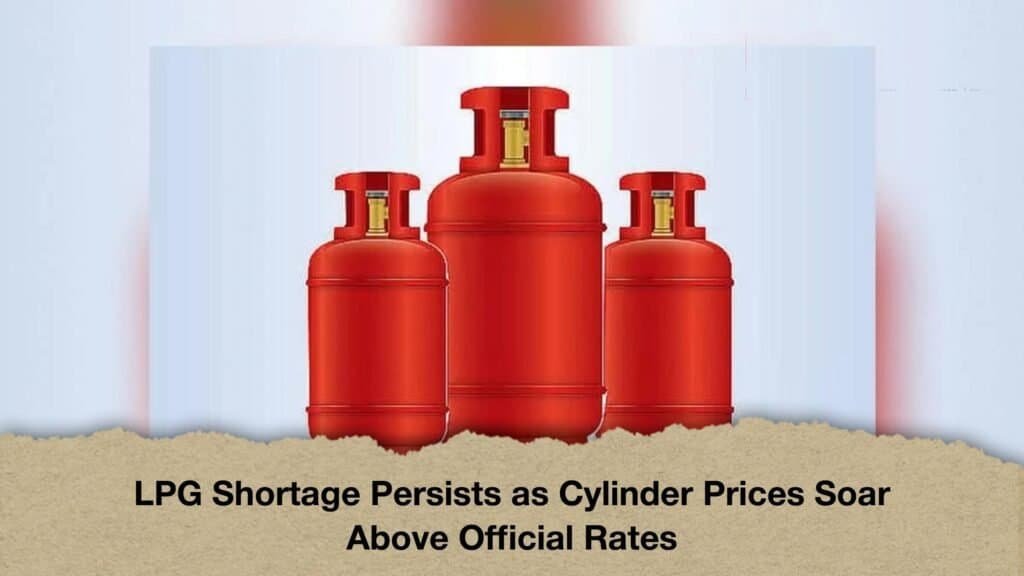
Bangladesh continues to face a shortage of liquefied petroleum gas (LPG), despite a recent increase in officially regulated prices. Distributors say supplies remain inadequate, with only six companies providing LPG regularly, and even these suppliers are unable to meet demand. Consumers are paying Tk 2,300 to Tk 2,500 for a 12kg cylinder, the most widely used household size, against the government-fixed retail price of Tk 1,837.
The gap means households are paying between Tk 463 and Tk 663 more than the official rate. The continuing shortage and high prices have raised concerns about market oversight, distribution practices and the financial burden on families that depend on LPG for cooking.
The Bangladesh Energy Regulatory Commission (BERC) announced the latest price adjustment on 4 October, raising the maximum retail price of a 12kg cylinder from Tk 1,585 in September to Tk 1,837 for October. However, the adjustment has yet to bring prices in the market under control.
Distributors seek higher commissions
The LPG Business Welfare Association wrote to BERC on 6 October, asking the regulator to address rising operating costs and review distributors’ commissions. According to the association, LPG companies issued their own price lists on the evening of the regulator’s announcement, setting prices for 12kg cylinders at between Tk 1,740 and Tk 2,000.
The association attributed the difficulties to higher fuel costs, licence fees, transport expenses and other operating charges. It argued that distributors could not operate sustainably while receiving the same commission that had been in place for around five years.
In its letter, the association outlined the expenses involved in moving a cylinder from a company’s premises to a distributor’s warehouse and then to a retail outlet. Transport from the company to the warehouse costs Tk 50 per cylinder, while loading, unloading and delivery to retailers account for another Tk 35. Staff wages, warehouse rent, electricity bills, licence fees and other operating expenses add Tk 25.
The association also wants a profit margin of Tk 40 per cylinder. Taken together, these items amount to Tk 150 per cylinder, according to its calculation. Distributors currently receive a commission of Tk 50, leaving a claimed shortfall of Tk 100.
The association said differences between companies’ prices had added to market instability. It urged the authorities to take measures that would protect both legitimate business interests and consumers.
The letter, signed by association president Md Selim Khan, was also sent to the Ministry of Power, Energy and Mineral Resources, the Ministry of Commerce, the Directorate of National Consumer Rights Protection and district administration offices.
BERC says formal hearings are required
BERC maintains that the regulated wholesale price of a 12kg cylinder is Tk 1,742. Distributors receive a commission of Tk 50, which means the expected price for supplying a cylinder to a retailer is Tk 1,792.
The regulator has acknowledged receiving the distributors’ letter but says the requested cost adjustments cannot be made without a public hearing.
BERC chairman Jalal Ahmed told Prothom Alo that the commission would discuss the association’s proposals at its meeting scheduled for the following Sunday and decide on the next course of action. He also said discussions would be held with businesses to encourage them to sell LPG at the prescribed prices until a new decision was reached.
BERC has been setting LPG prices since April 2021, when the distributors’ commission was fixed at Tk 50 per cylinder. Distributors now want that amount increased to reflect higher operating costs.
However, the dispute over commissions does not fully resolve the problem facing consumers. Even when official prices are adjusted, customers can still struggle to obtain cylinders at those rates. Reports of shortages and above-regulated prices have repeatedly raised questions about whether the existing pricing framework is being enforced effectively.
Consumers bear the cost of the shortage
For households reliant on LPG, the immediate consequence is a sharp increase in cooking costs.
Tamanna Akhtar, a resident of Shewrapara in Dhaka’s Mirpur area, told Prothom Alo on Thursday that a 12kg cylinder delivered to her home on Wednesday had cost Tk 2,500. That was Tk 663 above the official retail price.
Such additional expenses can put pressure on household budgets, particularly for families without access to piped natural gas. The problem is compounded when consumers pay more but still face uncertainty over whether they can obtain a cylinder when needed.
Distributors argue that inadequate supplies are forcing them to spend more time and money securing LPG. Some say they are selling above the official price because doing otherwise would leave them operating at a loss. Their claims, however, have not removed the obligation to comply with the regulated retail price.
Supply cuts reported since September
Distributors say some LPG companies began reducing supplies on 20 September. According to their account, Meghna Fresh, Omera, iGas, Jamuna, Petromax and BM are the main companies currently supplying the market regularly. They say these companies are selling at BERC-prescribed prices, while several other suppliers are providing only small quantities intermittently and, in some cases, charging more.
Distributors have also alleged that certain companies have issued price lists of Tk 1,960 to Tk 2,000 for a 12kg cylinder despite not supplying sufficient quantities. The resulting uncertainty, they say, has increased their operating costs and made it difficult to maintain regular sales.
Some distributors have warned that they could consider suspending LPG sales if their demands are not addressed by BERC. Such a move would risk worsening the difficulties faced by households and businesses already struggling with inadequate supplies.
The authorities therefore face two related challenges: ensuring that enough LPG reaches the market and enforcing the official prices. A review of distributors’ costs may help address their concerns, but it would not, by itself, guarantee that consumers receive cylinders at regulated rates.
Imports remain steady, industry body says
Despite the reported shortage, the LPG Operators Association of Bangladesh (LOAB), which represents businesses involved in importing and supplying LPG, says imports have remained broadly stable.
According to the association, Bangladesh imported 158,000 tonnes of LPG in August and 156,000 tonnes in September. The figures suggest that import volumes have not fallen sharply, although the association says it may take additional time for supplies to increase across the market.
The difference between reported import volumes and shortages at retail outlets raises questions about how imported LPG is being distributed through the supply chain. The available figures alone do not establish why particular distributors or filling stations are receiving less gas than they require.
Industry participants and regulators will need to examine whether the problem lies in the timing of deliveries, the allocation of available supplies or other distribution constraints. Reliable information about stocks and deliveries would help clarify the causes of the shortage.
Filling stations also face losses
The supply problem extends beyond household cooking. LPG is also used in industry and transport, and filling stations are reporting significant difficulties in obtaining enough gas.
Hasin Parvez, general secretary of the LPG Filling Station Owners Association, told Prothom Alo that a station requiring 30 tonnes of LPG a month was receiving only five to six tonnes. The shortfall had reduced sales and pushed stations towards losses, he said.
For filling stations, the shortage means they cannot meet customer demand even when they have the capacity to sell more. If the situation continues, it could affect businesses and motorists who rely on LPG as a vehicle fuel.
Demand has grown over the past decade
Bangladesh has approximately 10 million LPG customers, according to figures cited in the report, with around 80 per cent of consumption used for household cooking. Demand increased substantially after new residential natural gas connections were halted in 2015.
Annual LPG demand now exceeds 1.5 million tonnes. The sector is almost entirely privately operated, with private companies responsible for importing and supplying the fuel. In addition to domestic cooking, LPG serves industrial users and the transport sector.
This dependence makes consistent imports, adequate storage and efficient distribution particularly important. A shortage at any stage of the supply chain can affect households, retailers and businesses, even when national import volumes appear relatively stable.
The market’s reliance on private suppliers also places greater importance on effective monitoring of company stocks, delivery schedules and pricing practices. Regulators must balance the financial viability of distributors with the need to ensure that consumers are not charged more than the prescribed retail price.
Nationwide enforcement drive continues
The Directorate of National Consumer Rights Protection has been conducting inspections across the country to curb excessive LPG prices.
Director Atia Sultana said the directorate carried out 242 operations between 2 September and 6 October to monitor cylinder sales. A total of 478 businesses at distributor and retail levels were penalised during the operations, with fines amounting to Tk 1.125 million.
The inspections continued over the two days preceding her remarks.
Although the enforcement drive has resulted in penalties, the persistence of high prices suggests that inspections alone may not be enough to resolve the crisis. Consumers need both a dependable supply of LPG and a practical means of obtaining it at the regulated price.
The next steps will depend partly on the outcome of BERC’s discussions with distributors. Any revision to commissions or operating-cost allowances will require the regulatory process outlined by the commission. In parallel, authorities will need to address supply constraints and ensure that companies and retailers comply with the prevailing price structure.
For millions of households, the central concern remains straightforward: LPG must be available when needed and sold at a price they can reasonably expect to pay. Until supply improves and price enforcement becomes more effective, consumers are likely to continue bearing the cost of the market’s unresolved problems.