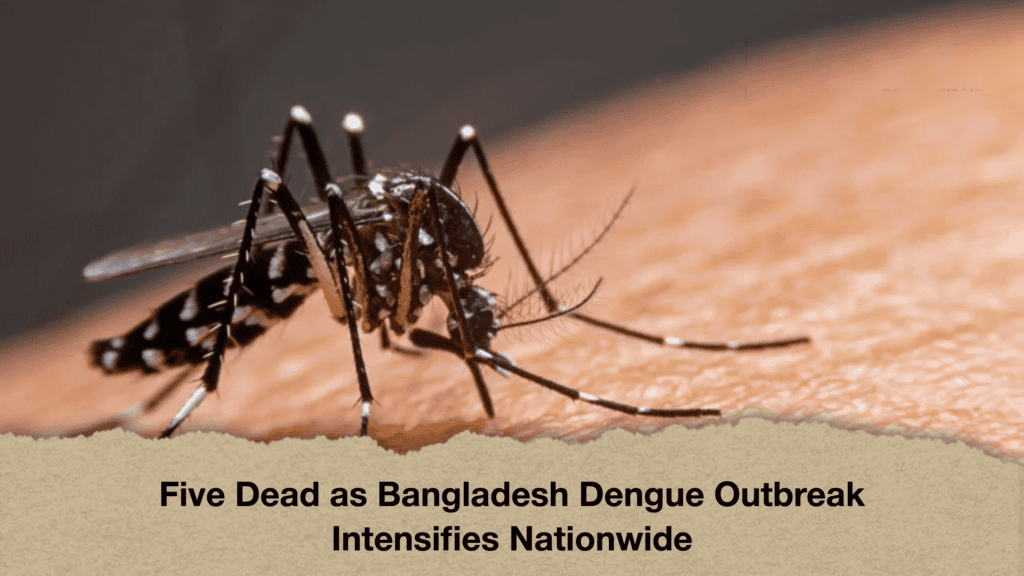
Bangladesh’s ongoing dengue surge has reached an alarming juncture following the deaths of five more patients in the last 24 hours, taking the country’s cumulative body count to 321 this year.
Data released on Wednesday by the Directorate General of Health Services (DGHS)—covering the 24-hour period from 8:00 AM Tuesday to 8:00 AM Wednesday—reveals that 1,920 new patients were admitted to hospitals nationwide with acute symptoms. October has proved exceptionally lethal, with 76 fatalities recorded during its first 13 days alone, accounting for nearly a quarter of all dengue deaths this year.
The latest fatalities demonstrate how widely the mosquito-borne virus has spread beyond traditional epicentres. Of the five deceased—comprising three men and two women—two were residents of Chattogram Division. The remaining three deaths occurred in the Dhaka South City Corporation, Mymensingh Division, and Rajshahi Division. While localized fatality rates do not automatically reflect total infection density, the geographic dispersal highlights an urgent need for synchronized vector control strategies across both urban hubs and regional divisions.
A month-by-month examination of official public health records shows a rapid escalation following the arrival of monsoon rains:
| Period / Month | Recorded Dengue Fatalities |
| January | 2 |
| February | 2 |
| March | Not reported |
| April | Not reported |
| May | 1 |
| June | 13 |
| July | 36 |
| August | 43 |
| September | 148 |
| October (First 13 Days) | 76 |
| Cumulative Total | 321 |
The trajectory underscores a severe post-monsoon wave. Early in the year, transmission remained minimal, with just four fatalities across January and February combined and no reported deaths in March or April. However, as stagnant rainwater accumulated in urban drainage channels, construction sites, and discarded domestic vessels, breeding sites expanded rapidly. Fatalities rose steadily from 13 in June to 43 in August, before jumping dramatically to 148 in September. Combined, September and the early days of October account for roughly 46 per cent of total deaths this year, making late-year vector control a dominant public health challenge.
The steady influx of nearly 2,000 new hospitalisations in a single day is straining medical facilities. Public and private hospitals face growing demands on bed capacity, medical supplies, and nursing staff needed for intensive patient monitoring. Medical experts stress that while dengue initially manifests as high fever, severe headache, body aches, and nausea, the most critical window often occurs right as the fever begins to subside. Symptoms such as persistent abdominal pain, continuous vomiting, mucosal bleeding from the nose or gums, acute lethargy, and breathing difficulty demand immediate clinical intervention. Unsupervised self-medication—particularly the use of non-steroidal anti-inflammatory drugs that heighten bleeding risks—remains a major hazard for patients recovering at home.
Eradicating vector breeding habitats remains the primary defense against continued transmission. Aedes mosquitoes reproduce in small volumes of clean, standing water found in flowerpots, discarded tires, coconut shells, and open storage drums. Public health authorities emphasize that chemical fogging alone provides temporary relief; long-term containment relies on sustained larval source destruction, regular site inspections by municipal bodies, and proactive domestic water management by residents.