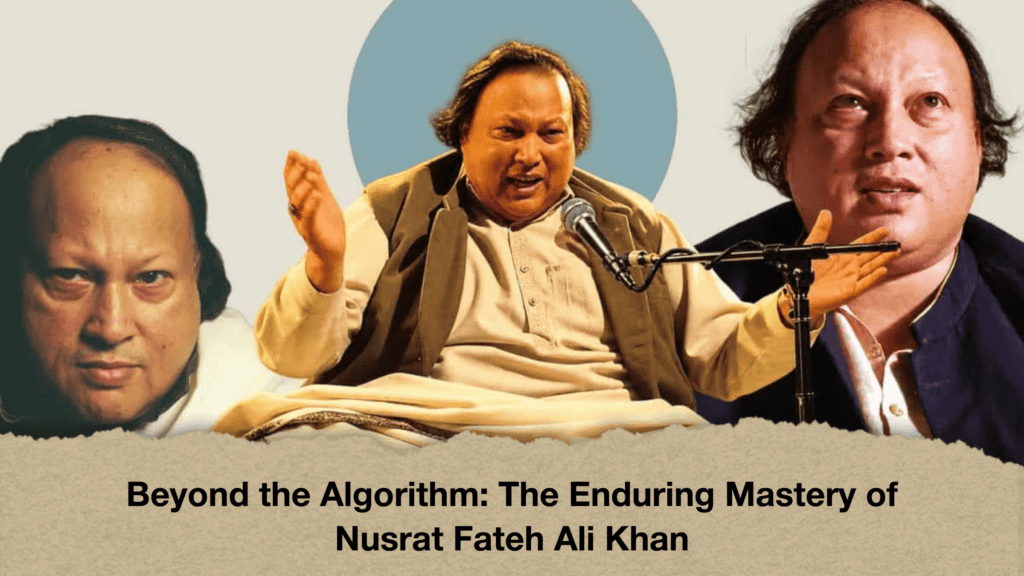
Amid the sea of choreographed dance routines, calculated internet stunts, and transient social media trends, a striking image routinely halts digital wanderers mid-scroll: a man sitting with eyes closed, head gently tilted, and a hand raised as if conducting an invisible orchestra.
This is how a new generation of listeners frequently encounters Ustad Nusrat Fateh Ali Khan. They do not meet him in the acoustic reverie of a concert hall or through a family vinyl collection, but via the modern accident of a short-form video algorithm. Yet, the instant his sound registers, the compulsion to scroll vanishes. The voice is unmistakable even to the uninitiated, carrying an extraordinary force that seems to transcend the physical limitations of recording—a rare synthesis of tenderness, agony, and spiritual exaltation. Younger listeners discover him untethered from nostalgia, while older generations return with their memories intact. Both find something enduringly magnetic.
Born on 13 October 1948 in Faisalabad, Pakistan, Nusrat Fateh Ali Khan was no ordinary vocalist. As a master of qawwali—the 700-year-old devotional musical tradition associated with Sufi shrines—he inherited a formidable musical lineage spanning six centuries. Rather than merely preserving this heritage, he expanded its horizons, captivating global audiences through a vocal range of exceptional depth, improvisational brilliance, and raw emotional power.
His live performances typically opened in quiet, meditative contemplation before gradually building into ecstatic intensity. Through intricate vocal ornamentations (sargam) and dynamic rhythmic shifts, he pushed human vocal capabilities to their absolute limits, leaving audiences spellbound.
Despite these deep roots in sacred tradition, his genius refused to be confined by genre, culture, or geography. One need not comprehend the nuances of Sufi philosophy, appreciate the conventions of Urdu poetry, or possess any background in South Asian classical ragas to be moved by his singing. The emotion invariably precedes the explanation. His voice speaks a universal dialect older than formal language: longing, surrender, grief, and unbridled joy.
This innate universality explains why his catalogue continues to flourish decades after his premature death in 1997. Digital algorithms may introduce his work to modern screens, but technology did not create his appeal; it merely stumbled upon a musical titan whose impact was already timeless.
Few works illustrate this cross-generational resonance as beguilingly as Afreen Afreen, released in 1996 on the landmark collaborative album Sangam. Composed and performed by Khan with lyrics penned by the renowned Indian poet Javed Akhtar, the track featured pop arrangements directed by Faakhir Mehmood and produced by the Pakistani band Strings. The resulting track was an elegant synthesis of classical virtuosity, poetic intelligence, and nineties pop sensibility that outlasted the fleeting fashions of the era.
The title itself—Afreen, an exclamation of praise and appreciative astonishment—serves as the composition’s thematic anchor. Akhtar’s lyrics draw deeply from Urdu romantic traditions, where a fleeting glance carries cosmic weight and physical beauty evokes spiritual transcendence. Khan elevates these verses into an undeniable emotional experience, moving seamlessly between delicate restraint and soaring abandon. The arrangement provides a supple rhythmic foundation without eclipsing the vocal performance, allowing the central refrain to linger long after the final note fades. It remains romantic music in its purest form: passionate without excess, accessible without ever verging on the shallow.
In an era where internet fame is notoriously short-lived and songs vanish as quickly as they trend, Khan’s music demonstrates a rare permanence. For older listeners, his voice remains inextricably bound to personal memories and cultural heritage. For newer audiences, he offers an unvarnished, profound auditory experience free from manufactured polish. Algorithms may open the door to his world, but it is the transcendent power of his voice that keeps listeners inside.