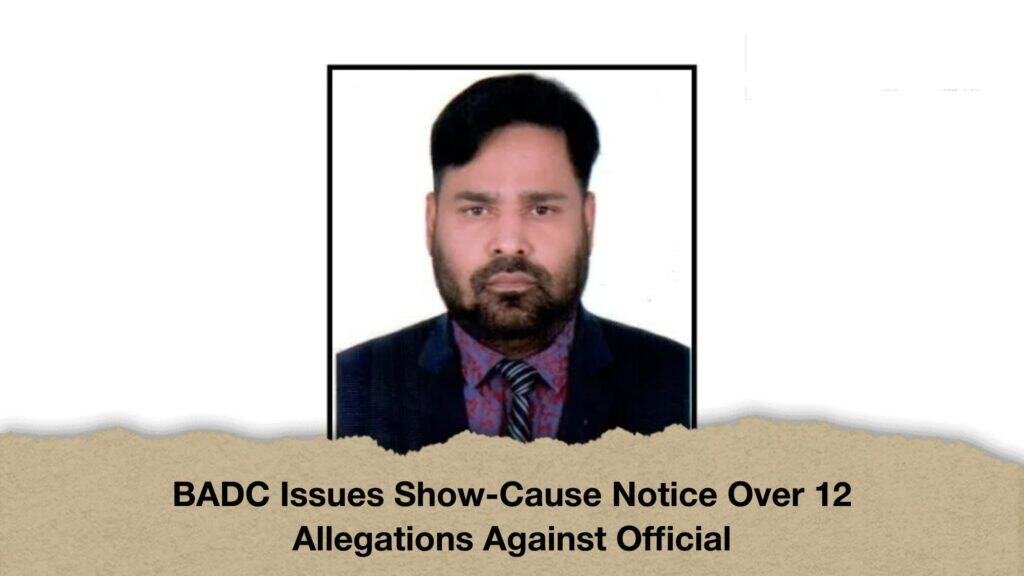
Mohammad Al-Amin, identified as president of the Zia Parishad at the Bangladesh Agricultural Development Corporation (BADC), has been served with a show-cause notice over 12 allegations, including interference in tender procedures, exerting influence over staff transfers and postings, misconduct towards senior officials and breaches of office discipline.
The notice asks why departmental proceedings, including possible temporary suspension, should not be initiated against him over the alleged conduct. The accusations cover several aspects of the corporation’s administrative and operational activities, although their validity remains to be established through the appropriate process.
According to the notice, the allegations include interference in the work of a Tender Evaluation Committee (TEC), a dispute over the committee’s chairmanship, taking away a laptop used for tender evaluation, bringing outsiders into official premises, threatening officials and throwing official documents. Al-Amin is also accused of being absent from work without authorisation, tearing up a letter seeking an explanation and behaving discourteously towards senior officials.
Alleged interference in tender evaluation
The notice states that on 4 October, Al-Amin objected to the appointment of the chair of the committee during the tender evaluation process for the MIEFP project. He is accused of threatening the official concerned with resignation and taking away a laptop used in the evaluation process. The notice also alleges that he brought outsiders into the office premises during the incident.
Tender evaluation is a key stage in public procurement, as it helps determine how contracts for publicly funded projects are awarded. The process requires adherence to established procedures, proper documentation and an assessment based on the applicable criteria. Allegations of interference therefore warrant scrutiny to establish whether the committee was able to carry out its responsibilities in accordance with the rules.
The accusations against Al-Amin raise questions about the conduct of the evaluation process. However, a formal allegation does not, by itself, establish wrongdoing. The relevant records, witness accounts and other available evidence would need to be examined before conclusions could be reached.
Dispute over audit matters and alleged misconduct
The show-cause notice also refers to an incident on 30 June involving an audit-related matter. According to the allegations, the issue led to a confrontation with senior officials, during which Al-Amin allegedly spoke loudly, issued threats and threw official documents.
Another allegation concerns his reported absence from the workplace without permission between 30 July and 4 August.
The notice further accuses him of attempting to influence transfers and postings of BADC employees and decisions relating to tenders for various projects. These allegations concern both workplace discipline and the administration of decisions that should be made in accordance with established rules and procedures.
If substantiated, interference in procurement or personnel decisions could raise concerns about administrative accountability. The extent of any misconduct, however, must be determined through an examination of the evidence and the applicable service regulations.
Employees reportedly express dissatisfaction
At least three BADC sources who spoke to Agrodut on condition of anonymity claimed that employees had become frustrated by what they described as Al-Amin’s arrogance and alleged corruption. They called for the government to give the matter appropriate attention and for the media to continue monitoring developments.
These accounts reflect the sources’ claims and do not independently establish the allegations. Verification through documentary evidence and responses from the parties concerned would be necessary to establish the full circumstances.
The reported concerns nevertheless highlight the importance of maintaining professional standards within public institutions. Employees should be able to perform their duties without intimidation, while administrative decisions should be taken through transparent and properly authorised procedures.
Responses from the parties concerned
When contacted by Agrodut, Al-Amin reportedly did not provide a clear explanation addressing the allegations.
Khan Faisal Ahmed, an additional chief engineer at BADC and general secretary of the Zia Parishad, was also contacted for comment. He said: “I am not fully aware of this matter.”
Attempts to contact BADC Chairman and Additional Secretary Azizul Islam and the corporation’s secretary, Abu Zafar Rashed, were unsuccessful, as neither could be reached by telephone.
Their responses to the allegations were therefore unavailable at the time of reporting.
Departmental proceedings will determine the next steps
The show-cause notice refers to relevant provisions of the BADC Employees Service Regulations, 1990. The authorities are expected to consider Al-Amin’s written response, the available evidence and the outcome of departmental proceedings before deciding what action, if any, should follow.
A show-cause notice is a formal administrative step that gives the person concerned an opportunity to respond to allegations. It should not be treated as proof of guilt. Any disciplinary decision must be based on the evidence and the applicable rules, with the employee’s response taken into account.
The case has implications for accountability within BADC, a government organisation involved in agricultural development. Transparent procurement, orderly administration and compliance with service regulations are essential to ensuring that public institutions operate effectively and responsibly.
Tender evaluation and staff transfers are particularly sensitive administrative functions because decisions in these areas must follow established procedures. Allegations of undue influence should therefore be examined impartially, with the findings made available through the appropriate official channels.
The 12 allegations against Al-Amin cover a range of issues, from the handling of tender evaluation to workplace conduct and unauthorised absence. Each requires appropriate assessment rather than a general conclusion based solely on the number of accusations.
The next steps will depend on Al-Amin’s written explanation, the evidence examined during the departmental process and the decision of the competent authorities. Until the allegations have been established, they must remain allegations.
Agrodut has said it will continue to monitor the matter and publish follow-up reports as further information becomes available.