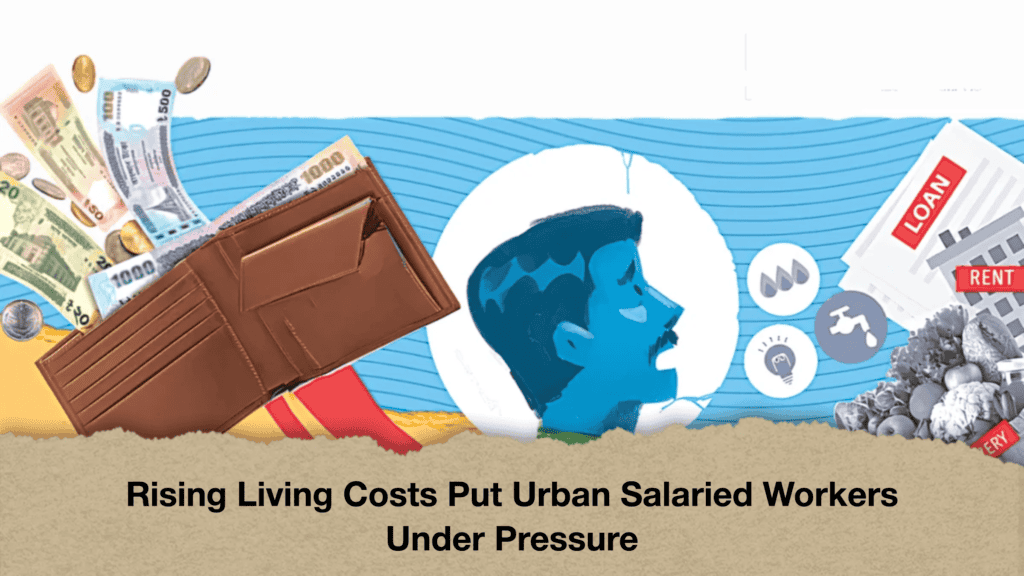
Before the month even reaches its final week, wallets are running empty across urban households. Anas, a private sector employee striving to save five thousand taka every month, regularly finds himself dipping into those savings just to cover basic living expenses. By the twenty-fifth day, his pockets are invariably bare. To tide himself over until the next payday, he occasionally turns to mobile financial services for short-term loans ranging from five to ten thousand taka, carrying a three-month repayment window and accompanying interest charges. When the salary finally arrives, servicing these debts immediately squeezes his tight budget once again.
Anas points out the stark disconnect between soaring living costs and stagnant compensation packages. Companies typically offer incremental annual raises of two to four thousand taka, an increment that fails entirely to absorb escalating household expenditures. Niloy, another private sector professional, echoes this sentiment, noting that expenses climb so rapidly that he has contemplated securing secondary employment. Yet, finding the time or opportunity to take on extra work proves nearly impossible amidst long working hours.
Anas and Niloy are far from isolated examples. Countless salaried individuals navigating the urban landscape confront identical hurdles. As the cost of living spirals upward, regular savings become an elusive luxury, pushing households toward debt merely to sustain everyday life.
Economic Indicators and Financial Metrics
Official figures from national statistical agencies underline persistent price pressures across the economy. To capture the full scope of these trends, the following table details the key economic and financial metrics referenced in official reports and individual accounts:
| Economic Indicator / Metric | Recorded Rate / Figure |
| Headline Inflation (September 2026) | 8.34% |
| Headline Inflation (August 2026) | 8.26% |
| Food Inflation (September 2026) | 7.22% |
| Food Inflation (Previous Period) | 7.02% |
| Non-Food Inflation (September 2026) | 9.30% |
| Non-Food Inflation (Previous Period) | 9.32% |
| Average Inflation (12 Months to Sept 2026) | 8.65% |
| Average Inflation (Preceding 12 Months) | 9.45% |
| National Wage Growth Rate (September 2026) | 7.90% |
| Unemployed Highly Educated Youth | 29.00% |
| Labour Demand Pressure from AI Integration | 2.00% |
| Daily Motorcycle Fuel Expense (Sample Commuter) | 200 BDT |
| Daily Metrorail Commute Expense | 240 BDT |
Understanding Inflation and Wage Disparity
A moderation in the inflation rate does not mean commodities are becoming cheaper; it simply indicates that price increases are happening at a slower pace than before. Consequently, families must disburse larger sums than ever just to acquire basic goods and services. Mahtab Uddin, an assistant professor of economics at the University of Dhaka and honorary research director at a regional economic modelling network, notes that evaluating inflation trajectories requires examining underlying monetary and fiscal policy decisions. Unlike peer economies that aggressively raised interest rates to rein in price spirals, domestic monetary policy has lacked sufficient rigour and timing. Continuous liquidity support to struggling banks and expansive fiscal policies have only exacerbated inflationary pressures. Weak revenue collection mechanisms and heavy expenditure on mega-development projects further compound public financial strains, making price stability difficult to achieve.
The brunt of inflation falls heaviest on low-income households, whose budgets are dominated by food and essential goods. When prices outpace real wages, households face grim compromises, cutting back on fish, meat, or fresh fruit, shifting toward less nutritious diets, or trimming educational investments for their children. Such decisions compromise long-term health, human capital development, and future financial mobility.
Wage growth continues to counterbalance commodity price escalation inadequately. National wage rate indices for September 2026 recorded a growth rate of 7.90 percent, trailing behind the headline inflation rate of 8.34 percent by 0.44 percentage points. While individual earning trajectories vary based on sector and enterprise, aggregate data confirms that general wage adjustments have failed to keep pace with the cost of living.
The Cycle of Debt and Structural Labour Pressures
This financial squeeze extends beyond full-time workers to students relying on family support. Abdullah Al Mahmud, a private university student, spends two hundred taka daily on motorcycle fuel alongside two hundred and forty taka for metro rail commutes, requiring careful calculation before every journey. Many of his peers routinely borrow money towards the end of the month, settling debts upon receiving allowances only to face immediate shortfalls that trigger new cycles of borrowing.
Structural labour market dynamics compound these challenges. Workers face limited collective bargaining capabilities compared to organised labour movements abroad, where professionals like teachers, doctors, and railway staff can secure wage revisions through coordinated action. In an environment where labour supply outstrips demand, extracting living-wage adjustments becomes exceptionally difficult.
Beyond daily outlays, broader structural shifts loom large. Projections from international financial institutions indicate that approximately twenty-nine percent of high-educated youth remain unemployed, while emerging technologies threaten a baseline portion of labour demand. These converging factors highlight deep-seated vulnerabilities in employment generation and macroeconomic resilience.
Budgeting and Personal Financial Management
Adopting disciplined financial tracking offers some clarity. Keeping a meticulous daily ledger—recording every expense from transport fares to a cup of tea—helps individuals identify non-essential leaks and structure realistic personal budgets. Financial commentators note that while monitoring spending habits illuminates where money goes, it remains an incomplete remedy when incomes barely cover baseline survival needs.
For those with a small margin of discretionary spending, proactive financial management—such as setting aside savings immediately upon receiving income rather than saving whatever remains at month-end—can build resilience. Establishing separate savings accounts, automated deposit schemes, or pension-linked deposit products fosters disciplined saving habits and creates emergency buffers against unexpected shocks.
Yet, as educators observe, budgeting has inherent boundaries. When earnings fall short of covering fundamental necessities like rent, food, and healthcare, thrift alone cannot bridge the gap. Ensuring that remuneration aligns with macroeconomic realities remains the ultimate imperative for alleviating household distress.