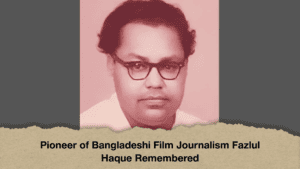
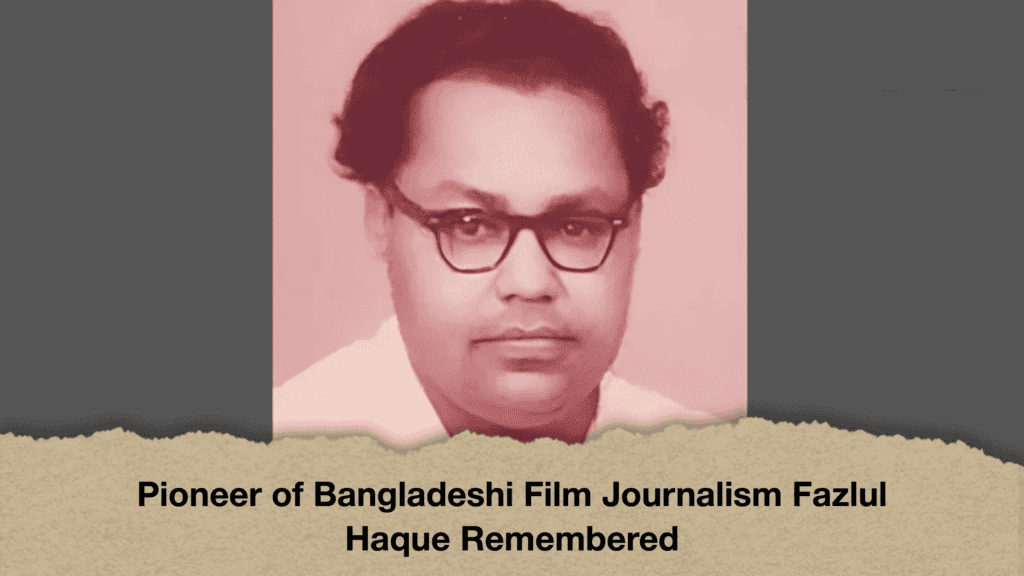
Fazlul Haque remains a revered figure in the cultural history of Bangladesh, recognized as a trailblazer who transformed both film journalism and children’s cinema in the country. He viewed motion pictures not merely as light commercial entertainment, but as a potent medium for artistic expression, social consciousness, and intellectual enrichment. His versatile contributions across journalism, editing, and film production earned him a distinctive position in the nation’s cultural heritage.
Born on 26 May 1930 into an aristocratic family in Maltinagar, Bogura, Haque developed a passion for the arts at a young age. Driven by this inclination, he entered film journalism during an era when cinematic criticism and analytical writing were virtually non-existent in the region. His foresight and commitment helped cultivate a thoughtful readership, fostering constructive public discourse, critical analysis, and aesthetic awareness surrounding cinema.
Among his most enduring achievements was advancing Bengali-language film periodicals within the subcontinent. As editor and publisher, he launched Cinema, a groundbreaking magazine that stands as a historic milestone in Bangladeshi journalism. The publication went beyond basic industry reporting, establishing a vital forum for exploring cinematic aesthetics, production techniques, and artistic merit.
Beyond journalism, Haque left an indelible mark on Bangladeshi cinema as a director. He directed President, widely celebrated as the first children’s film in Bangladesh. Bringing children’s imagination, psychology, and joy to the silver screen was an innovative step well ahead of its time. He recognized that quality children’s media serves a purpose beyond mere pastime, actively shaping young minds, human values, and creative imagination.
A defining characteristic of Haque’s career was his ability to link film criticism with active filmmaking. Combining theoretical analysis with hands-on directorial experience established him as a uniquely rounded cultural figure. His life demonstrated that the growth of any art form requires visionary directors alongside responsible journalism and an engaged audience.
Haque passed away on 26 October 1990 at the age of sixty. His legacy, however, continues to endure. To preserve his memory, his wife, the eminent novelist Rabeya Khatun, instituted the ‘Fazlul Haque Memorial Award’ in 2004. Awarded annually to honor outstanding contributions in film journalism and direction, the prize includes a crest, honorarium, and citation.
The Bangladesh Film Development Corporation (BFDC) also paid tribute to his legacy by naming an auditorium the ‘Fazlul Haque Memorial Auditorium’, ensuring future generations remain connected to his contributions. His family continues to influence Bangladesh’s media sector; his son, Faridur Reza Sagar, is a prominent cultural personality and managing director of Channel i, while his daughter, Keka Ferdousi, is a celebrated culinary artist and television personality. Haque’s pioneering spirit remains an enduring benchmark for Bangladeshi journalism and cinema.