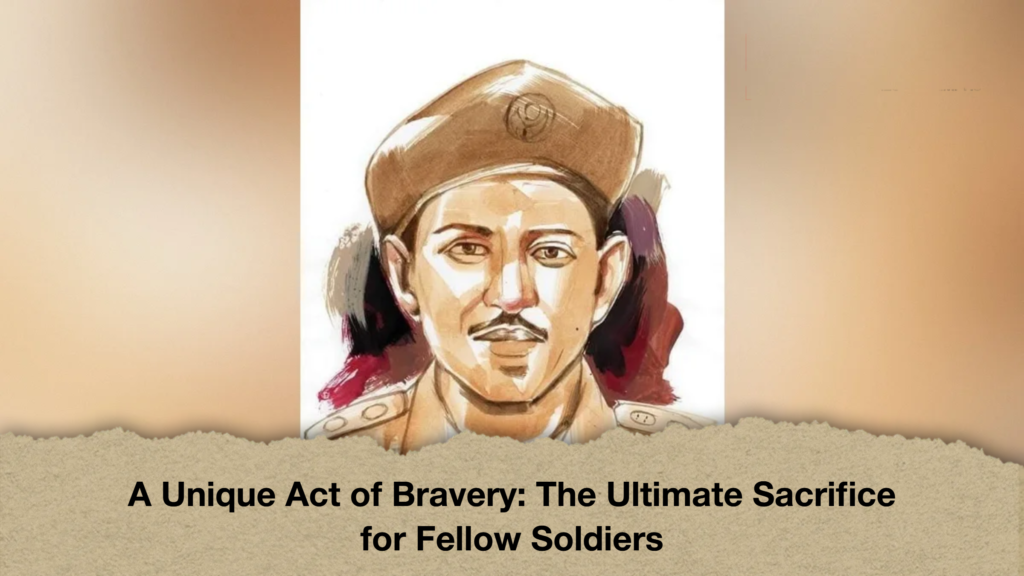
Today, 5 September, marks the death anniversary of Bir Sreshtho Shaheed Lance Naik Nur Mohammad Sheikh, one of Bangladesh’s most revered freedom fighters. On this day in 1971, during the Liberation War, he made the ultimate sacrifice while fighting Pakistani forces in the Gowalhati and Chhutipur areas of Jessore. His final act of courage saved the lives of fellow fighters and established him as a lasting symbol of bravery, duty and self-sacrifice.
Nur Mohammad Sheikh was born on 26 February 1936 in Mahishkhola village, then part of Narail subdivision in Jessore district. His father, Mohammad Amanat Sheikh, was a farmer, while his mother, Jennatunnesa, was a homemaker. He lost both parents during childhood and grew up amid considerable hardship. Although he had limited opportunities for formal education, the struggles of early life helped shape his resilience, sense of responsibility and determination.
He married Tota Bibi in 1952. Seeking a livelihood, he initially joined the Mujahid force and later enlisted in the East Pakistan Rifles in 1959 as a soldier. His service number was 9459. He subsequently rose to the rank of Lance Naik.
Nur Mohammad distinguished himself through courage and dedication during his military career. In the 1965 Indo-Pakistan war, he served in the Dinajpur sector and was wounded in action. His bravery earned him the Tamgha-i-Jang and Sitara-i-Harb medals.
On 10 July 1970, he was transferred from Dinajpur to the Jessore sector. When the Liberation War began in 1971, he joined the struggle for independence and served in Sector 8, which covered the Jessore region.
The Final Battle on 5 September
The morning of 5 September 1971 became the defining moment of Nur Mohammad’s life.
He was leading a five-member patrol near Gowalhati village, in front of the Chhutipur defensive position. Their task was to observe enemy movements and relay vital information to their own defensive forces.
At around 9.30am, Pakistani troops surrounded the patrol from three sides and launched a sudden attack. The small group was placed in an extremely dangerous position, with enemy fire coming from several directions.
During the exchange of fire, fellow fighter Nannu Mia was seriously wounded. Nur Mohammad immediately placed the injured man on his shoulder. Despite carrying his wounded comrade, he continued firing his light machine gun at the advancing enemy.
His decision demonstrated not only physical courage but also a remarkable sense of responsibility. He realised that if the entire patrol attempted to withdraw together, the enemy could wipe them out. He therefore ordered the other fighters to retreat to safety while he remained behind to provide covering fire.
Mustafa Kamal, one of his comrades, initially refused to leave him behind. Nur Mohammad, however, insisted that he withdraw and effectively forced him to move to safety.
Nur Mohammad then continued fighting alone.
Although he was eventually struck and severely wounded by a mortar shell, he refused to abandon his position. Surrounded by enemy fire and suffering serious injuries, he continued resisting until the end. His final moments were spent fighting to protect his comrades and prevent the enemy from advancing.
He was killed in action that day.
His death was not simply the loss of a soldier. It became one of the defining examples of personal sacrifice in Bangladesh’s Liberation War. By choosing to remain behind while his comrades withdrew, Nur Mohammad placed their survival above his own.
A Legacy That Lives On
After independence, the Government of Bangladesh recognised his extraordinary courage by awarding him the title of Bir Sreshtho, the country’s highest military gallantry award. The honour placed his name among the most distinguished heroes of the Liberation War.
Nur Mohammad Sheikh was buried at Kashipur in Sharsha upazila of Jessore. His grave remains a place of remembrance and respect for generations who came after him.
His birthplace also continues to preserve his memory. On 18 March 2008, Mahishkhola village was renamed Nur Mohammad Nagar in his honour. A library and memorial museum, a monument and educational institutions have also been established there to commemorate his life and sacrifice.
The story of Nur Mohammad Sheikh carries a meaning that extends beyond the battlefield. Courage is not merely the ability to confront an enemy with a weapon. It is also the willingness to put another person’s life before one’s own when danger is at its greatest.
Born in an ordinary village and raised in difficult circumstances, Nur Mohammad became extraordinary through his devotion to duty, love for his comrades and commitment to the dream of an independent Bangladesh. He carried a weapon in his hands, but it was his determination and sense of sacrifice that made his final stand unforgettable.
Today, on his death anniversary, the nation remembers a soldier who knowingly placed himself in mortal danger so that his comrades could live.
Bir Sreshtho Shaheed Lance Naik Nur Mohammad Sheikh remains more than a decorated freedom fighter. He is a symbol of courage, comradeship, duty and sacrifice, and a proud part of Bangladesh’s history of independence.
His sacrifice can never be repaid.
His name lives on in the land for which he fought, in the national flag for which he gave his life, and in the history of an independent Bangladesh.