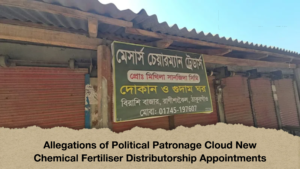
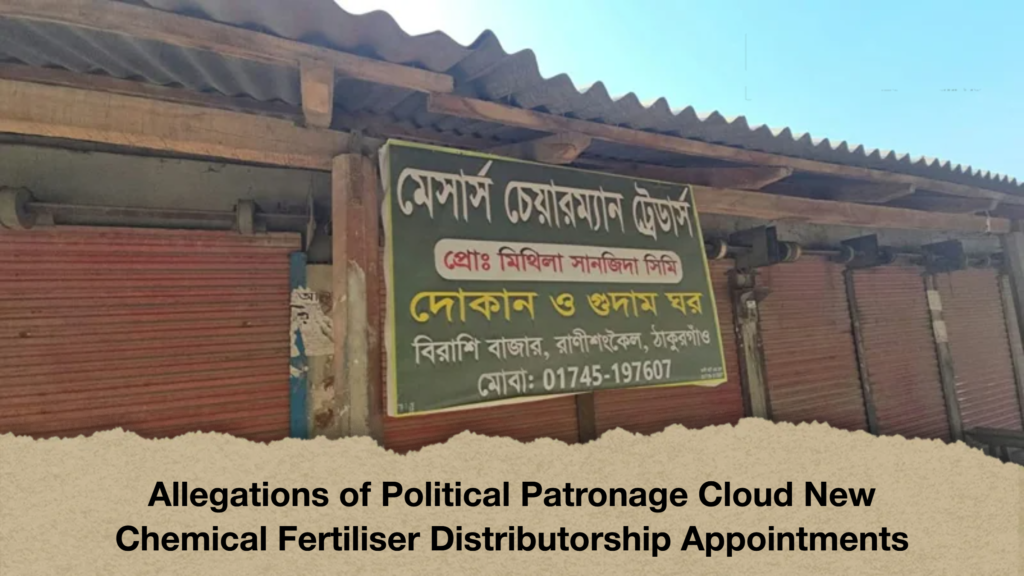
Controversy has erupted in the northern Bangladeshi district of Thakurgaon following allegations that political influence and nepotism dictated the selection of new government fertiliser distributors. Amongst the list of newly appointed chemical fertiliser dealers is Shabnam Mustari Synthia, an undergraduate university student with no prior background in agricultural trade. Her father, Mamunur Rashid, serves as a lecturer at a local madrasa and holds the position of General Secretary for the Bangladesh Nationalist Party (BNP) in the Pirganj Union unit. Local critics allege that the dealership was obtained predominantly through her family’s political connections.
The appointment of Ms Synthia is not an isolated incident across the district. The freshly published distribution roster features numerous wives, children, siblings, and close relatives of prominent political figures. Several of the successful candidates already operate as retail merchants, government Trading Corporation of Bangladesh (TCB) dealers, or beneficiaries of state food assistance schemes, whilst others hail from affluent civil service families. Strikingly, multiple appointees possess no previous commercial experience in agricultural inputs.
According to official records, 31 new fertiliser dealers were sanctioned across 29 unions and two municipalities spanning four sub-districts (upazilas) in Thakurgaon. Local business circles allege that 28 of these newly minted distributors share explicit ties with the BNP. Of the remaining three positions, two were awarded to leaders and supporters affiliated with the Awami League.
Meanwhile, established agricultural traders who have operated within the district for decades report being overlooked entirely. Disgruntled merchants claim that political allegiances and financial leverage took precedence over merit and compliance during the vetting procedure. The final recruitment notice was officially published by the Fertiliser Management and Monitoring Wing of the Ministry of Agriculture on 4 November. However, the integrity of the selection pipeline, candidate verification, and list generation has drawn fierce public criticism.
Under official state guidelines issued by the Ministry of Agriculture, securing a distributorship for subsidised fertilisers—including Urea, Triple Superphosphate (TSP), Di-ammonium Phosphate (DAP), and Muriate of Potash (MOP)—requires strict adherence to mandatory criteria. Statutory prerequisites mandate that candidates present a valid trade licence, a bank solvency certificate demonstrating a minimum capital reserve of 500,000 Bangladeshi Taka, up-to-date income tax returns, and dedicated warehouse facilities capable of storing at least 25 metric tonnes of inventory. Authorities are expected to evaluate an applicant’s commercial infrastructure, financial standing, and technical capacity to guarantee uninterrupted supply chains to local farming communities.
Serious doubts have been raised regarding whether the new dealers satisfy these basic criteria. Business representatives allege that 26 of the 31 appointees had never operated a commercial enterprise prior to their selection. Several candidates reportedly lacked official tax documentation or active bank accounts until the recruitment notification was issued. Local merchants further contend that many appointees do not own or lease storage facilities meeting the mandatory 25-tonne capacity.
Jainal Ali, a long-standing fertiliser merchant based in the Battali Market of Ranisankail Upazila, expressed frustration over the selections. He noted that partisan preferences resulted in the appointment of unqualified individuals who lack both physical warehouses and foundational trade experience, leaving genuine agricultural suppliers marginalized.
Similarly, Abdul Wahab, a member of the Baliandangi Upazila BNP Convenor Committee who has traded fertilisers in Bhanor Union for 27 years, failed to secure a dealership. Mr Wahab openly condemned the selection process, alleging widespread corruption in the allocation of state distributorships.
Those involved in the process present conflicting accounts of the outcome. Ms Synthia, currently studying at a private university in Dhaka, could not be reached for comment, whilst her father declined to speak when contacted by telephone.
Conversely, Nazma Parvin, the General Secretary of the District Mohila Dal who secured a distributorship in the Bhaturia Union of Haripur Upazila, defended her appointment. She stated that her family has engaged in commercial trade for decades and maintained that her selection was based strictly on documented experience following formal verification, denying any political interference.
Paigham Ali, General Secretary of the Thakurgaon District BNP, observed that party activists had suffered socio-economic exclusion for years. He explained that many members are now concentrating on commercial enterprises and applied through standard channels, asserting that the party exerted no influence over the monitoring board.
Abdus Salam, the Member of Parliament for the Thakurgaon-2 constituency, dismissed the allegations as grievances voiced by unsuccessful candidates. He stressed that the selection process was conducted independently by the Upazila Nirbahi Officer (UNO) and the District Commissioner. Mr Salam added that he played no role in the proceedings, noting that the appointee accused of holding Awami League ties had simply supported his election campaign.
Official administration representatives have maintained a cautious stance. Md Majedul Islam, Deputy Director of the Department of Agricultural Extension and Member Secretary of the District Fertiliser and Seed Monitoring Committee, declined to comment on the appointments.
However, District Commissioner Mohammad Rafiqul Haq, who chairs the monitoring committee, clarified that upazila-level panels evaluated all applications and submitted recommendations in consultation with local representatives, adhering to government policy. He confirmed that the district committee forwarded the list to the Ministry of Agriculture without alterations, where final approval was granted. Mr Haq noted that his office has not received formal complaints regarding procedural irregularities, assuring that any official grievances would be thoroughly investigated.