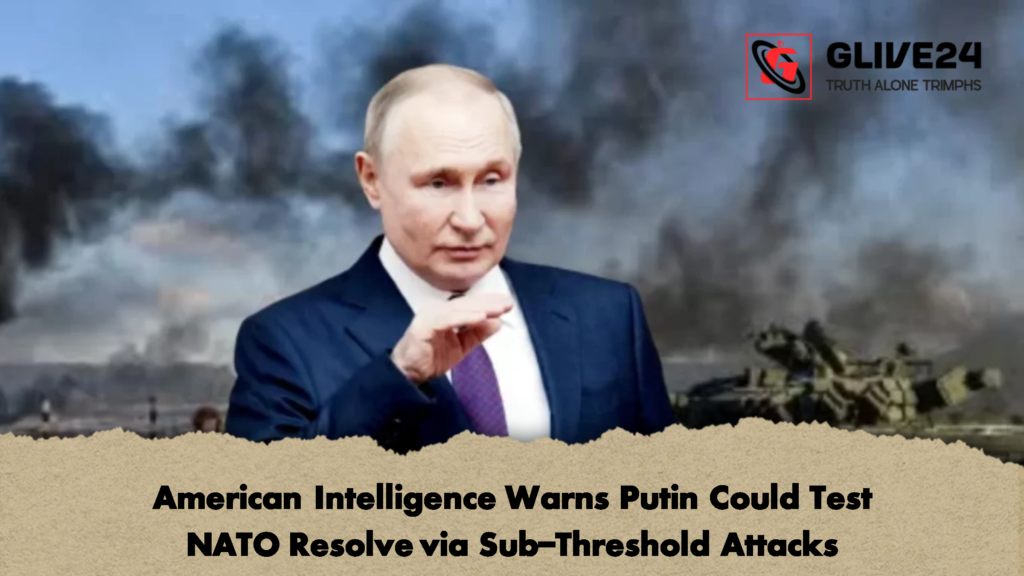
WASHINGTON — United States intelligence agencies have compiled a sobering evaluation suggesting that Russian President Vladimir Putin may execute limited military operations against a NATO member state in the coming years to probe the structural cohesion and collective resolve of the Western alliance.
According to a recently disclosed US intelligence assessment initially reported by The Wall Street Journal, American national security officials have mapped out multiple confrontation scenarios. These potential actions range from calibrated, small-scale territorial incursions to aggressive cyber operations, all calibrated to test the alliance’s adherence to Article 5—the central mutual defense pillar stating that an attack against one member nation constitutes an attack against all.
Intelligence analysts believe Moscow’s primary objective would not be to provoke a full-scale military conflict with NATO or invite a decisive Allied response. Rather, the Kremlin is believed to be evaluating ways to fracture Western solidarity through sub-threshold aggression, with the Baltic nations and Poland flagged as the most susceptible targets.
Escalating Incursions and Hybrid Threats along the Eastern Flank
European security analysts contend that if President Putin fails to achieve a favourable outcome in Ukraine, he may seek to widen the theatre of tension directly into NATO territory. This concern arises against a backdrop of increasing airspace incursions and suspected state-sponsored sabotage operations across Europe.
A series of recent incidents underlines the heightened risk profile along NATO’s eastern frontier:
-
Romania (May 2026): An explosive-carrying drone struck a residential building inside Romanian borders, leaving two civilians injured.
-
Poland (September 2025): NATO aircraft were scrambled to shoot down several Russian drones that crossed into Polish airspace during strikes on western Ukraine.
-
Germany (August 2026): Security services recovered a drone armed with military-grade explosives near a major German airport, with US defense officials pointing to potential Russian intelligence involvement.
Commenting on the airport breach, German Interior Minister Alexander Dobrindt described the presence of weaponised drones near critical civil aviation hubs as a severe security escalation, explicitly hinting at foreign state orchestration. The discovery prompted German Chancellor Friedrich Merz to call an emergency session of the National Security Council to address domestic vulnerabilities.
Strain on US Air Defense Stockpiles as Ukrainian Casualties Rise
The publication of the intelligence summary coincides with mounting alarm over depleted United States arms reserves. Extended military commitments and heavy air defense utilization in the Middle East have significantly drawn down key stockpiles, creating logistical complications for global contingency planning.
According to US defense reports, nearly 80 per cent of the military’s Terminal High Altitude Area Defense (THAAD) interceptor missiles and roughly half of its Patriot missile inventory have been deployed or expended in recent operations.
This logistical squeeze occurs alongside a sharp increase in non-combatant casualties in Ukraine. United Nations statistics indicate that long-range Russian missile and drone bombardments resulted in a 60 per cent surge in civilian casualties between January and June 2026 compared to the corresponding period last year. A recent night-time attack claimed the lives of 17 civilians after local air defense batteries failed to intercept incoming ballistic missiles.
Although US President Donald Trump stated on Truth Social that national arms reserves remain formidable and production lines are expanding, officials acknowledged off-the-record that he voiced deep concern during a recent cabinet gathering at Camp David regarding depleted interceptor stocks. Concurrently, diplomatic initiatives aimed at brokering a ceasefire between Kyiv and Moscow remain deadlocked, while Western economic sanctions have failed to halt Russian offensive maneuvers. NATO military spokesman Martin O’Donnell refrained from addressing specific intelligence reports, maintaining that the alliance remains fully prepared to safeguard all member territories.