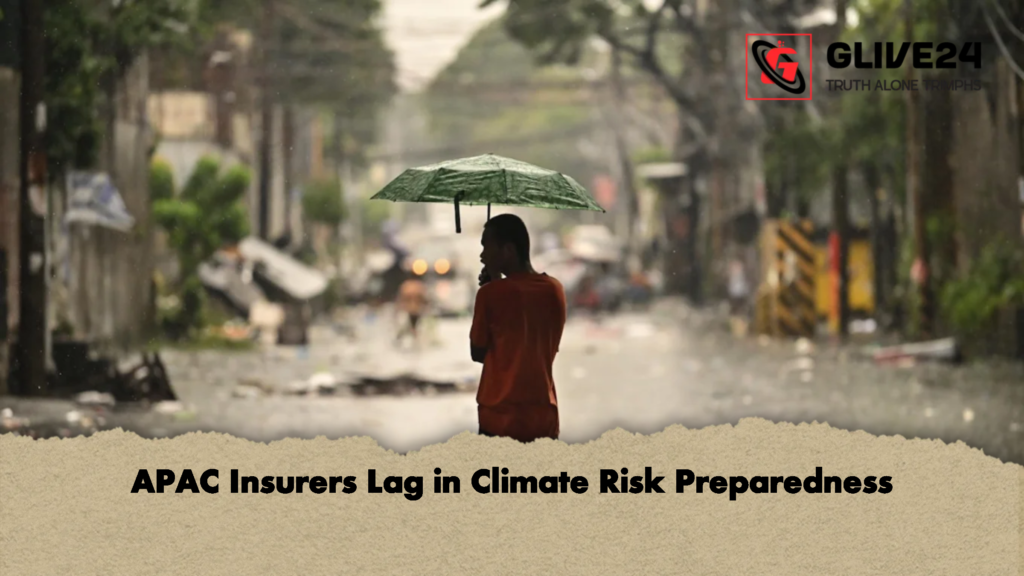
Asia-Pacific insurers are facing mounting pressure to reinforce their resilience against climate-related risks, as increasingly severe weather events expose fundamental weaknesses in underwriting practices, capital deployment, and long-term strategic planning. What was once treated as a technical underwriting issue has now evolved into a systemic financial threat with far-reaching implications for the stability of insurance markets.
A recent global survey by MSCI, Inc., which examined 50 of the world’s leading property and casualty insurers and reinsurers, reveals a widening gap between awareness and effective action. While many firms express confidence in their individual preparedness, significantly fewer believe the industry as a whole is adequately equipped to manage escalating climate risks.
Growing Alarm, Slow Progress
Across the Asia-Pacific (APAC) region, 50% of insurers surveyed consider the industry insufficiently prepared to handle physical climate risks. This perception is even more pronounced in North America at 62%, while Europe appears comparatively more confident at 46%. The data reflects a global recognition of vulnerability, albeit with notable regional differences.
Concerns deepen further when examining systemic risk. All APAC respondents reported moderate to very high concern about the potential for climate-related physical risks to disrupt financial systems—exceeding the already elevated global average of 88%. Despite this heightened awareness, integration of climate considerations into operational frameworks remains limited.
Indeed, while 64% of APAC insurers indicated strong concern about climate risk, a nearly identical proportion—63%—acknowledged that they remain at early or intermediate stages of embedding such risks into underwriting models, enterprise risk management structures, and capital allocation frameworks. This disparity highlights a critical execution gap that continues to hinder progress.
Mounting Losses Underscore Urgency
Figures from Swiss Reinsurance Company Ltd emphasise the growing financial toll of climate-related disasters. In 2025, global insured losses from natural catastrophes reached approximately $107 billion, with “secondary perils”—such as floods, storms, and wildfires—accounting for an overwhelming 92% of that total.
The broader economic impact is even more striking:
| Category | Estimated Loss (2025) | Share (%) |
|---|---|---|
| Total economic losses | $220 billion | 100% |
| Total insured losses | $107 billion | 49% |
| Secondary perils contribution | ~$98 billion | 92% |
| Uninsured losses (approximate) | $113 billion | 51% |
Although nearly half of total economic losses were insured—a record proportion—significant protection gaps persist, particularly across emerging APAC markets. In many of these economies, between 80% and 90% of catastrophe-related losses remain uninsured, leaving governments, businesses, and households acutely exposed to financial disruption.
Looking ahead, Swiss Re anticipates a continued upward trajectory in insured losses, driven by population growth, rising asset values, and increasing reconstruction costs. Historically, such losses have grown at an annual rate of 5% to 7%, with extreme scenarios potentially pushing annual insured losses as high as $320 billion.
Regional Gaps in Readiness
The survey also highlights stark regional disparities in climate risk preparedness:
| Region | Risk Integration into Management | Underwriting Preparedness |
|---|---|---|
| Europe | 68% | 79% |
| North America | ~33% | Moderate |
| Asia-Pacific | 36% | 23% |
European insurers are leading the way, with strong integration of climate risks into enterprise risk management and relatively advanced underwriting capabilities. By contrast, only 36% of APAC insurers have incorporated climate risks into their broader risk management frameworks, and a mere 23% consider their underwriting sufficiently prepared.
Regulatory Scrutiny and Accountability Challenges
Regulatory bodies across APAC are intensifying their focus on climate risk governance, calling for enhanced board-level oversight, stronger internal controls, and more transparent climate-related disclosures. However, many insurers have yet to fully align their governance structures with these expectations.
A key weakness lies in accountability. Although climate risk is widely acknowledged as a strategic priority, relatively few insurers have linked climate-related objectives to executive remuneration or performance evaluations. This disconnect reduces incentives for senior leadership to prioritise long-term resilience over short-term financial outcomes.
Closing the Gap
To bridge the climate readiness gap, APAC insurers must accelerate the integration of climate risk into core operations, invest in sophisticated risk modelling tools, and align leadership incentives with sustainability and resilience goals. Strengthening collaboration with regulators and improving data quality will also be essential.
Ultimately, the challenge is no longer one of awareness but of execution. Without decisive and coordinated action, the region risks falling further behind as climate volatility intensifies and financial exposures grow ever more complex.