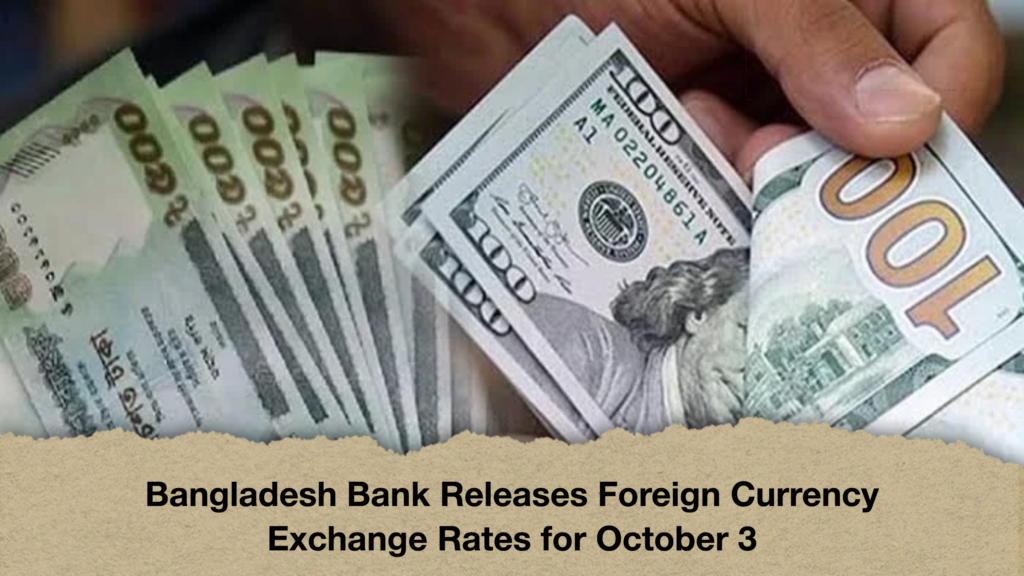
Bangladesh Bank has published the latest foreign currency exchange rates for Saturday, 3 October 2026, offering crucial clarity for commercial banks, international traders, importers, and expatriates managing remittance inflows. The official figures reflect ongoing dynamics across global forex markets and provide a baseline for commercial banking transactions across the country.
According to the official schedule released by the central bank, the Bangladeshi Taka (BDT) displays varying exchange spreads against key international and regional currencies.
Key Exchange Rates Overview
The United States Dollar (USD), which remains the primary currency for Bangladesh’s international trade and settlement, is quoted with a buying rate of 122.75 BDT and a selling rate of 122.85 BDT. This tight spread reflects relative stability in spot market valuations for trade settlements.
Among major European currencies, the British Pound Sterling (GBP) stands out as one of the strongest foreign currencies against the Taka, with buying and selling rates posted at 162.67 BDT and 162.87 BDT respectively. Meanwhile, the Euro (EUR) is set at 139.57 BDT for buying and 139.71 BDT for selling.
In Asian and regional currency markets, the Indian Rupee (INR) remains steady, quoted identically at 1.28 BDT for both buying and selling transactions. The Chinese Yuan (CNY), an increasingly vital currency for bilateral trade and raw material imports, is listed with a buying rate of 18.29 BDT and a selling rate of 18.30 BDT. The Japanese Yen (JPY) trades at 0.78 BDT for both buying and selling per single Yen unit.
For Commonwealth economies, the Australian Dollar (AUD) stands at 86.10 BDT buying and 86.24 BDT selling, whereas the Singapore Dollar (SGD) records buying and selling rates of 96.09 BDT and 96.22 BDT respectively.
Market Context and Economic Background
Central bank foreign exchange rates serve as a critical benchmark across the Bangladeshi financial landscape. Commercial banks utilize these baseline rates to set real-time counters for foreign trade financing, cross-border remittances, travel card conversions, and interbank liquidity adjustments.
The stability of key currencies like the US Dollar and Euro plays a vital role in determining local import costs for fuel, essential food commodities, and industrial raw materials—particularly for the export-oriented ready-made garment (RMG) sector. Concurrently, competitive exchange rates for the Pound, Dollar, and Euro encourage non-resident Bangladeshis to channel remittances through formal banking pathways, bolstering national foreign exchange reserves.
Financial analysts note that while central bank rates offer a foundational anchor, retail counter rates at individual commercial banks and money changers may experience minor variances based on operational fees, cash availability, and real-time market liquidity. Trade participants and remittance recipients are advised to verify exact transactional rates directly with authorized banking channels prior to executing cross-border transactions.