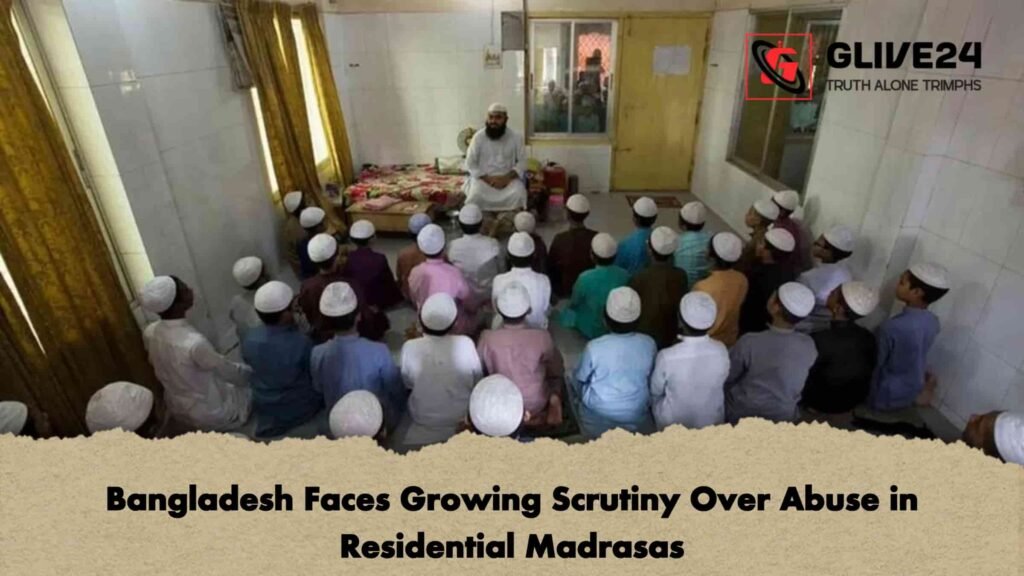
Deepening concerns regarding student safety and institutional accountability have taken centre stage in Bangladesh following a series of grave allegations involving the sexual abuse and exploitation of minors within residential madrasas.
Although national human rights organisations maintain detailed records of sexual violence across the country, statistical data specifically segregated by educational institutions is not currently compiled. Despite the absence of formal institutional metrics, rights advocates and legal scholars warn that reported court cases represent only a fraction of the actual occurrences, with many incidents remaining concealed due to social stigma, religious pressure, and inadequate oversight.
+----------------------------------------------------------------------------------------------------+
|                      CHRONOLOGY OF RECENT REPORTED INCIDENTS IN MADRASAS                           |
+----------------------+----------------------+------------------------------------------------------+
| Date / Period        | Location             | Summary of Incident & Legal Status                   |
+----------------------+----------------------+------------------------------------------------------+
| July 2019            | Narayanganj          | RAB arrested a teacher accused of abusing 11 students|
|                      |                      | over three years using spiritual coercion.           |
+----------------------+----------------------+------------------------------------------------------+
| July 2019            | Kendua, Netrokona    | Principal mobbed and arrested for abusing young girls|
|                      |                      | and forcing them to swear secrecy on the Quran.      |
+----------------------+----------------------+------------------------------------------------------+
| March 2025           | Sreepur, Gazipur     | Teacher arrested following an attempted rape; full   |
|                      |                      | confession recorded on video.                        |
+----------------------+----------------------+------------------------------------------------------+
| May 2025             | Netrokona            | Teacher arrested after an 11-year-old student became |
|                      |                      | pregnant following repeated sexual assaults.         |
+----------------------+----------------------+------------------------------------------------------+
| July 2025            | Kumarkhali, Kushtia  | Teacher detained for repeatedly assaulting a male    |
|                      |                      | student over a fortnight under the guise of dreams.  |
+----------------------+----------------------+------------------------------------------------------+
| August 2025          | Banshkhali, Chittagong| Principal arrested by RAB for repeatedly abusing an  |
|                      |                      | eight-year-old student in washrooms.                 |
+----------------------+----------------------+------------------------------------------------------+
| Jan - Jun 2025       | Nationwide (HRSS)    | 404 total rapes reported; 238 victims were minors;   |
|                      |                      | 17 victims were murdered following assault.          |
+----------------------+----------------------+------------------------------------------------------+
| Jan - Jun 2025       | Nationwide (ASK)     | 319 rape incidents recorded; 164 involved minors;    |
|                      |                      | 30 victims were killed post-assault.                 |
+----------------------+----------------------+------------------------------------------------------+
| July 2025            | Nationwide (HRSS)    | 95 females raped in one month; 61 were under 18;     |
|                      |                      | 11 subjected to gang rape.                           |
+----------------------+----------------------+------------------------------------------------------+
| Full Year 2025       | Nationwide (ASK)     | 759 total rapes recorded; 370 victims were minors;   |
|                      |                      | 36 victims were killed post-assault.                 |
+----------------------+----------------------+------------------------------------------------------+
Recurring Tactics of Coercion and Administrative Neglect
A closer examination of documented criminal complaints highlights consistent operational methods utilized by perpetrators. In the vast majority of cases, those accused are senior teachers or institutional directors who exploit their authority over vulnerable, underage students. Abuses routinely affect both male and female pupils, particularly within residential facilities where children remain away from parental protection for extended periods.
To enforce silence, perpetrators frequently invoke spiritual authority—instilling fear of divine punishment or family ruin. Furthermore, when allegations come to light, institutional authorities often attempt to settle matters through informal local arbitration (salish) rather than reporting the offences to law enforcement authorities.
Abu Ahmed Faizul Kabir, Senior Co-ordinator at the Ain o Salish Centre (ASK), emphasized that whilst child exploitation occurs across various sectors, its prevalence in residential madrasas is particularly troubling. He underscored that non-consensual sexual acts against young boys have reached alarming proportions.
“The fundamental problem lies in the complete lack of external monitoring within these institutions,” Kabir noted. “Because a large proportion of madrasas operate on a boarding basis, parents have limited contact, and religious fear is repeatedly manipulated to suppress complaints.”
Concurring with these observations, Ejazul Islam, Chief Executive of the Human Rights Support Society (HRSS), observed that the problem is deeply rooted. He noted that increased media coverage has brought longstanding issues into the public domain, though the actual scope remains hidden behind a veil of silence.
Rebuttal from Madrasa Authorities and Regulatory Boards
In response to public scrutiny, leaders from the independent Qawmi madrasa sector have strongly rejected claims of widespread systemic failure, characterizing public coverage as sensationalized.
Maulana Manzurul Islam Afendi, head of the Jamia Islamia Islambag Madrasa in Dhaka, stated that religious authorities take criminal allegations seriously. “Whenever an offence occurs, we advocate for immediate legal prosecution. However, our investigations reveal that anti-religious elements are intentionally exaggerating isolated events to discredit traditional madrasa education,” he argued.
Similarly, Mufti Mehdi Hasan, Director of the Darul Quran Meherunnisa Women’s Madrasa in Khilgaon, attributed the surge in news reports to online commentary and financial motives, asserting that verified abuse accounts for less than a fraction of one per cent of cases. He maintained that such acts stem from individual wrongdoing rather than institutional flaws.
Addressing the structural challenges, Maulana Muslehuddin Raju, Vice-President of the primary Qawmi education board (BEFAQ), acknowledged that misconduct occurs but contested its portrayed scale. He revealed that out of an estimated 50,000 Qawmi madrasas in Bangladesh, approximately 35,000 are formally registered with the board, leaving roughly 15,000 operating entirely without regulatory oversight.
“We enforce a zero-tolerance policy against sexual misconduct and mandate security measures, such as CCTV installation and code-of-conduct guidelines,” Maulana Raju stated, emphasizing that unregistered facilities remain the primary obstacle to comprehensive monitoring.
By contrast, government-regulated institutions operate under direct state oversight. Professor Khondokar Md. Sadequr Rahman, Chairman of the Alia Madrasa Education Board, explained that state-controlled bodies maintain formal procedures to investigate complaints, immediately suspending accused staff and transferring criminal investigations to the judiciary.
Socio-Economic Realities and the Call for Legal Reform
Socio-political analysts point out that socio-economic vulnerabilities significantly exacerbate the risk of child exploitation within these environments. Professor Mojibur Rahman from the Institute of Education and Research at Dhaka University highlighted that residential madrasas often provide free accommodation and meals, attracting families from underprivileged backgrounds who lack the resources to maintain regular contact or oversight.
“The Supreme Court of Bangladesh issued explicit directives mandating anti-sexual harassment committees across all educational establishments,” Professor Rahman stated. “Yet, when major universities struggle to fully implement these safeguards, enforcement within unregistered madrasas becomes exceptionally difficult.”
The severity of the issue was previously documented by investigative journalist Saiful Baten Titu in his 2019 book Bishphora (The Carbuncle), written after visiting 200 male boarding madrasas in disguise. His findings detailed entrenched impunity and cycles of abuse. The publication was subsequently banned by the Bangladeshi government in 2020, forcing the author to seek asylum in Europe following persistent threats to his life.
Anthropologist Professor Snigdha Rezwana of Jahangirnagar University advocated for addressing child protection through a broader socio-economic framework rather than isolated institutional critiques, which often incite defensive reactions from religious bodies. Meanwhile, Maleka Banu, General Secretary of Bangladesh Mahila Parishad, urged the government to enforce strict transparency, legal compliance, and independent civil oversight across all residential learning centres.
From a judicial perspective, Supreme Court Advocate Ishrat Hasan stressed that Bangladeshi criminal law treats sexual assault against male minors with severe gravity, carrying penalties up to life imprisonment or the death penalty. However, she emphasized that legal remedies remain ineffective without administrative accountability.
“Numerous residential madrasas operate in rented quarters without official registration or background checks for teaching staff,” Advocate Hasan observed. “To ensure the safety of vulnerable children, the state must mandate comprehensive registration and stringently enforce high court protection guidelines across every educational facility.”