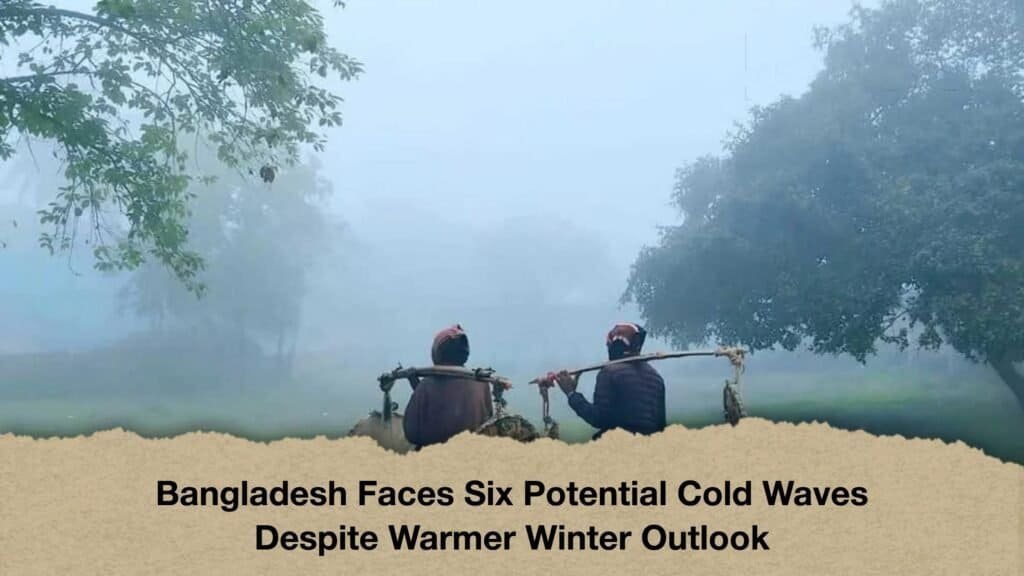
Bangladesh could experience four to six cold waves between November and January, with two to three potentially developing into severe cold spells, according to the Bangladesh Meteorological Department (BMD). Despite the prospect of several bouts of cold weather, the overall winter season is expected to be relatively warmer than usual, as El Niño could keep average daytime and night-time temperatures above normal.
The outlook is part of the BMD’s three-month long-range forecast covering November, December and January. Alongside the anticipated cold waves, the department has highlighted the likelihood of moderate to dense fog, seasonal rainfall and the formation of low-pressure systems over the Bay of Bengal, some of which could develop into cyclones.
Meteorologist Dr Muhammad Abul Kalam Mallick of the BMD told the Bangladesh Sangbad Sangstha (BSS) that one or two mild cold waves could affect the country in December. The northern and western regions are expected to experience the greatest impact, particularly parts of Rajshahi, Rangpur and Khulna divisions, where temperatures could fall to between 8 and 10 degrees Celsius.
Conditions could become more severe in January. Dr Mallick said moderate cold waves were possible during the month, with one or two severe cold spells potentially bringing temperatures down to between 4 and 6 degrees Celsius in some areas.
Dense fog could make winter feel colder
Moderate to dense fog is expected in different parts of the country during the final hours of the night and early morning throughout the three-month period. River basins are particularly likely to experience heavier fog, while other areas may see light to moderate fog.
Dense fog can reduce daytime sunshine and limit the rise in temperatures, narrowing the gap between daytime and night-time readings. This could make conditions feel colder, especially during the early morning hours, even when average temperatures remain relatively high.
Explaining the expected temperature pattern, Dr Mallick said El Niño, combined with the effects of global warming, could contribute to above-normal average temperatures across Bangladesh and other parts of South Asia.
The influence of these climatic factors is expected to make the coming winter comparatively warmer. However, this does not rule out sudden drops in temperature. Readings could still fall below 10 degrees Celsius in some areas, triggering cold waves.
According to the meteorologist, the number, duration and geographical coverage of extremely severe cold spells are likely to remain relatively limited this season. Nevertheless, uncertainty remains over the frequency and persistence of cold waves because of El Niño. He stressed the need to remain alert as weather conditions evolve.
Bay of Bengal may produce up to four low-pressure systems
The seasonal outlook also indicates that between two and four low-pressure systems could develop over the Bay of Bengal during the next three months. One or two of these may intensify into cyclones, depending on prevailing atmospheric and oceanic conditions.
Dr Mallick noted that October and November are generally considered cyclone-prone months in the region. Low-pressure systems commonly form over the Bay of Bengal during this period, and some can gather sufficient strength to develop into cyclonic storms.
He explained that the seasonal movement of the Sun towards the Southern Hemisphere reduces the length of daylight and increases the duration of nights. However, the availability of solar radiation over the Bay of Bengal can contribute to higher sea-surface temperatures. This is a natural seasonal process, although similar conditions do not necessarily occur every year. Such developments are considered temporary weather systems.
Rainfall expected to remain within normal limits
The BMD has forecast normal overall rainfall across Bangladesh during the November-January period, although the amount is expected to vary between divisions and months.
Chattogram Division is likely to receive the highest rainfall in November, with an estimated 35-40 millimetres. Barishal is forecast to receive 30-40 millimetres, while Dhaka, Sylhet and Khulna may record between 15 and 25 millimetres.
Mymensingh and Rajshahi divisions could receive 10-15 millimetres, while Rangpur is expected to experience comparatively little rainfall, at around 4-8 millimetres.
Rainfall is forecast to decline further in December and January. In December, Dhaka Division may receive 8-10 millimetres, while Sylhet could record 10-15 millimetres.
In January, Khulna Division is expected to receive 10-14 millimetres of rainfall. Dhaka and the other divisions are forecast to receive between 6 and 10 millimetres.
These projections indicate that rainfall will remain relatively limited during the winter months, although regional variations are expected.
Historical records and climate models inform the outlook
The BMD said its three-month forecast was prepared by analysing various meteorological datasets, upper-air atmospheric patterns, climate models and forecasts from international centres authorised by the World Meteorological Organisation (WMO). Both El Niño and La Niña conditions were taken into consideration.
Explaining the methodology, Dr Mallick said the department had analysed records of low-pressure systems that developed over the Bay of Bengal during October and November between 1948 and 2025.
The historical analysis showed that an average of one to three low-pressure systems form over the bay during these months. Some may strengthen and develop into cyclones when atmospheric and oceanic conditions are favourable.
The long-range outlook is based on these historical patterns, combined with contemporary weather observations and climate-model projections. However, such forecasts involve a degree of uncertainty because atmospheric conditions can change over time.
Dr Mallick therefore advised the public not to rely solely on the three-month outlook, recommending that people also follow the department’s regular daily weather bulletins. Updated forecasts are particularly important when cold waves, dense fog or potential cyclonic syste