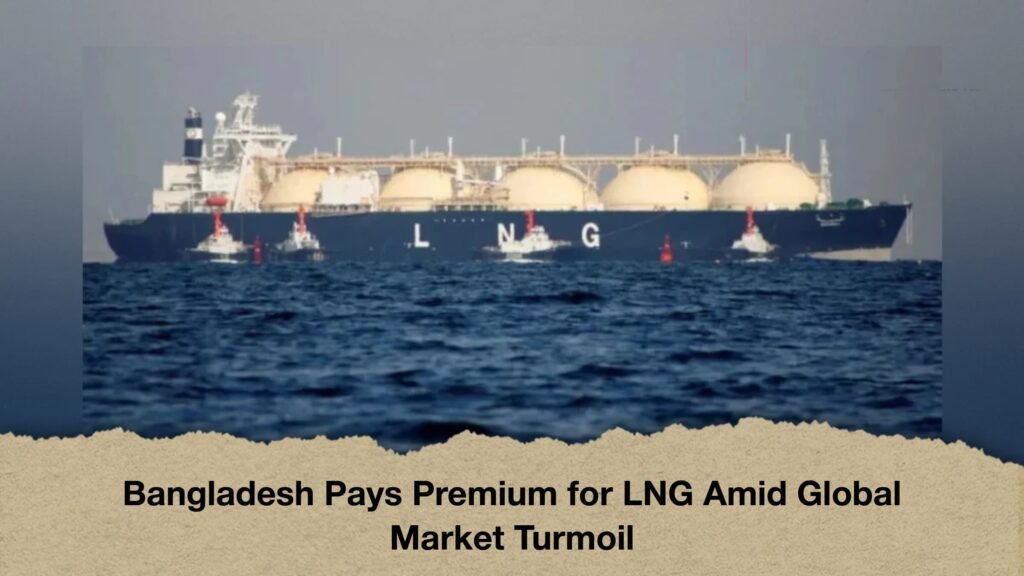
Bangladesh is being forced to purchase liquefied natural gas (LNG) from the spot market at prices significantly higher than prevailing international benchmarks, increasing pressure on the country’s energy import bill. Petrobangla purchased three LNG cargoes through a spot-market tender last week for around Tk 3,400 crore, according to sources familiar with the transactions.
The tenders were invited under the Japan Korea Marker (JKM)-linked pricing mechanism. However, the three cargoes reportedly cost at least Tk 300 crore more than the corresponding JKM benchmark, highlighting the growing premium Bangladesh is paying to secure immediate supplies.
Against this backdrop, Petrobangla and the Energy and Mineral Resources Division are seeking to reduce dependence on spot purchases. The authorities are attempting to secure at least 20 cargoes through long- and short-term agreements up to December.
An official involved in the process said the international LNG supply business had become a multi-billion-dollar market and that the government suspected attempts by a group of traders to influence the market. The government therefore wants to approach a wider range of international suppliers and secure LNG through negotiated short- or long-term arrangements. Spot-market purchases would be used only when supplies cannot be secured through contracts.
Efforts to obtain a comment from Petrobangla’s chairman were unsuccessful despite repeated attempts.
War Disrupts Contracted Supplies
The ongoing conflict in the Middle East has added to uncertainty in the international LNG market. According to the information provided by officials, suppliers from Qatar and Oman, along with US-based Excelerate Energy, have suspended promised LNG deliveries under long-term arrangements.
As a result, Bangladesh has had to turn increasingly to the spot market to meet domestic demand. The Energy Division estimates that around 25 to 30 LNG cargoes may be required between October and December to maintain supplies.
Nine cargoes have already been arranged for September. For October, Petrobangla expects to receive four cargoes under existing long- and short-term arrangements. Two of those cargoes have been sought from US-based Gunvor.
Under Bangladesh’s agreement with Gunvor, the company is entitled to receive LNG at a price linked to the JKM benchmark, along with an additional eight US cents per unit, through 2028.
Spot Purchases Carry a Heavy Premium
Recent tenders illustrate the gap between spot-market offers and benchmark prices.
For delivery on 25-26 September, the lowest bid came from Aramco Trading Singapore at $27.54 per unit, while the JKM price at the time was as high as $24.09. The difference meant an additional cost of more than $9 million for that cargo, according to the report.
For another cargo scheduled for delivery on 1-2 October, BP Singapore submitted the lowest bid at $28.03 per unit, compared with a JKM price of around $25. The additional cost for that cargo was estimated at around $9 million.
For delivery on 5-6 October, the lowest bidder was Vitol Bahrain, with an offer of $26.6688 per unit, while the JKM price was around $25. This cargo also required Bangladesh to pay several million dollars above the benchmark.
Petrobangla’s subsidiary, the Rupantarita Prakritik Gas Company Limited (RPGCL), said the Platts and JKM-linked prices stood between $22.82 and $24.61 per unit when the three spot cargoes were tendered last week. The final bids were consequently well above those reference levels.
Short-Term Deal Offers Some Relief
The contrast is particularly clear when spot purchases are compared with short-term contractual arrangements.
Last week, the Cabinet Committee on Government Purchase approved the purchase of one LNG cargo from Saudi Aramco for delivery on 10-11 September. The agreed price was $23.98 per unit, slightly below the JKM benchmark of $24.076 at that time.
The transaction demonstrates that negotiated short-term arrangements can sometimes secure LNG at a price below the prevailing benchmark. The government is therefore seeking similar agreements with major international suppliers.
Officials have contacted Japan’s JERA, South Korea’s POSCO, Indonesia’s Pertamina and Saudi Aramco, among other companies. They have been offered incentives such as prompt payment if they can supply LNG under short-term agreements at prices below the JKM index.
So far, however, several sources said no company had agreed to supply LNG to Bangladesh under such arrangements during the next three months.
Supply Specifications Also Limit Options
Officials have identified several reasons why Bangladesh is paying more for LNG.
The first is the volatility caused by the Middle East conflict. LNG that previously traded at around $9-$10 per unit is now selling for more than $20 in international markets, according to the explanation provided to the Energy Division.
The second involves Bangladesh’s technical requirements for imported LNG. International LNG generally has a gross heating value of around 1,090-1,118 British thermal units per standard cubic foot. Bangladesh, however, has to blend imported LNG with domestically produced natural gas before feeding it into the national grid. This requires the imported gas to meet particular quality and heating-value specifications.
These restrictions can narrow the pool of suppliers willing or able to participate in Bangladesh’s tenders. A smaller pool of bidders can, in turn, reduce competitive pressure on prices.
Timing is another major factor. Spot tenders are often issued with very short delivery windows because the gas is needed urgently. Suppliers that require longer preparation and shipping periods may therefore be unable to participate, even when they are interested in the Bangladeshi market.
Government Seeks More Predictable Supply
Concern over the rising cost of spot-market LNG has reached the highest levels of government. Following several rounds of discussions, Energy Secretary Md Ziaul Haque held meetings last Friday as officials stepped up efforts to secure supplies through alternative arrangements.
The immediate priority is to ensure adequate LNG availability through December while containing the cost of imports. Bangladesh’s dependence on imported LNG means that prolonged volatility in global gas prices can have significant implications for the country’s energy costs.
For the authorities, the challenge is therefore twofold: secure enough cargoes to avoid supply shortages and negotiate prices that are closer to international benchmarks. Whether that can be achieved will depend heavily on global LNG availability, the duration of the Middle East conflict and Bangladesh’s ability to secure more flexible supply agreements.