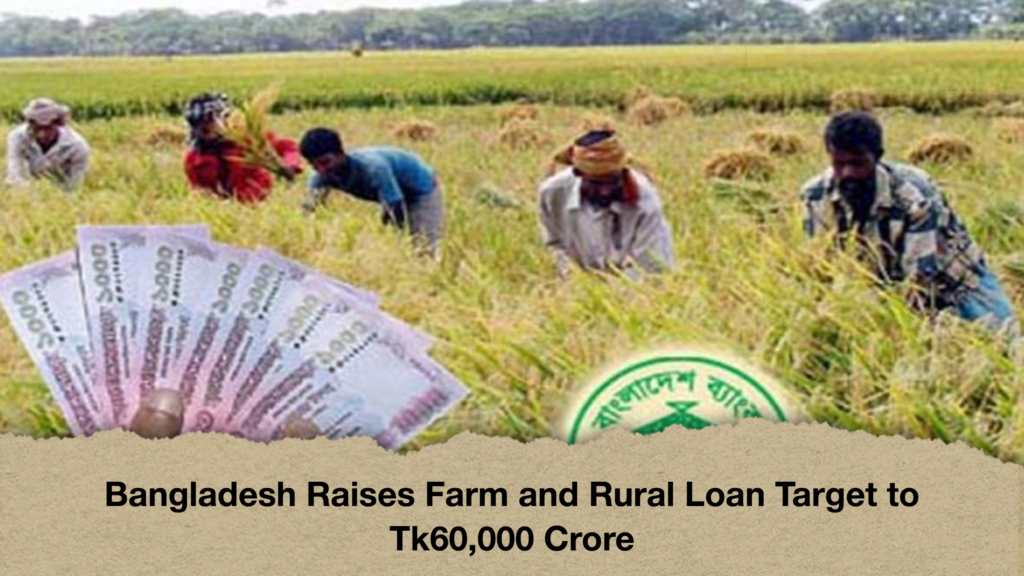
Bangladesh Bank has raised the target for agricultural and rural loan disbursement by 53.85 per cent to Tk60,000 crore for the 2026–27 financial year, signalling a major expansion of institutional financing for farmers and rural economic activities.
The new target represents an increase of Tk21,000 crore from the Tk39,000 crore target set for the 2025–26 financial year. The previous target itself had been raised from Tk38,000 crore in 2024–25, reflecting a continued policy focus on expanding formal credit to the agricultural sector and strengthening financial flows in rural areas.
Bangladesh Bank Governor Md Mostaqur Rahman announced the new agricultural and rural credit policy and programme at a press conference at the central bank’s headquarters on Monday, 17 August.
According to Bangladesh Bank, the substantial increase has been made to support agricultural production, improve farmers’ access to finance and strengthen the flow of credit into the rural economy. Adequate and timely financing can help farmers meet expenses for seeds, fertilisers, irrigation, machinery and other production inputs, while also enabling them to maintain operations during periods when income from agricultural activities is limited.
Agricultural and Rural Credit Targets
| Financial year | Credit target | Change from previous year |
|---|---|---|
| 2024–25 | Tk38,000 crore | — |
| 2025–26 | Tk39,000 crore | Tk1,000 crore |
| 2026–27 | Tk60,000 crore | Tk21,000 crore |
| Increase in 2026–27 | 53.85% | — |
Agricultural and rural credit extends beyond crop cultivation. Financing is also important for livestock, fisheries, agricultural machinery, small rural enterprises and other income-generating activities linked to the countryside. Wider access to institutional credit could therefore help support businesses and livelihoods across rural communities rather than benefiting crop producers alone.
The central bank’s latest policy places particular emphasis on increasing agricultural production and ensuring financial support for farmers. The broader objectives include strengthening food security, encouraging investment in agriculture and improving the supply of agricultural products. These priorities are especially significant because disruptions in farm production can affect both rural incomes and the availability and prices of essential food items.
Timely access to credit can also reduce farmers’ dependence on informal sources of finance, where borrowing costs and repayment conditions may be less favourable. Institutional lending, when properly targeted and responsibly managed, can provide farmers with greater financial flexibility during planting, cultivation and harvesting cycles.
The expanded lending target also has implications for the wider rural economy. Increased credit availability can support small entrepreneurs, create economic activity and contribute to employment and income generation outside major urban centres. In this sense, agricultural lending forms part of a broader effort to strengthen rural economic activity.
Bangladesh Bank has linked stronger agricultural financing with efforts to improve the supply of farm products and support price stability. If increased credit contributes to higher and more consistent production, it could help improve market supplies. At the same time, easier access to financing may help farmers manage production costs and reduce financial pressure at critical stages of the agricultural cycle.
However, achieving the Tk60,000 crore target will depend not only on the volume of lending but also on how effectively the funds reach genuine farmers and rural entrepreneurs. Ensuring that credit is distributed on time, used for productive purposes and repaid under appropriate conditions will be important for the programme’s effectiveness.
The sharp rise in the target therefore marks a significant expansion of Bangladesh Bank’s agricultural financing ambition for the new financial year. By increasing institutional credit to farmers and rural businesses, the central bank aims to support production, strengthen rural livelihoods, contribute to food security and reinforce the role of agriculture in the wider economy.