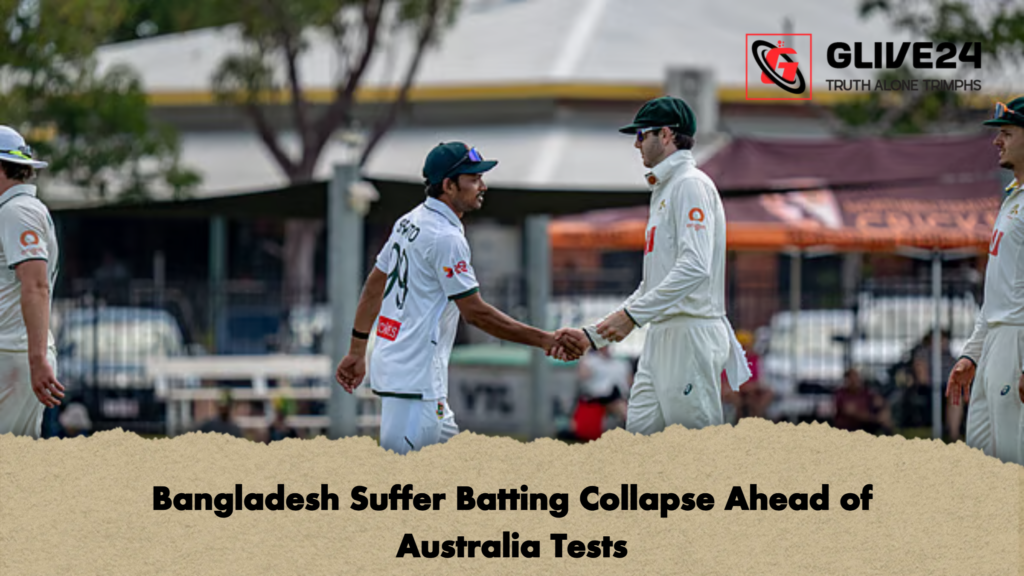
Bangladesh’s batting frailties were laid bare in their final preparation match before the Test series in Australia, as Najmul Hossain’s side suffered a heavy innings-and-38-run defeat against a Cricket Australia XI at Marrara Oval in Darwin.
After showing some resistance in the first innings, Bangladesh collapsed spectacularly in their second, being dismissed for just 54 runs. The defeat itself came in a practice fixture, but the manner of the batting collapse will raise serious concerns ahead of the opening Test.
Bangladesh made 263 in their first innings, with Mehidy Hasan Miraz providing the standout contribution. The all-rounder scored a century, but none of his team-mates managed to reach fifty. In reply, the Cricket Australia XI posted 355, securing a 92-run first-innings advantage.
That deficit left Bangladesh needing a composed batting effort to remain competitive. At the close of the second day, they were 19 for two, with eight wickets still in hand. The position offered a realistic opportunity to erase the deficit and put pressure back on the hosts.
Instead, the final day turned into a rapid collapse. Bangladesh lost their remaining eight wickets in only 17 overs, adding just 35 runs to their overnight total. Their innings ended at 54, leaving them well short of the 92-run deficit and handing the Cricket Australia XI a convincing victory.
Left-arm paceman Campbell Thompson was the chief architect of Bangladesh’s downfall. He claimed eight of the ten wickets, while off-spinner Corey Rocchiccioli took the other two. Bangladesh’s batters struggled to cope with the pressure created by Thompson, repeatedly losing wickets before they could establish partnerships.
Tanžid Hasan top-scored with 22 from 41 deliveries after remaining unbeaten overnight. No other Bangladesh batter reached double figures. Miraz, who had produced a century in the first innings, managed only six from 19 balls in the second. Captain Najmul Hossain, Taskin Ahmed and Ebadot Hossain were all dismissed without scoring.
The performance of Thompson is particularly striking. The 22-year-old left-arm seamer has yet to make his international debut and had entered the match with extremely limited first-class experience. He had played only two first-class matches and taken three wickets, while his List A record also consisted of just two appearances and one wicket.
That makes Bangladesh’s collapse even more concerning. It was not merely the result of facing an established international bowling attack; a relatively inexperienced bowler was able to dismantle the batting line-up almost single-handedly.
The match nevertheless offered one significant positive for Bangladesh. Miraz’s century in the first innings demonstrated that the team can produce substantial individual performances in Australian conditions. The challenge now is to turn such individual contributions into sustained batting partnerships.
The conditions in Australia are traditionally demanding for visiting batters, particularly when the new ball is moving and carrying through to the wicketkeeper. Patience, sound defensive technique and the ability to leave deliveries outside the off stump are often crucial to building long innings. Bangladesh’s second-innings display suggested that these qualities will need considerable improvement before the Tests begin.
The first Test of Bangladesh’s Australian tour is scheduled to begin in Darwin on 13 August, followed by the second Test in Mackay from 22 August. The two matches will provide a substantially tougher examination, with Bangladesh expected to face a stronger and more experienced Australian pace attack.
Practice matches do not determine the outcome of a Test series, and their primary purpose is to expose weaknesses and allow players to adjust to unfamiliar conditions. In that respect, the defeat at Marrara Oval could prove valuable if Bangladesh act on what it revealed.
The immediate priority will be to address the fragility of the top and middle order. Bangladesh must find ways to absorb pressure, build partnerships and remain at the crease for extended periods. If the dramatic second-innings collapse is not corrected before the opening Test, Australia could present an even more difficult challenge.