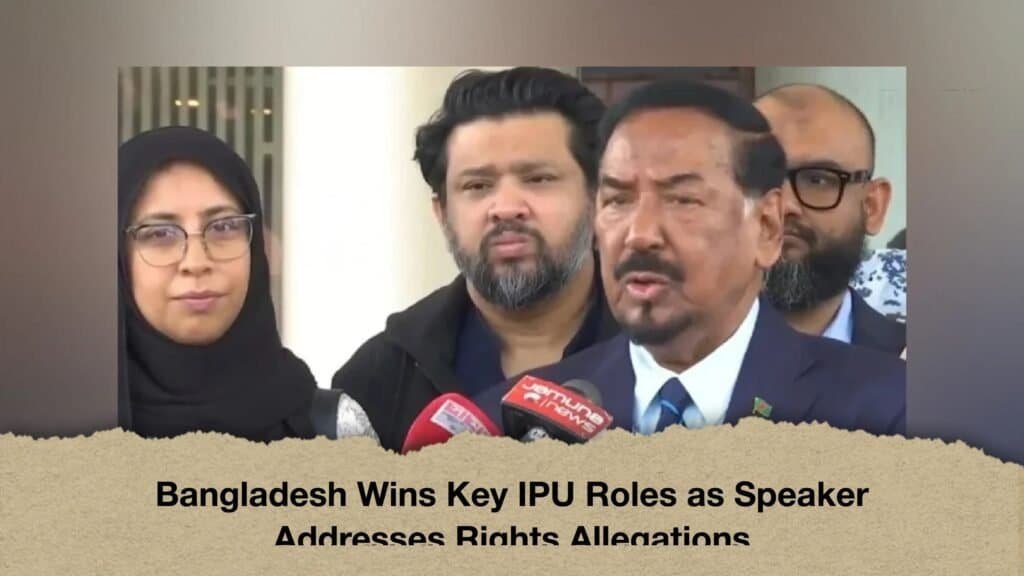
Bangladesh’s Speaker, Hafiz Uddin Ahmad Bir Bikram, has claimed that an investigation by the Inter-Parliamentary Union (IPU) found no evidence to support the Awami League’s allegations of human rights violations in the country. He also said Bangladesh had been removed from a blacklist following the investigation, although the claim was not independently verified in the information available.
Speaking to journalists at Hazrat Shahjalal International Airport on Sunday morning, 11 October, after returning from an IPU conference in Tanzania, the Speaker described the visit as an opportunity to explain Bangladesh’s political circumstances and strengthen its standing in international parliamentary diplomacy.
According to Hafiz Uddin Ahmad, Awami League leaders raised allegations of human rights violations against their party during the IPU’s 152nd Assembly in Istanbul in April. IPU members subsequently visited Dhaka to investigate the claims. The Speaker said their findings did not substantiate the allegations and that Bangladesh’s name had consequently been removed from the blacklist.
No official IPU report or separate statement confirming the precise findings of the investigation or the reported removal of Bangladesh from the list was cited in his remarks.
Speaker Highlights Bangladesh’s Democratic Struggle
Hafiz Uddin Ahmad said he had presented Bangladesh’s political circumstances to international delegates, focusing on the people’s struggle for democracy over the past 16 years. He said the accounts of the country’s prolonged political struggle had deeply affected IPU representatives.
The Speaker maintained that his discussions had helped address what he described as misconceptions about Bangladesh’s political situation. He said the country’s experience of pursuing democratic rights had attracted international attention.
International parliamentary forums provide opportunities for legislators to exchange views on governance, human rights, democratic institutions and cooperation between countries. For Bangladesh, participation in such meetings offers a platform to explain its position, engage with lawmakers from different political systems and establish channels for further dialogue.
The Speaker’s comments came against the backdrop of competing political claims about Bangladesh’s human rights situation. His account of the IPU investigation remains an attribution to him unless supported by an independently available statement or report from the organisation.
Bangladesh Assumes Chairmanship of Asia-Pacific Group
A major development during the Tanzanian conference was Bangladesh’s assumption of the chairmanship of the IPU’s Asia-Pacific Group (APG).
On 5 October, Hafiz Uddin Ahmad formally took over as chairman from Bhutan’s Speaker, Tempa Dorji. According to the Speaker, he will serve a one-year term.
The Asia-Pacific Group has 37 member countries. Its chairmanship gives Bangladesh an opportunity to take a more active role in regional parliamentary discussions, encourage engagement among member states and contribute to deliberations within the wider IPU.
Parliamentary diplomacy complements conventional diplomatic engagement by enabling elected representatives to discuss shared interests, exchange legislative experiences and build relationships across national boundaries. The chairmanship could provide Bangladesh with a stronger platform for these activities, although its practical impact will depend on how the position is used during the term.
The appointment was one of the key outcomes highlighted by the Bangladeshi delegation following its participation in the assembly.
Bangladeshi MP Elected to IPU Executive Committee
Bangladesh secured another position within the organisation on the same day. Barrister Johorat Adib Chowdhury, a member of parliament and chairman of the parliamentary standing committee on the Ministry of Foreign Affairs, was elected to the IPU Executive Committee as a representative of the Asia-Pacific Group at the organisation’s 153rd Assembly.
The election gives a Bangladeshi parliamentarian a place in a body involved in overseeing the organisation’s affairs. Together with the Speaker’s appointment as APG chairman, it offers Bangladesh additional opportunities to participate in international parliamentary discussions.
The two positions were presented as significant achievements for the country’s parliamentary representation abroad. They also create opportunities for Bangladeshi lawmakers to engage with counterparts from other countries on institutional and diplomatic matters.
Bilateral Discussions with Six Countries
The IPU conference took place in Tanzania from 5 to 9 October. Bangladesh sent a 13-member parliamentary delegation led by the Speaker.
During the visit, the delegation held bilateral discussions with representatives from Australia, Pakistan, Bahrain, Bhutan, Canada and Türkiye. Hafiz Uddin Ahmad said the meetings covered matters of mutual interest.
The delegation also held a meeting with the Human Rights Commission. The Speaker described the discussions with different groups and international counterparts as an important part of the visit, saying they had enabled Bangladesh to present its position and pursue shared interests.
Bilateral parliamentary meetings can provide an additional channel for countries to maintain communication, discuss policy priorities and explore areas of cooperation. They also allow lawmakers to exchange views on political developments and institutional practices outside formal government-to-government negotiations.
The Speaker said Bangladesh had attracted attention during the conference and regarded the delegation’s engagement with various countries and groups as a success.
Members of the Parliamentary Delegation
The delegation included Chief Whip Mia Nuruddin Ahmed Apu and several members of parliament. Those named among the participants were Sarwar Jamal Nizam, A. E. Sultan Mahmud Babu, Md Shamsur Rahman Shimul Biswas, S. K. Azizul Bari, Humam Qader Chowdhury, Mir Ahmad Bin Quasem, Sansila Jebrin and Rokeya Begum.
Barrister Md Golam Sarwar Bhuiyan, secretary of the Bangladesh Parliament Secretariat, also accompanied the delegation.
When the group arrived at Hazrat Shahjalal International Airport on Sunday morning, officials from the Parliament Secretariat and the Ministry of Foreign Affairs welcomed the returning representatives.
The visit combined Bangladesh’s participation in the IPU’s 153rd Assembly with efforts to strengthen parliamentary relationships abroad. The country’s assumption of the Asia-Pacific Group chairmanship and the election of a Bangladeshi MP to the Executive Committee were among its principal institutional outcomes.
At the same time, the Speaker’s statements about the Awami League’s human rights complaint and the reported removal of Bangladesh from a blacklist remain claims attributed to him. An official IPU statement or investigation report would be needed to establish the precise findings and confirm the formal status of any blacklist decision.