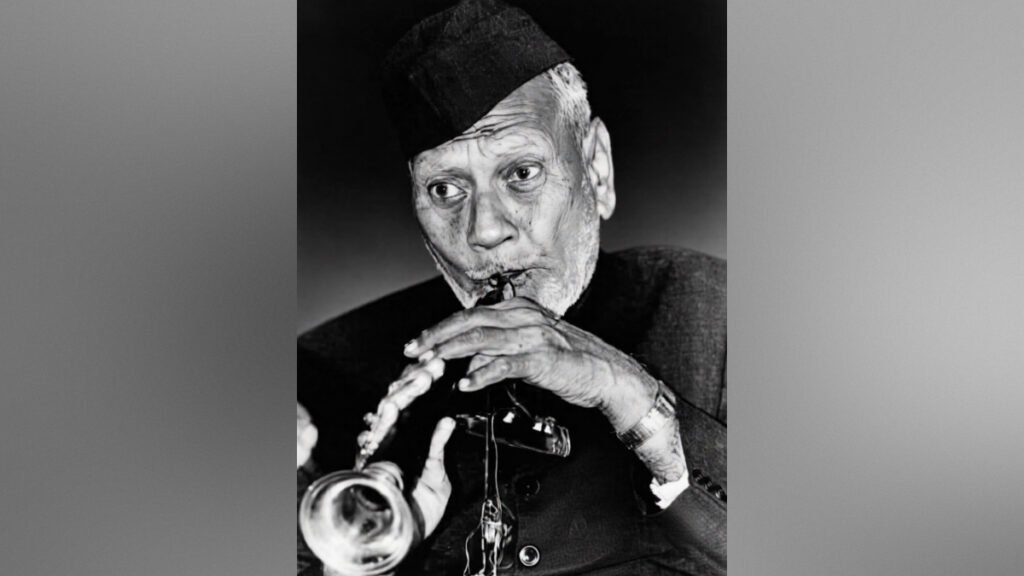
Ustad Bismillah Khan, one of India’s most revered classical musicians, transformed the shehnai from an instrument associated largely with weddings, religious ceremonies and traditional festivities into a respected voice of Hindustani classical music. His mastery of the instrument earned him international recognition and made the shehnai inseparable from his name.
Born on 21 March 1916 in Dumraon, in present-day Bihar, Bismillah Khan came from a family with a strong musical tradition. His father, Paigambar Khan, was a shehnai player in the Dumraon royal court. He was initially named Qamaruddin, but the name Bismillah became closely associated with him from childhood and eventually became his identity as an artist.
His musical journey took a decisive turn after he moved to Varanasi during his childhood. There, he came under the guidance of Ustad Ali Bux ‘Vilayatu’ Khan, a distinguished shehnai player associated with the Kashi Vishwanath Temple. Under his guru’s rigorous training, Bismillah Khan spent years practising and developing an approach to the instrument that was deeply rooted in the traditions of Hindustani classical music.
Varanasi became central to his artistic identity. The city’s temples, ghats, lanes and spiritual atmosphere provided the setting for much of his musical development. He was known for his disciplined practice and for drawing inspiration from the sounds and rhythms of everyday life around the Ganges.
What set Bismillah Khan apart was his ability to make the shehnai speak in the language of classical music. Traditionally, the instrument had a strong association with ceremonial occasions. Khan expanded its expressive possibilities through his command of ragas, intricate melodic movements, meend, gamak and taan. His performances demonstrated that the shehnai could command the same serious attention as other established instruments of Indian classical music.
A major breakthrough came in 1937, when his performance at the All India Music Conference in Calcutta brought him significant national recognition. From that point, his reputation grew steadily, and he became one of the leading instrumentalists of Indian classical music.
His music also became intertwined with the story of independent India. On 15 August 1947, as the country marked its independence, Bismillah Khan performed the shehnai at Delhi’s Red Fort. His association with Independence Day subsequently became an important part of India’s cultural memory. The sound of his instrument came to represent, for many listeners, a connection between India’s musical heritage and the country’s new national identity.
His influence was not confined to India. He travelled widely and performed in countries across Asia, Europe and North America, helping introduce international audiences to the richness of Indian classical music. His performances in countries including Afghanistan, Iran, Iraq, Canada, the United States, Japan and the Soviet Union contributed to the growing international appreciation of the shehnai.
The recognition he received in India reflected the extraordinary stature he achieved. He was awarded the Padma Shri, Padma Bhushan and Padma Vibhushan before receiving the Bharat Ratna, India’s highest civilian honour. He was also awarded honorary doctorates by institutions including Banaras Hindu University and Visva-Bharati.
Despite his fame, Bismillah Khan remained known for his simplicity and humility. Varanasi continued to be at the heart of his life. He maintained a close connection with ordinary people and was not known for adopting the extravagant lifestyle often associated with international celebrity.
His life also became an enduring example of India’s composite cultural tradition. A Shia Muslim, Bismillah Khan maintained a deep connection with the religious and cultural environment of Varanasi. His regular association with the Kashi Vishwanath Temple and his reverence for Hindu traditions existed alongside his own Islamic faith. For him, music provided a space where religious boundaries could give way to a shared human experience.
His contribution extended, albeit selectively, into Indian cinema as well. His shehnai playing is associated with the film Goonj Uthi Shehnai, while his music also featured in Satyajit Ray’s Jalsaghar. These appearances helped bring the distinctive sound of the shehnai to wider audiences beyond the traditional concert setting.
Bismillah Khan’s playing was distinguished not simply by technical command but by its emotional depth. In his hands, the shehnai could convey celebration, longing, devotion and melancholy. The instrument seemed capable of expressing emotions that words could not easily capture.
For Khan, music was far more than a profession. It was a lifelong discipline. Years of practice, performance and devotion turned the shehnai into an extension of his artistic voice. His legacy therefore rests not only on the awards he received or the stages on which he performed, but also on the transformation he brought to the status of his instrument.
Bismillah Khan died on 21 August 2006 in Varanasi at the age of 90 after suffering cardiac arrest. He was survived by five sons and three daughters. His death marked the passing of one of the defining figures of twentieth-century Indian classical music.
Yet his artistic legacy has continued well beyond his lifetime. Every time the shehnai takes centre stage in a classical performance, Bismillah Khan’s contribution to the instrument’s evolution remains part of that tradition.
He did not merely become synonymous with the shehnai. He gave the instrument a new place in India’s classical musical heritage and carried its voice to audiences around the world.
On his death anniversary, Ustad Bismillah Khan is remembered as a pioneering musician, a devoted practitioner of classical music and a powerful symbol of India’s plural cultural heritage. His music crossed geographical and religious boundaries, leaving behind a legacy that continues to resonate wherever the shehnai is heard.