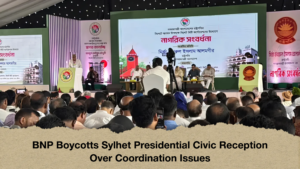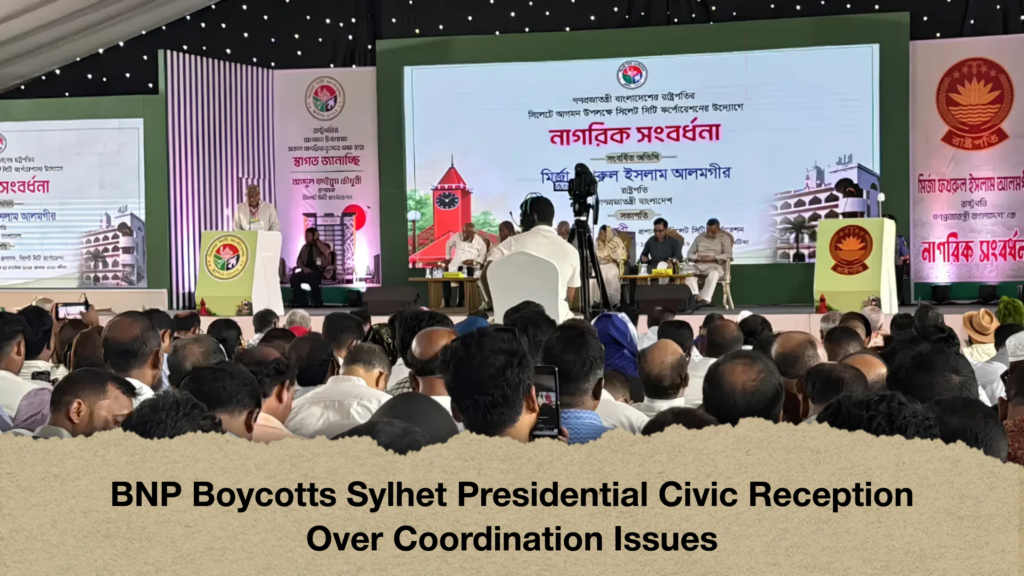
A major political friction point has emerged in Sylhet after top local and central leaders of the Bangladesh Nationalist Party (BNP), alongside several members of parliament, staged a formal boycott of a civic reception organised in honour of the president. The high-profile snub highlights simmering discontent over local administrative planning and a perceived failure to properly consult grassroots political stakeholders.
The diplomatic friction unfolded on Tuesday during the president’s inaugural single-day official visit to the northeastern division since assuming office. According to the official itinerary, the presidential visit commenced with solemn prayers and the customary pilgrimage to the revered shrines of Hazrat Shah Jalal and Hazrat Shah Paran. Following the spiritual observances, the Sylhet City Corporation (SCC) hosted a grand civic reception and public gathering to welcome the head of state.
However, the celebratory atmosphere was visibly overshadowed by the conspicuous absence of senior BNP figures and allied parliamentarians. A significant roster of influential party leaders opted out of the municipal function. Among those who boycotted the gathering were the chairperson’s adviser Dr Mohammad Enamul Haque Chowdhury, central assistant organising secretary and Sylhet Wasa Chairman Miftah Siddiqui, Member of Parliament and district BNP general secretary Advocate Imran Ahmad Chowdhury, MP Kamruzzaman Kamrul, MP Advocate Nurul Islam Nurul, Sylhet Development Authority Chairman and former metropolitan acting president Rezaউল Hasan Kayes Lodi, central assistant secretary for microfinance Freedom Fighter Abdur Razzaq, district council administrator Abul Kaher Shamim, metropolitan BNP president Nasim Hossain, general secretary Emdad Hossain Chowdhury, and Jalalabad Gas Director Md Badruzzaman Selim, alongside numerous other local cadres.
Despite the sweeping boycott of the municipal reception, BNP leaders maintained that their absence was directed strictly at the city corporation’s organisational approach rather than the head of state. Sylhet Metropolitan BNP General Secretary Emdad Hossain Chowdhury clarified that party representatives actively participated in welcoming the president at the airport and accompanied him during the sacred shrine visits, ensuring full logistical and security cooperation.
Nevertheless, critical grievances drove the collective decision to stay away from the civic venue. Local leaders lambasted the city corporation administration for unilateral decision-making, alleging that the formation of the organising committee bypassed critical consultations with community and political stakeholders. Furthermore, leaders expressed deep frustration over procedural slights, noting that while previous high-level visits by senior figures permitted official vehicles unhindered access to sacred historical sites like the Shah Jalal shrine and Shahi Eidgah ground, equivalent clearance was denied this time around, leaving several senior political figures feeling disrespected.
Echoing these sentiments, Sylhet Development Authority Chairman Rezaউল Hasan Kayes Lodi emphasised that while the president commands absolute personal and institutional respect, his conscience barred him from attending an event that omitted a vast cross-section of veteran activists. He pointed out that hundreds of grassroots loyalists who suffered severe persecution, imprisonment, and physical injuries during protracted political struggles over the past decade and a half were deliberately excluded from the invitation lists. Choosing solidarity with these sidelined comrades, he chose to skip the banquet while remaining steadfast in his loyalty to both the party and the nation.
As the presidential tour concluded with a formal farewell at Sylhet Airport, the local political landscape remains abuzz with the fallout from the boycott. While administrative officials worked to ensure tight security throughout the region, the incident has laid bare deep-seated tensions between municipal authorities and prominent political figures in one of the country’s most politically sensitive regions.