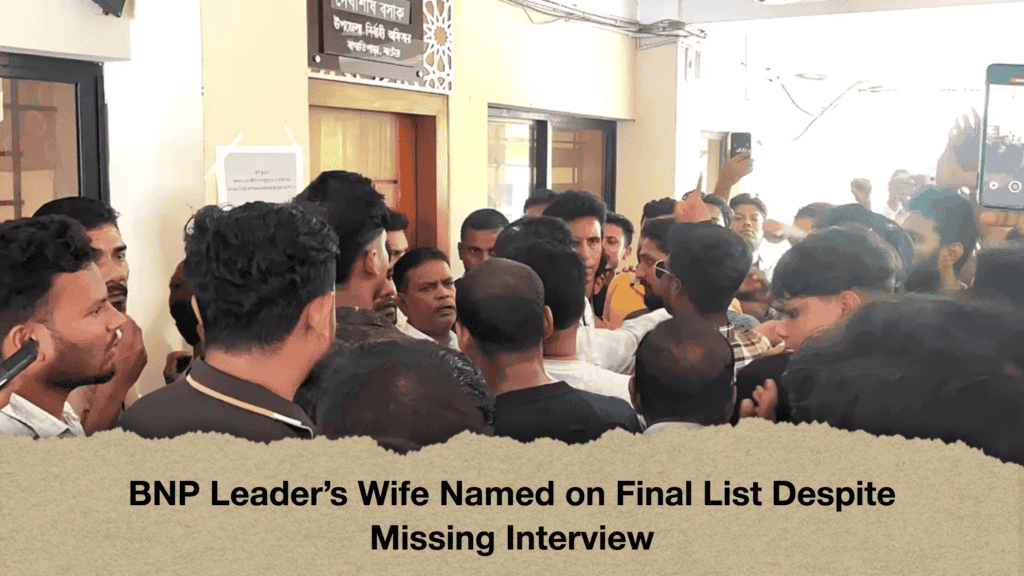
The candidate, Sonia Khatun, said she was refused permission to sit the interview because she had exceeded the prescribed age limit. Despite this, her name appeared on the final list, raising concerns about how applicants’ eligibility was checked and how the selection process was conducted.
The incident has drawn particular attention because Sonia is the wife of Touhidul Islam Janet, a former joint secretary of the Awami League’s rival Bangladesh Nationalist Party (BNP) at the Arbab Union level in Lalpur. The area falls within the electoral constituency of Social Welfare State Minister Farzana Sharmin Putul.
According to the available information, applicants for the data collector positions were required to be no older than 40. Sonia’s national identity card records her year of birth as 1984, which would make her 42 in 2026 and therefore above the stated age limit.
Sonia said she attended the venue on the day of the oral examination but was not allowed to proceed after the examiners checked her age.
“My interview was not taken because I was over the age limit. The examiner told me that an oral examination could not be conducted because I was older than 40. I was sent back without taking the interview. However, my name appeared on the final results list,” she said.
Her account has prompted questions about why a candidate who says she did not complete the interview was included in the final selection. The available information does not establish how her name came to be listed or whether the discrepancy resulted from an administrative error, a problem with the records or another cause.
Officials promise to examine the case
Contacted for comment, Lalpur Upazila Social Services Officer Masud Rana said he was unaware of the matter. He added that if an investigation established the accuracy of the claim, the issue would be reported to senior officials.
Lalpur Upazila Nirbahi Officer (UNO) Md Abir Hossain said the authorities would investigate how Sonia’s name had been included on the final list despite the reported age-limit issue and her claim that she had not been allowed to take the oral examination. Necessary action would be taken on the basis of the findings, he said.
No detailed explanation has yet been provided about the verification of Sonia’s age, the handling of her application or the records used to prepare the final list. It is also unclear whether the recruitment authorities documented her absence from the oral examination or how that matter was considered during the selection process.
Residents have questioned whether the age requirements and interview procedures were applied consistently to all applicants. The case has therefore placed renewed attention on the need for clear eligibility checks and properly documented selection decisions.
The allegations have not, by themselves, established that the recruitment process was manipulated. An examination of the application documents, identity records, interview attendance sheets and final selection records would be needed to determine why the discrepancy occurred.
Earlier unrest over recruitment results
The recruitment process has already been contentious in Lalpur and neighbouring Bagatipara, both within the electoral constituency of State Minister Farzana Sharmin Putul.
On 12 August, the announcement of recruitment results for supervisors and workers involved in the family card census triggered protests. BNP and affiliated youth and student organisation activists alleged that people associated with the Awami League had been selected for the work.
According to accounts from five eyewitnesses and two district administration officials, protesters organised a procession and gathered outside the UNO’s office in Bagatipara. The march began near the Malanchi railway crossing and was led by Sohel Rana, convener of the upazila unit of the Jatiyatabadi Chhatra Dal, the BNP’s student organisation.
The demonstrators accused the UNO of irregularities and financial misconduct in the recruitment of family card data collectors. Tensions escalated, and protesters allegedly vandalised the UNO’s office and physically harassed the UNO and several government officials.
Journalists covering the incident were also reportedly assaulted. Their mobile phones and cameras were allegedly seized, and recorded material was deleted. Police were present at the scene, but allegations were raised that they failed to intervene effectively.
The following day, the divisional commissioner of Rajshahi, the deputy commissioner of Natore and the UNOs of Lalpur and Bagatipara were transferred after a complaint was lodged with the police. The incident generated widespread debate locally and added to concerns surrounding the recruitment exercise.
Recruitment for the family card census in Natore district was subsequently suspended. The results from that process have recently been published, bringing the selection procedure back into public scrutiny.
Recruitment transparency under scrutiny
The latest case raises questions about whether the prescribed age limit and interview requirements were applied uniformly and whether the final list was prepared after all relevant records had been checked.
Data collectors play an important role in compiling information for the family card census. The credibility of the wider exercise depends, in part, on recruiting eligible personnel through a process that can be explained and verified.
The authorities’ investigation will need to establish the circumstances behind Sonia Khatun’s inclusion on the final list. Checking her application, date of birth, interview records and the documents used to approve the selected candidates could help clarify whether a procedural error occurred and whether corrective action is required.
For now, the candidate’s account and the administration’s promise of an investigation remain the principal information available. A definitive conclusion about the recruitment process will depend on the findings of that inquiry and any explanation provided by the officials responsible for preparing the final list.