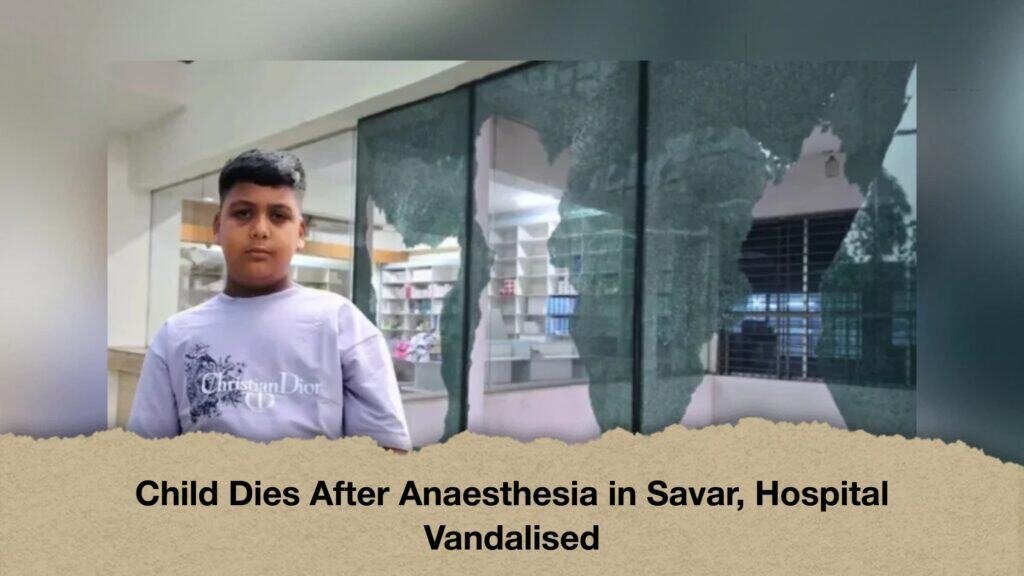
The incident occurred on Wednesday (21 October) at Abbas Specialised Hospital in the Ulail area of Savar municipality. Following the child’s death, doctors, nurses and other hospital employees reportedly left the premises, leaving several patients without medical supervision.
The deceased was identified as Abraham, 11, the son of Abdul Alim, a Bangladeshi expatriate living in Dubai. The family is originally from Singair upazila in Manikganj district.
Abraham’s mother, Kona Akter, accused the attending doctor and hospital authorities of negligence, alleging that her son had been taken for surgery without undergoing all the recommended medical examinations.
“My son was killed because of improper treatment. The operation was carried out through gross negligence without completing the necessary medical examinations. I want justice for my son’s death,” she alleged.
According to family members, Abraham had been suffering from nasal polyps and complications involving his tonsils. A few days before the incident, he was taken to Dr Md Suman Hossain at Abbas Specialised Hospital for medical consultation.
After examining the child, the doctor reportedly recommended an urgent operation and advised the family to arrange an electrocardiogram (ECG) and an echocardiogram to assess his heart condition before the procedure.
The ECG was conducted at the hospital on Tuesday. However, the echocardiogram could not be performed because the relevant doctor was unavailable.
Family members said they offered to arrange the remaining examination at another medical facility, but Dr Suman allegedly told them it was unnecessary because the ECG results were satisfactory.
An ECG records the electrical activity of the heart, while an echocardiogram uses ultrasound to assess its structure and function. The tests provide different types of clinical information, although the need for either examination before surgery depends on the patient’s medical condition and the assessment of the treating team.
Following the doctor’s instructions, Abraham’s mother brought him to the hospital at approximately 11.30 am on Wednesday.
The child was taken directly into the operating theatre shortly after arriving.
According to Kona Akter, relatives waiting outside became concerned when they noticed unusual activity among doctors and nurses approximately an hour and a half later.
Medical personnel were reportedly moving hurriedly around the operating theatre, raising fears that something had gone wrong.
The family was subsequently informed that Abraham’s condition had deteriorated critically and that he required immediate transfer to an intensive care unit (ICU).
Acting on the hospital staff’s advice, relatives rushed the child to Enam Medical College Hospital in Savar at approximately 2 pm.
However, doctors at the receiving hospital pronounced him dead after examining him.
Dr Abdul Ahad, a medical officer in the ICU at Enam Medical College Hospital, confirmed that Abraham had no detectable heartbeat when he arrived.
He said the medical team conducted the necessary examinations before informing the family that the child had died.
Regarding the circumstances surrounding the death, Dr Ahad said preliminary information suggested that Abraham’s physical condition had deteriorated rapidly shortly after anaesthetic medication was administered at Abbas Specialised Hospital.
The precise medical cause of death has not yet been established.
Anaesthesia is routinely administered during surgical procedures to prevent pain and, where necessary, render patients unconscious. Its administration requires clinical assessment and monitoring because complications can occur, although an adverse event does not in itself establish medical negligence.
In Abraham’s case, questions remain about the preoperative assessment, the sequence of events inside the operating theatre and the emergency measures taken after his condition deteriorated.
Meanwhile, news of the boy’s death triggered anger among his relatives, who gathered at Abbas Specialised Hospital and vandalised parts of the premises.
As tensions escalated, Dr Suman Hossain, hospital owner Md Abbas Uddin and other doctors, nurses and employees reportedly abandoned the facility.
Attempts to contact the hospital authorities and the accused doctor by mobile telephone were unsuccessful, as their numbers were found switched off.
Their responses to the allegations could therefore not be obtained.
The sudden absence of medical personnel also created difficulties for patients who remained admitted to the hospital.
One patient who had undergone surgery said there had been no doctors or nurses available since the afternoon incident, leaving those requiring postoperative care in a vulnerable position.
The patient expressed concern about the lack of medical supervision and uncertainty surrounding further treatment.
A security guard at the hospital said most patients and employees had left following the incident.
According to the guard, only two or three patients remained inside the facility at the time.
Savar Upazila Health and Family Planning Officer Md Fazle Bari confirmed that his office had received information about the death of a child during a surgical procedure at Abbas Specialised Hospital.
He said the authorities would investigate the incident and take appropriate action if a written complaint was submitted.
Police have also begun examining the circumstances surrounding Abraham’s death.
Sub-Inspector Fazr Ali of Savar Model Police Station said officers had conducted an inquest examination of the child’s body.
During the examination, police found no visible surgical incisions or other cut marks on the body. However, there were signs of bleeding from the nose and mouth.
According to the officer, preliminary information indicated that the child’s condition had deteriorated after he was given anaesthesia and that he died shortly afterwards.
Police visited the scene and were taking steps towards further legal action.
The absence of visible surgical incisions has raised questions about whether the planned operation had begun before the child’s condition deteriorated. However, the available information does not conclusively establish the sequence of events.
Determining what happened will require examination of the child’s medical records, the preoperative assessment, details of the anaesthetic medication administered and the clinical response to the emergency.
Although the family has accused the medical team of negligence, the exact cause of death and whether the treatment fell below accepted medical standards remain matters for investigation.
The incident has also raised concerns about the welfare of patients who were reportedly left without medical supervision after hospital staff departed.
For Abraham’s family, the immediate priority is accountability.
His mother has demanded a thorough investigation into the circumstances surrounding her son’s death and appropriate punishment for anyone found responsible.
Police and local health authorities have indicated that further action will be taken in accordance with the findings of their inquiries and the relevant legal procedures.