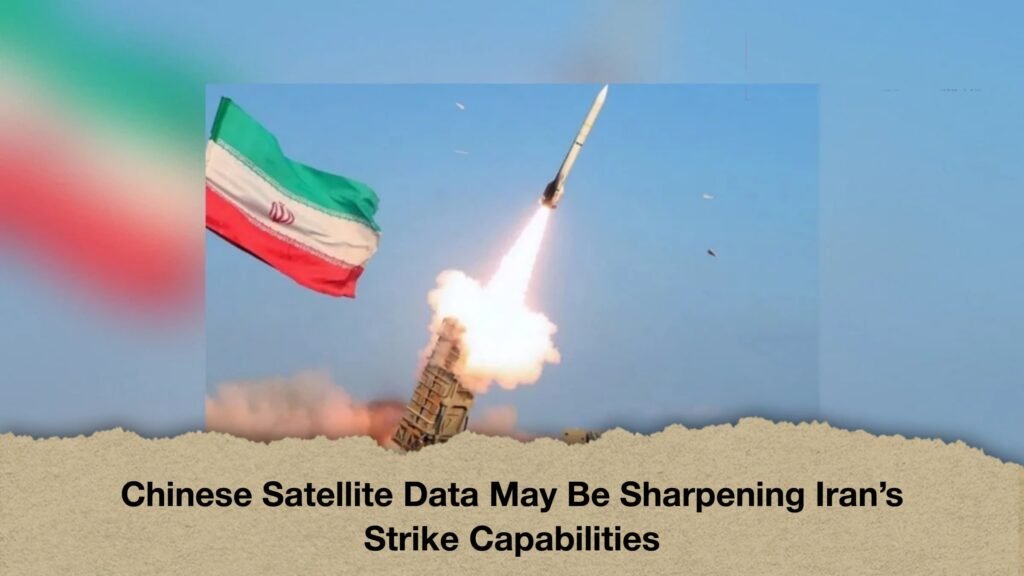
Chinese satellite imagery and intelligence reportedly supplied to Iran may be playing a significant role in improving Tehran’s ability to identify and strike military targets, according to US officials familiar with recent intelligence assessments.
The information is said to have particular significance in two areas: Iran’s ability to monitor shipping through the Strait of Hormuz and its growing capacity to conduct more precise attacks against US military positions across the Middle East.
According to four sources familiar with multiple US intelligence assessments, Iran’s ability to identify and track targets has improved markedly in recent months. US officials believe the improvement reflects a combination of external assistance and lessons learned from prolonged combat operations.
One of the most closely examined incidents was a strike on a US base in Jordan in July. American officials believe Chinese satellite imagery and geospatial information may have helped Iran determine the location and timing of the attack with a level of precision that would otherwise have been difficult to achieve. Three US service members were killed in the strike.
The alleged Chinese contribution extends beyond fixed military targets. US officials say geospatial information has also improved Iran’s ability to monitor vessels moving through the Strait of Hormuz, a vital maritime passage through which a significant share of global energy supplies travels.
Satellite imagery and drone warfare
Two US sources said Chinese-provided information may have made Iran’s relatively simple heat-seeking drones more effective.
Such drones can be difficult to control once they are airborne. Accurate information about a vessel’s position and expected movement, however, could allow Iranian forces to launch drones at a carefully chosen moment, increasing the possibility that the weapons will detect and follow the vessel’s heat signature.
US officials say Iran has also used a tactic involving the simultaneous launch of large numbers of drones. The objective is to overwhelm defensive systems and increase the chances that some of the drones will reach their intended targets.
During a recent US naval escort operation, one American official said US forces intercepted more than a dozen Iranian missiles and destroyed around 20 drones. American forces also carried out counter-strikes against roughly 60 targets around the Strait of Hormuz.
The episode illustrates the increasingly complex security environment in and around the waterway, where commercial shipping, military escorts and Iranian forces operate in close proximity.
US officials believe China is not the only external factor behind Iran’s changing capabilities. Russian assistance, Iranian technical expertise and battlefield experience accumulated during prolonged conflict are also believed to have contributed to the improvement.
How extensive is China’s role?
The precise scale of Chinese assistance remains unclear. US officials have not established publicly whether the Chinese government directly authorised the transfer of intelligence or whether Chinese companies provided information with some form of tacit approval.
There are also differing assessments within the US government about Beijing’s broader objectives.
One intelligence-linked source said recent information suggested China had an interest in preventing disruption in the Strait of Hormuz because prolonged instability there could contribute to higher global oil prices. At the same time, other US officials maintain that Chinese intelligence support has already had a tangible effect on Iran’s military tactics.
The Strait of Hormuz is particularly sensitive because of its strategic importance to international energy markets. Any sustained disruption to shipping could affect transport costs, insurance rates and global oil prices, making the waterway a longstanding focus of regional security concerns.
Missile and air-defence capabilities
US officials also claim that Chinese and Russian technical assistance has contributed to improvements in the guidance systems of Iranian missiles and drones.
Iran’s military capabilities have developed over years, including through domestic research and battlefield experience. The prolonged conflict has provided its forces with opportunities to refine targeting methods, adapt tactics and identify weaknesses in opposing air-defence systems.
Washington has taken steps to limit the flow of satellite imagery that it says could assist Iranian military operations. In May, the US administration imposed sanctions on three Chinese satellite companies, accusing them of supplying imagery that could enable Iranian attacks against American forces in the Middle East.
The dispute highlights a broader concern surrounding commercial satellite technology. High-resolution imagery that has legitimate civilian applications can also provide information of potential military value, particularly when combined with other intelligence and targeting data.
Growing pressure on US bases
As the conflict entered its seventh month, US intelligence officials said Iran was adapting its tactics to maintain pressure on American military installations and assets across the region.
An intelligence-linked source claimed Iran had been regularly shooting down MQ-9 Reaper drones, while US forces have continued to issue warnings about Iranian drone activity.
Another US source said the length of the conflict had given Iran additional time to improve its military methods and capabilities. The same source claimed Iran had also received air-defence systems from China.
Low- and medium-altitude threats are a particular concern for the United States. American forces possess sophisticated and costly systems designed to intercept high-altitude missile threats, but drones and missiles flying at lower altitudes can present different detection and interception challenges.
As a result, additional defensive systems have reportedly been deployed at some US military and diplomatic facilities in the Middle East.
The significance of the Jordan strike
Iran had already demonstrated its ability to strike US military positions in the region in January 2020, following the killing of senior Iranian commander Qassem Soleimani on the orders of then-US President Donald Trump. Iran subsequently launched ballistic missiles at a US base in Iraq.
US officials now argue that Iran’s ability to identify and hit specific targets has improved considerably since then.
A recent report by the Pentagon’s Inspector General, cited in the assessments, said Iranian attacks during the first months of the conflict damaged or destroyed hundreds of buildings and facilities at US bases in Kuwait, Bahrain, Qatar, the United Arab Emirates, Saudi Arabia, Iraq, Oman and Jordan.
The report also said US Central Command, known as CENTCOM, changed the locations of personnel, military equipment and stockpiles in response to attacks by Iran and allied armed groups.
The July attack in Jordan has attracted particular attention because some US officials believe Chinese satellite intelligence played an important role. The Wall Street Journal had previously reported a possible connection between Chinese satellite imagery and the strike.
Washington watches China-Iran ties
Beijing has not acknowledged wrongdoing in relation to the allegations. Chinese Foreign Ministry spokesman Guo Jiakun previously said China complies with its international obligations and opposes using conflicts as a basis for accusations against the country.
US Secretary of State Marco Rubio has also declined to give a direct answer when asked whether China was helping Iran identify military targets. Rubio said China’s actions had not altered the course of the US-Iran conflict and that, in some circumstances, Beijing had played a co-operative role.
A US official said the issue could be raised during a meeting between Trump and Chinese President Xi Jinping.
Washington is also concerned about the flow of so-called dual-use components from China to Iran. These are items that can serve legitimate civilian purposes but can also be incorporated into military systems.
One US official claimed that without access to Chinese components, Iran would find it difficult to sustain the same level of military activity over an extended period.
Another US official offered a more nuanced assessment, saying Iran’s efforts to rebuild its military stockpiles were consistent with earlier US intelligence assessments. The official also argued that the Trump administration’s decision to halt full-scale military operations before all intended targets had been struck gave Tehran an opportunity to rebuild parts of its military capacity.
Taken together, the US assessments point to several factors behind Iran’s improving strike capabilities: access to foreign intelligence, reported Chinese and Russian technical assistance, Iran’s own technological development and the battlefield experience gained during a prolonged conflict.
Yet a key question remains unresolved. While US officials have linked Chinese satellite imagery and other forms of intelligence to improvements in Iranian targeting, there is no publicly confirmed evidence establishing that the Chinese government directly ordered or authorised the assistance. That distinction remains central to the debate over the extent of Beijing’s involvement in Iran’s military operations.