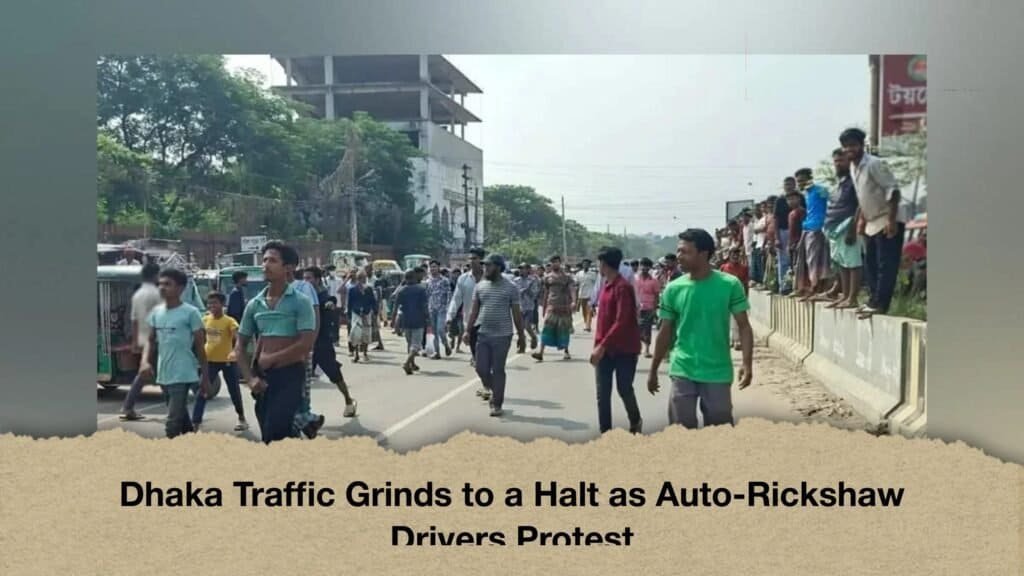
A protest by battery-powered auto-rickshaw drivers brought traffic on the Mohammadpur-Basila road in Bangladesh’s capital to a virtual standstill on Sunday, 11 October, leaving commuters stranded and disrupting movement across nearby streets.
The blockade began at around 10 am at Mohammadpur Four-Way Junction, where drivers gathered to protest against a warning that battery-powered auto-rickshaws would be stopped from operating across Dhaka within three days. The disruption caused severe congestion, affecting office-goers, workers and passengers travelling to various destinations.
With vehicles unable to move through the affected junction, many commuters found themselves stuck in traffic for extended periods. Some were unable to reach their destinations despite having urgent commitments, while congestion on surrounding roads added to the difficulties faced by people travelling through the area.
Commuters Bear the Brunt of the Blockade
The disruption was particularly frustrating for passengers travelling during the busy morning period. One commuter heading to New Market said they had been sitting in a CNG-powered auto-rickshaw for around half an hour without making any progress.
The passenger’s experience reflected the difficulties faced by many others caught in the congestion. With the road blocked, journeys that would ordinarily involve routine travel became unpredictable, leaving commuters uncertain about when they would reach their destinations.
Another passenger expressed frustration over the repeated disruption caused by road blockades linked to disputes over battery-powered auto-rickshaws. The passenger urged the government to reconsider its approach to regulating these vehicles, arguing that ordinary people should not have to suffer whenever drivers decide to block a road.
The commuter also stressed that such protests were particularly disruptive during peak hours, when people were travelling to workplaces and other essential appointments.
The incident once again highlighted how a blockade at a busy junction can affect traffic well beyond the immediate protest site. When vehicles cannot pass through a major intersection, pressure can quickly build on adjoining roads, making journeys difficult for people who have no direct involvement in the dispute.
Drivers Demand Access to Approved Routes
The protesting drivers said their demonstration was prompted by a warning from the Roads and Bridges Minister that battery-powered auto-rickshaws would be barred from operating throughout Dhaka within three days.
They argued that their principal demand was not unrestricted access to every road in the capital. Instead, they wanted to be allowed to operate without unnecessary obstacles on roads where their vehicles are permitted.
One driver taking part in the protest said they were not seeking permission to drive throughout the city. According to the driver, they respected the restrictions imposed on roads where battery-powered auto-rickshaws were not allowed to operate.
The driver maintained that the authorities should ensure that existing permissions were honoured and that vehicles could travel freely along designated routes.
The drivers’ position centres on the distinction between unrestricted citywide access and the right to operate on authorised roads. Their protest reflects concerns about the potential impact of tighter restrictions on their ability to earn a living.
However, the blockade also raised concerns about the consequences of using public roads as a means of protest. While the drivers sought to draw attention to their demands, the resulting disruption placed an immediate burden on commuters and other road users.
Balancing Drivers’ Livelihoods with Urban Mobility
The dispute illustrates the challenge facing Dhaka’s transport authorities as they seek to regulate battery-powered auto-rickshaws while maintaining orderly traffic movement. For drivers who depend on these vehicles for their income, restrictions on where they can operate may have significant economic consequences.
At the same time, busy urban roads must accommodate different types of vehicles and the daily movement of large numbers of commuters. Clear rules governing which vehicles may use particular roads are essential to maintaining order and reducing uncertainty for both drivers and passengers.
A practical response would require clear communication about authorised routes, consistent enforcement of traffic regulations and dialogue between the authorities and transport workers. Such measures could help reduce disputes over road access while ensuring that restrictions are understood and applied fairly.
The authorities also face the challenge of preventing disagreements over transport policy from escalating into road blockades that disrupt everyday life. Protest-related congestion can affect workers, students, businesses and people travelling for essential reasons, even when they have no connection to the underlying dispute.
For commuters using the Mohammadpur-Basila route, the immediate concern was the inability to travel normally. The incident underscored the need for a resolution that addresses drivers’ concerns without allowing key roads to become inaccessible.
A negotiated solution, supported by clear operating rules and effective traffic management, could help protect drivers’ livelihoods while reducing the risk of similar disruptions in the future.