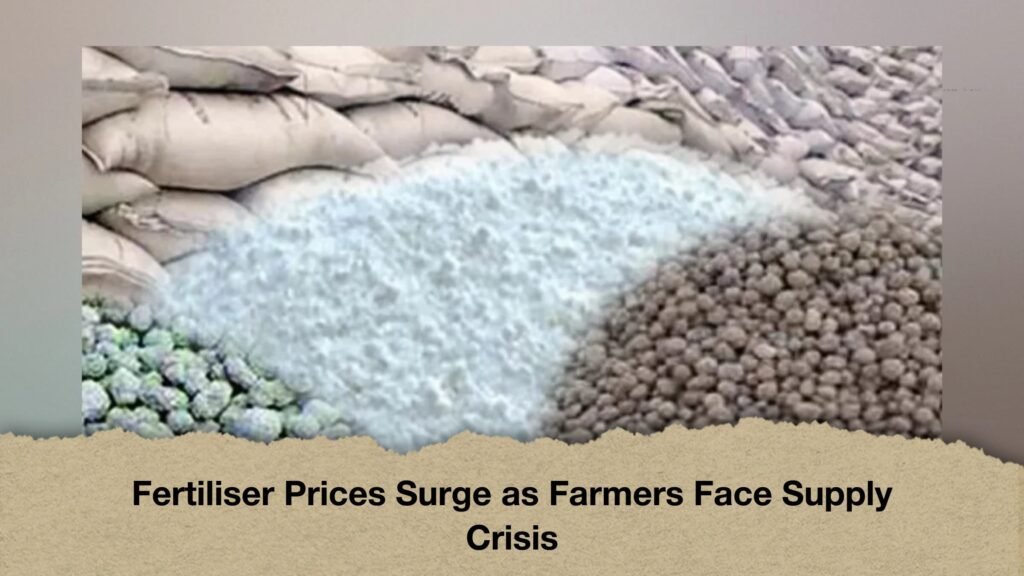
Farmers in several districts are struggling to obtain fertiliser at government-set prices as the Aman cultivation season enters a crucial stage, with complaints of excessive pricing in Joypurhat and severe shortages of TSP fertiliser in Meherpur.
In Joypurhat, where officials say supplies are available, farmers allege that dealers and retailers are charging Tk400 to Tk600 more per 50kg bag than the authorised prices. In Meherpur, meanwhile, limited allocations have intensified a shortage, particularly of triple super phosphate (TSP), leaving farmers waiting in long queues and, in some cases, receiving only a fraction of what they need.
The situation is raising concerns about higher production costs at a time when farmers are already facing increased expenses for labour and other agricultural inputs. Many fear that the additional cost of fertiliser could further reduce their returns from Aman cultivation.
Table of Contents
Joypurhat farmers pay above official rates
According to the Department of Agricultural Extension, Joypurhat has set an Aman cultivation target of 70,095 hectares this season. Around 97 per cent of the targeted land has already been planted, meaning farmers are now entering the stage when fertiliser application and field management are particularly important.
Farmers said the price difference between the government rate and the retail market is substantial.
A 50kg bag of urea, officially priced at Tk1,350, is reportedly being sold by retailers for Tk1,900 to Tk1,950. TSP, also priced at Tk1,350, is being sold for Tk1,900 to Tk2,000. DAP, whose official price is Tk1,050, is reportedly selling for Tk1,500 to Tk1,600, while MOP, also priced at Tk1,050, is being sold for around Tk1,400.
The allegations suggest that farmers are paying hundreds of taka more for essential fertilisers at a critical point in the crop cycle.
Aminur Rahman, a farmer from Awra neighbourhood in Kalai municipal town, said displaying the official price at a shop was of little use when traders were still charging more. He also alleged that some sellers were reluctant to provide fertiliser when customers asked for a receipt.
Nazrul Islam, a farmer from Hatshahar village in Khetlal, said the rising cost of fertiliser was adding to the overall expense of cultivation.
“Other farming costs have also increased, but the price of paddy has not risen accordingly,” he said.
Local traders have acknowledged that farmers’ complaints are not without basis. Shahjahan Talukdar, a fertiliser trader in Khetlal, said stronger monitoring would benefit farmers.
However, Rawnakul Islam Chowdhury, president of the district fertiliser traders’ association, said fertiliser availability was lower than demand. He maintained that dealers under the Bangladesh Chemical Industries Corporation were not charging above the official rates, while acknowledging that problems could exist in remote areas.
A K M Sadikul Islam, deputy director of the Department of Agricultural Extension in Joypurhat, said contact numbers of officials had been displayed at dealer points across the district. He said action would be taken if evidence-backed complaints of overcharging were received.
Meherpur faces acute TSP shortage
The situation in Meherpur is centred less on price alone and more on availability. The district has set an Aman cultivation target of 26,800 hectares this season, but farmers and officials say fertiliser allocations have fallen well short of requirements.
Farmers reportedly receive only around 50 to 60 per cent of the fertiliser required to meet seasonal demand for urea, MOP, TSP and DAP. TSP has emerged as the most difficult fertiliser to obtain.
At government-authorised dealer outlets, farmers have reportedly waited for hours in queues but received only 5kg to 10kg of TSP at a time. Such restricted distribution is making it difficult for farmers to apply fertiliser according to the requirements of their crops.
Asadul Islam, a farmer from Ujulpur village in Sadar upazila, said a bag of fertiliser officially priced at Tk1,350 was being offered for Tk1,800 to Tk2,000 in the local market. He alleged that prices were even higher when purchases were made on credit.
Abed Ali, a banana grower, said he needed eight bags of TSP for eight bighas of land. After spending much of the day waiting at a dealer’s outlet, he received only 10kg against one identification card.
Hafizur Rahman Hafi, president of the Meherpur district branch of the Bangladesh Fertiliser Association, said TSP was currently facing the most severe shortage. He claimed that the amount supplied was far below the allocation expected by dealers, while denying allegations of widespread overpricing.
Sanjib Mridha, deputy director of the district Department of Agricultural Extension, attributed part of the pressure to Meherpur’s intensive cropping pattern. Farmers cultivate the same land three or four times a year, he said, increasing the requirement for fertiliser.
District administrator Shilpi Rani Roy said the agriculture authorities had been instructed to take steps to address the shortage and expressed hope that the situation would improve soon.
Fertiliser consignment seized in Gangni
Amid the shortage, local residents in Gangni upazila intercepted an auto-van carrying 20 bags of fertiliser at Juginda market in Dhanakhola Union on Thursday.
A mobile court later fined the auto-van driver, Shahabul Islam, Tk1,000. Arafat Mia, additional agriculture officer of Gangni upazila, said the seized fertiliser was subsequently sold to farmers at the government-set price.
The incident has added to concerns over the movement and distribution of fertiliser during a period when farmers are already struggling to secure supplies.
Three dealers surrender licences in Kishoreganj
The difficulties are not limited to farmers and retail markets. In Itna upazila of Kishoreganj, three BCIC fertiliser dealers have surrendered their licences, citing the prospect of losses under a new policy.
Pradip Kumar Pal, Sajjad Mia and Sanjoy Saha said the required security deposit had been increased from Tk200,000 to Tk300,000. They also said the number of dealers in each union had increased while the total allocation remained unchanged.
According to the dealers, the combination of higher financial obligations and unchanged allocations would make it difficult to operate profitably.
Dr Sadikur Rahman, deputy director of the Kishoreganj Department of Agricultural Extension, said advertisements had been issued to fill the three vacant dealership positions. The deadline for applications is 31 August.
The developments in Joypurhat, Meherpur and Kishoreganj highlight different pressures within the fertiliser distribution system: farmers in one area are complaining of excessive prices despite reported availability, while those elsewhere are struggling with shortages. For Aman growers, ensuring adequate supply and enforcing official prices remain crucial as cultivation moves through a stage when timely fertiliser application can directly affect crop management and production costs.