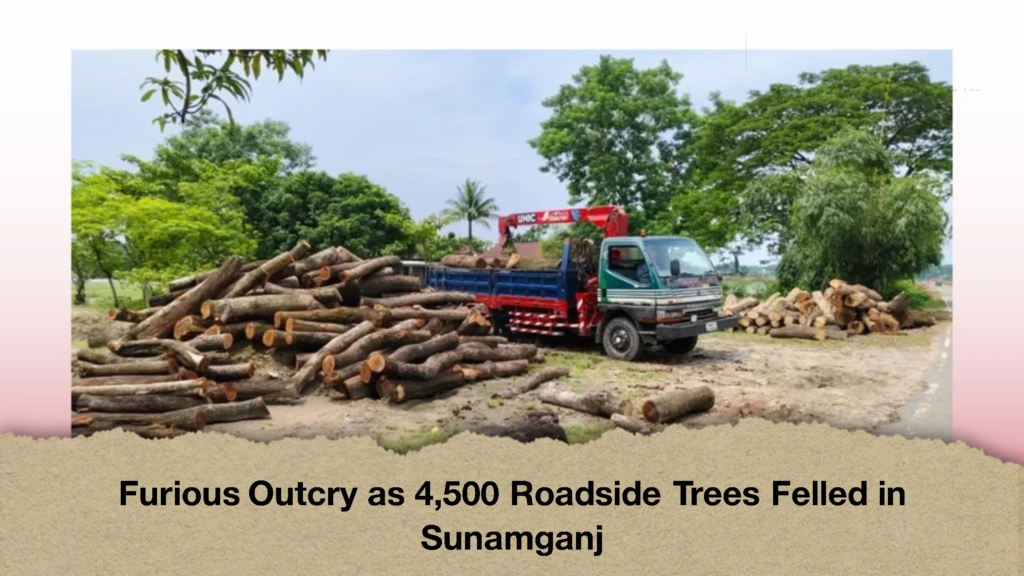
The felling of approximately 4,500 mature roadside trees along a 19-kilometre stretch of the Sunamganj-Sachna highway has triggered widespread public indignation across the north-eastern haor basin. The logging operation, initiated by the Forest Department across land managed by the Roads and Highways Department (RHD), has proceeded despite highway engineers confirming that no infrastructure expansion or road-widening project is underway to justify clearing the canopy.
The large-scale tree clearance has drawn together local residents, environmental campaigners, and civil society groups in protest. Demonstrators under the banner of the Sunamganj District Haor and River Protection Movement staged a human chain at Iccharchar on Saturday, voicing grave alarm over the ecological destruction of the wetland belt. Organisers delivered an ultimatum to local administrators, warning that they would lay siege to the district forest office unless all logging activity ceased within 24 hours.
While forestry officials insisted the logging targeted only introduced timber varieties, villagers reported that longstanding indigenous fruit-bearing and shade trees were being systematically destroyed. Manik Mia, a resident of Iccharchar village, pointed towards the fresh stump of a mature Java plum tree outside his homestead. He recounted how he had planted and nurtured the sapling on public land decades ago to provide fruit and relief from the intense summer heat for local schoolchildren and pedestrians. Despite concerted resistance from nearby families, felling contractors removed the trees regardless. Another local resident, Abul Hossain, noted that while tenders were supposedly restricted to exotic species like Acacia (akashmoni) and raintree, indigenous flora fell victim to indiscriminate cutting.
Civic leaders also raised serious questions regarding the commercial and financial terms of the operation. Movement president Raju Ahmed and general secretary Obaidul Haque revealed that 4,468 trees had been auctioned off for 8.48 million taka, an amount they described as a fraction of their genuine market value. They argued that the commercial timber alone was worth tens of millions of taka, representing a substantial loss of state revenue alongside the irreparable loss of natural canopy cover.
The trees originate from a 2004 social forestry initiative that saw nearly 20,000 saplings planted along the corridor, with local caretakers maintaining them over the past two decades. A similar attempt to harvest 3,000 trees in 2024 was aborted after public resistance. Activists highlighted a 2025 High Court directive arising from a public interest writ by Human Rights and Peace for Bangladesh (HRPB), which instructed the government to evaluate the timber value and disburse direct financial compensation to beneficiaries rather than fell the trees. The court had also stipulated that any social forestry harvesting required formal review and approval from a seven-member committee led by the Deputy Commissioner.
Administrative discrepancies have deepened local scepticism. Sunamganj District Forest Officer Riaz Uddin claimed the felling had received the requisite clearance from the district committee. In contrast, Additional Deputy Commissioner Motiur Rahman Khan stated that no such authorisation had been granted during the tenure of the current Deputy Commissioner over the past three to four months, noting that any prior records would require rigorous verification. RHD Sub-Divisional Engineer Sajedur Rahman reiterated that no road-widening works were scheduled for the corridor, adding that his office had merely received an informational copy of the auction tender.
Defending the clearance, Sylhet Divisional Forest Officer Mohammad Abdur Rahman explained that social forestry regulations mandate the harvesting of ten-year-old plantations to distribute accumulated profits among registered participants and facilitate fresh afforestation. He stated that the tender followed formal requests by beneficiaries and adhered to standard procurement rules across regional offices. Rahman maintained that non-native species would be replaced by native varieties under the Forest Conservation Act 2026, assuring that indigenous trees would be spared from further cutting. Addressing the judicial ruling on alternative financial compensation, he stated that while the policy had been discussed under the interim administration, the department had received no gazetted guidelines to suspend social forestry harvests.