“Taking up the pen in defence of truth is not merely a profession; it is a responsibility.”
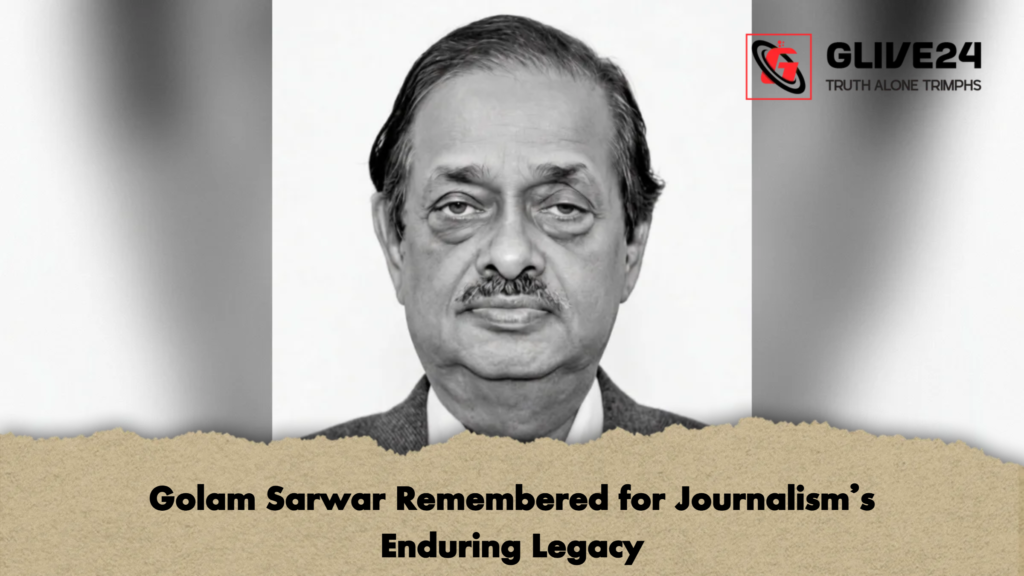
Golam Sarwar remains one of the most respected figures in the history of journalism and newspaper publishing in Bangladesh. Over a career spanning several decades, he established himself not only as an accomplished journalist, but also as an editor, essayist, columnist and influential figure in the country’s media landscape. His professional life was marked by a firm commitment to truth, editorial independence and responsible journalism.
Born on 1 April 1943 in Banaripara, Barishal, Sarwar developed an early interest in writing and literature. He later studied Bengali language and literature at the University of Dhaka, earning both undergraduate and postgraduate degrees. His academic background played an important role in shaping the clarity, elegance and intellectual depth that became characteristic of his writing.
Sarwar began his professional journalism career in 1963. Over the following years, he worked for several prominent Bangladeshi newspapers, taking on increasingly important editorial and managerial responsibilities. His ability to combine sharp news judgement with polished language helped him earn a distinctive reputation within the profession. As an editor, he was known for encouraging strong journalism while maintaining a clear sense of editorial responsibility.
The Liberation War of 1971 was a defining period in his life. Until 25 March that year, he had been performing important professional duties in the newsroom. He subsequently became directly involved in the country’s struggle for independence. After liberation, he briefly served as the headteacher of Banaripara Union Institution. Journalism, however, remained his principal vocation, and he eventually returned to the profession with renewed commitment.
His contribution extended beyond daily journalism. Sarwar was also a thoughtful writer whose works reflected his observations of society, politics, culture and human behaviour. Among his notable books are Rongin Balloon, Sompadoker Jobanbondi, Amiya Gorol, Amar Joto Kotha and Shopno Beche Thak. His writing combined analytical insight with literary quality, wit and a keen understanding of contemporary life.
His contribution to journalism was recognised with the Ekushey Padak in 2014, one of Bangladesh’s highest civilian honours. He also received lifetime achievement awards from the Cultural Journalists Forum of Bangladesh in 2016 and the Ataus Samad Memorial Trust in 2017.
Sarwar held several important positions within the media profession. He served as president of the Editors’ Council and as a senior vice-president of the National Press Club. He was also involved with the appeals division of the country’s censorship board. In August 2015, he was appointed chairman of the Press Institute of Bangladesh, further reflecting the confidence placed in his experience and professional standing.
For Sarwar, journalism was more than the production of news. It was a public duty. He believed that a journalist’s greatest strength was the pen and that its foremost obligation was to present the truth to readers with honesty and responsibility.
On 13 August 2018, Golam Sarwar died while undergoing treatment in Singapore. His death left a profound void in Bangladesh’s journalistic community. Yet his influence did not end with his passing. The institutions he served, the journalists he inspired and the body of work he left behind continue to form part of his enduring legacy.
On the anniversary of his death, Golam Sarwar is remembered with deep respect as a journalist, editor and writer who devoted much of his life to the pursuit of truth and the advancement of responsible journalism.
His voice may have fallen silent, but the values represented by his work continue to resonate. His professional legacy remains a reminder that journalism carries a responsibility far greater than simply reporting events—it must seek truth, serve society and preserve the public’s right to be informed.
Golam Sarwar is no longer with us, but the light of his pen continues to endure.
Humble tribute to a distinguished journalist, editor and writer.