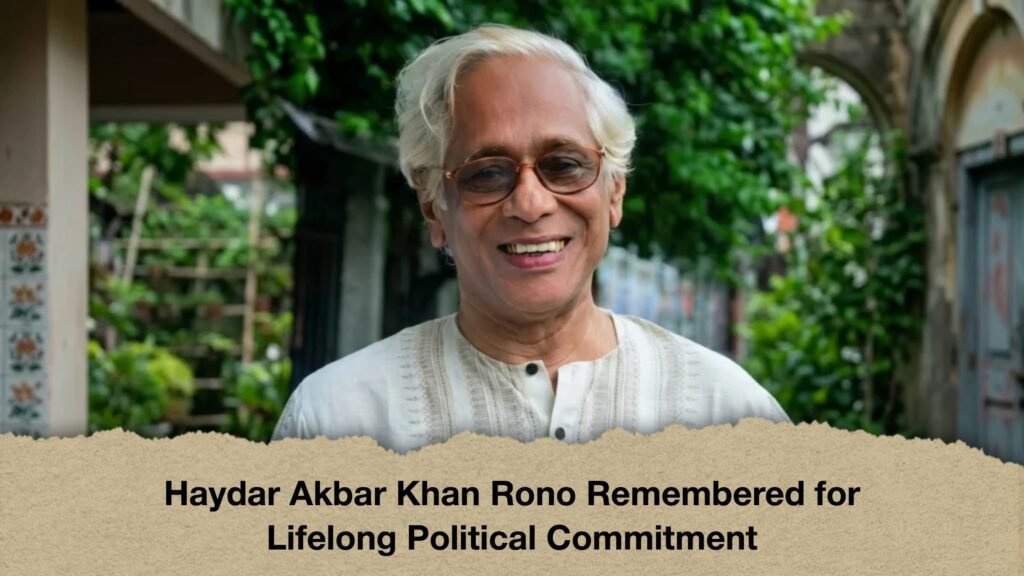
Haydar Akbar Khan Rono remains a distinctive figure in the history of Bangladesh’s left-wing politics, democratic movements and Liberation War. Across a political career spanning several decades, he established himself not only as a politician but also as an organiser, political theorist, writer and public leader. He was known for maintaining a firm commitment to his political principles and for placing questions of democracy, equality, secularism and social justice at the centre of his public life.
Born on 31 August 1942 into an established and affluent family, Rono developed an interest in politics during his student years. While studying physics at the University of Dhaka, he became secretly involved with the Communist Party. His political activities began to take shape during the early 1960s, at a time when opposition to Pakistan’s military rule was gaining momentum among students and wider sections of society.
Rono emerged as an active participant in the anti-military-rule movement of 1962. He subsequently served as general secretary of the Pakistan Students Union, taking part in efforts to organise students around issues including education, democracy, political rights and opposition to exploitation and discrimination.
As political consciousness grew in what was then East Pakistan, Rono remained involved in movements centred on the rights of ordinary people and the demand for social justice. During the Liberation War of 1971, he played an important role as an organiser and leader. His political engagement continued after Bangladesh achieved independence, with democracy, equality and people’s rights remaining central to his activism.
He was also active in the movement against military autocracy from 1982 to 1990. As opposition to military rule expanded, Rono worked as an organiser and political leader alongside forces involved in the democratic struggle. His role continued through the mass uprising of 1990, which ultimately led to the fall of the military-backed autocratic regime.
Rono served as a member of the Politburo of the Communist Party of Bangladesh and remained associated with the organisation’s political activities and principles until the end of his life. His political outlook was rooted in the pursuit of economic and social emancipation, democratic rights and a society free from exploitation and inequality.
Politics, however, was only one part of his intellectual life. Rono had a strong interest in history, philosophy, politics and social thought and devoted considerable time to writing and study. He authored and published 13 books, through which he explored political developments, historical questions and broader ideas about society. His writings added to Bangladesh’s tradition of political and intellectual literature.
Those who worked with him often remembered a sharp contrast between the intensity of his political convictions and the simplicity of his personal life. He was regarded as modest, approachable, courteous and cheerful. Despite decades spent in politics, he maintained an unassuming lifestyle and remained closely connected with colleagues, political associates and ordinary people.
His contribution to political thought, intellectual work and literature was recognised when he received the Bangla Academy Literary Award in 2021. The award marked an important recognition of his longstanding contribution to Bangla writing and intellectual life.
After a lifetime of political activity, Rono died on 10 May 2024 at the age of 81. His death brought to an end a career that had begun in the student movements of the 1960s and extended through the Liberation War, the struggle against military rule and decades of left-wing political activism in independent Bangladesh.
His political positions and ideology were shaped by a particular historical period and, like those of any long-standing political figure, may be viewed from different perspectives. Yet his sustained commitment to democracy, social equality, secularism and the rights of working and marginalised people remains a defining feature of his public life.
On his birth anniversary, Haydar Akbar Khan Rono is remembered for a life marked by political conviction, intellectual engagement and personal simplicity. His writings and political activities remain part of Bangladesh’s broader record of democratic and left-wing movements, while his career offers an example of a public figure who remained closely attached to his principles throughout a long and often turbulent political journey.