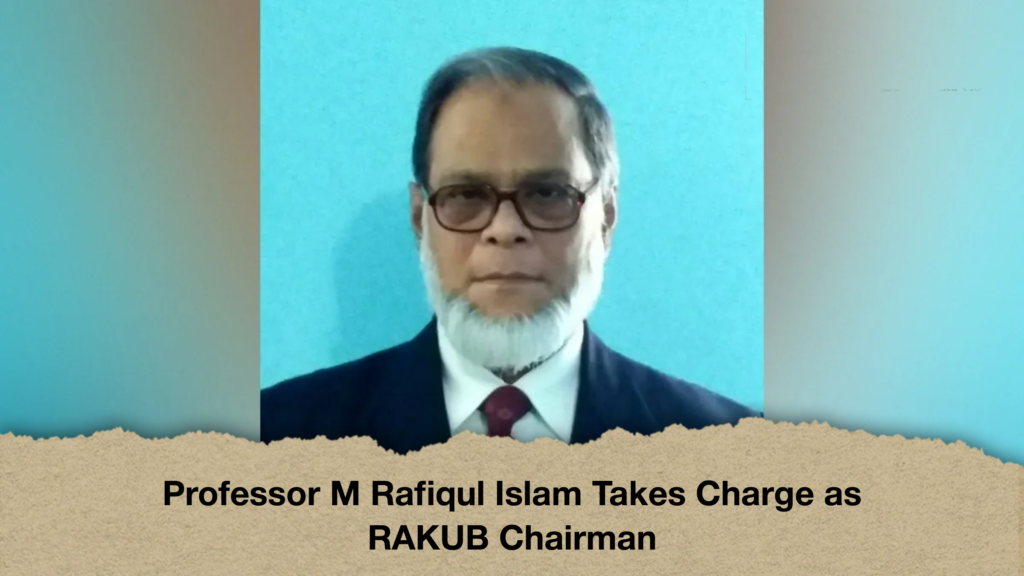
Professor M. Rafiqul Islam, a veteran freedom fighter, economist, researcher, administrator and respected academic, has taken on the responsibility of chairman of Rajshahi Krishi Unnayan Bank (RAKUB), marking a new chapter in his long professional career.
Professor Islam has spent around 35 years teaching in the Department of Economics at Rajshahi University, where he built a distinguished academic career and remained closely associated with teaching, research and intellectual activities. His extensive experience in economics and higher education has also been complemented by senior administrative responsibilities.
He served as the eighth vice-chancellor of Islamic University, Kushtia. He assumed office on 3 April 2004 and continued in the position until 10 July 2006. During his career, his work has extended beyond the classroom, bringing together academic knowledge, research experience and institutional administration.
His association with Rajshahi University’s Department of Economics has remained active even after his long teaching career. In 2026, he served as convener of the organising committee for the department’s fifth biennial alumni reunion, reflecting his continuing connection with former students, colleagues and the wider academic community.
His appointment to the chairmanship of RAKUB comes with responsibilities that extend well beyond the administration of a financial institution. The bank is a specialised institution closely connected with agriculture and the rural economy of northern Bangladesh. Its activities have particular relevance to farmers, small entrepreneurs and people whose livelihoods are linked to agriculture and rural economic activity.
For a bank serving such a large and important economic sector, leadership requires an understanding of both financial administration and the realities faced by agricultural communities. Professor Islam’s long association with economics, teaching, research and institutional administration provides a broad professional background as he begins his new responsibility.
RAKUB’s role is particularly significant in a region where agriculture remains closely tied to household incomes, employment and local economic activity. Access to appropriate financial services can affect farmers’ ability to manage production costs, invest in agricultural activities and sustain small businesses. The effectiveness of specialised financial institutions therefore has implications beyond banking itself.
Professor Islam’s appointment has prompted congratulations and goodwill from colleagues, former students and well-wishers who recognise his long career in education and public institutional leadership. His supporters have expressed the hope that his experience and knowledge will contribute to strengthening the bank’s engagement with farmers, small entrepreneurs and the wider rural economy.
As he begins his tenure, expectations will naturally centre on effective administration, sound institutional management and continued attention to the needs of the communities RAKUB serves. His new role also brings together two areas with which he has long been associated: economics and public service.
Professor M. Rafiqul Islam is being wished success in his new responsibility, along with good health, longevity and personal well-being. His appointment adds another significant public institutional responsibility to a career spanning decades of teaching, research and administration.
For RAKUB and the communities it serves, the coming period will provide an opportunity to build on its role in supporting agriculture and rural economic activity under his leadership.