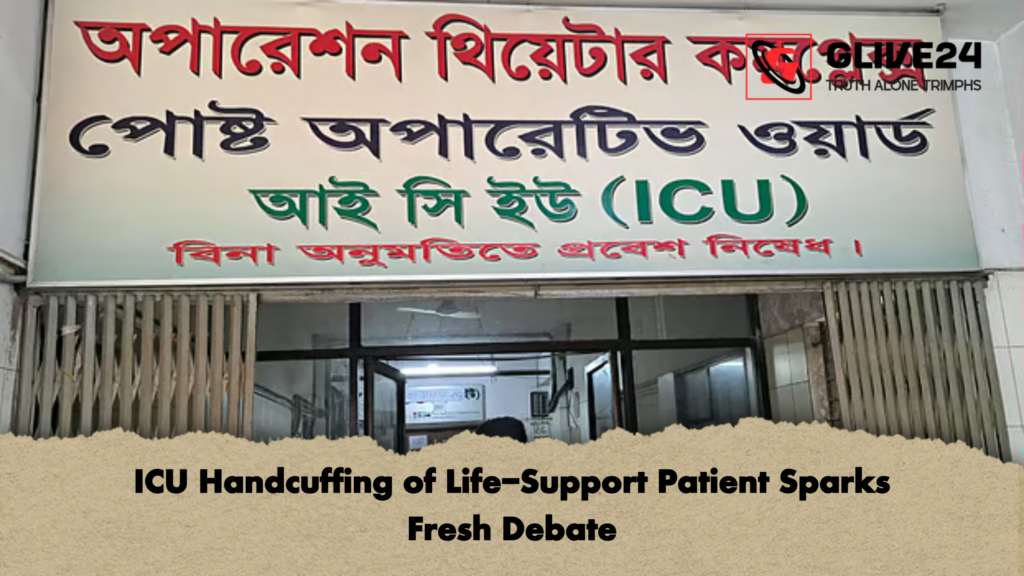
A critically ill detainee kept in handcuffs while receiving life support at the intensive care unit of Dhaka Medical College Hospital has triggered renewed questions over the treatment of prisoners and accused persons undergoing emergency medical care.
Mizanur Rahman, 48, has been in the ICU of the hospital’s Critical Care Medicine Department since 14 June. He was placed on life support two days after admission, according to his family. A photograph recently circulated on social media appears to show him lying unconscious with a thick tube inserted into his throat and another tube placed through his nose. His right hand is secured with a handcuff attached to a thick rope, while an oximeter is clipped to one of his fingers.
His wife, Salma Jahan, confirmed that the photograph was of her husband but said the family had no idea who took it or how it was circulated from inside the ICU.
She said the handcuffs remained in place for roughly a month. According to her, police officers eventually removed them last week after doctors informed the family that Rahman’s condition had deteriorated sharply. She said the family had repeatedly requested that the restraints be removed earlier, but officers had told them that they were not permitted to do so.
The issue has drawn particular attention because Rahman is reportedly in a condition that leaves him unable to move independently. Doctors treating him said he remains on life support and that his survival cannot be predicted with certainty. His condition has deteriorated several times, prompting medical staff to advise relatives to be prepared for the worst.
One doctor involved in his care said the restraints had interfered with treatment, including the placement and management of intravenous cannulas. The doctor also questioned whether the rope attached to the handcuffs had been adequately sterilised. Most significantly, the doctor argued that a patient in such a critical condition posed no realistic risk of escaping from an ICU.
Rahman is a former vice-chairman of Patuakhali Sadar Upazila Parishad and was a member of the Patuakhali district committee of the now-banned Awami League. Following the fall of the Awami League government amid the mass uprising on 5 August 2024, his family home in Patuakhali was reportedly attacked.
He is facing several criminal cases, including murder and attempted murder charges. He was arrested in Dhaka in September last year in connection with a murder case and was subsequently held at Kashimpur Central Jail in Gazipur. His lawyer, H M Sarwar Hossain, said Rahman has so far secured bail in eight cases filed in Patuakhali and Dhaka. Yet, while he was critically ill in hospital, he was also summoned in another case as a suspected accused on 23 June. A virtual hearing has now been scheduled for 30 July.
Rahman’s family says his health problems began while he was in Kashimpur prison. His wife said he became seriously ill on 9 June, but the family was not informed by prison authorities at the time. They learned of his condition through a relative of another prisoner known to the family.
He was initially admitted to Shaheed Tajuddin Ahmad Medical College Hospital in Gazipur. He was later transferred between several hospitals, including Dhaka Medical College Hospital, Shaheed Suhrawardy Medical College Hospital and the National Institute of Neurosciences and Hospital, before returning to Dhaka Medical College Hospital and being moved to the ICU.
The case has also highlighted the difficulties faced by families of critically ill detainees. Rahman’s mother, wife, sisters and other relatives have reportedly been taking turns staying outside the ICU, often sleeping on mats on the hospital floor. Rahman is the only brother among five sisters, and his family has depended heavily on him since his father died about two decades ago.
His wife has also faced legal proceedings. She was detained for around six months in connection with three cases and held at Patuakhali District Jail and Kashimpur Women’s Jail before securing bail. She is a former chairman of Kalikapur Union Parishad in Patuakhali Sadar Upazila and a former organisational secretary of the district unit of the Krishak League.
The circumstances surrounding the handcuffing have raised questions about the balance between prison security and humane medical treatment. Several police officers stationed outside the ICU reportedly said they were following orders from senior authorities and did not have the authority to remove the restraints on their own.
The Inspector General of Prisons, Brigadier General Syed Mohammad Motaher Hossain, said handcuffs are generally used to prevent an accused person from escaping or for security purposes. He said that when a detained patient is undergoing treatment in hospital and doctors object to the use of restraints, the handcuffs are normally removed.
He acknowledged, however, that the situation involving seriously ill prisoners can be complicated. Prisoners may receive treatment in different hospitals and locations, creating security concerns for the authorities responsible for their custody.
The debate over Rahman’s case therefore extends beyond one individual. It raises a broader question about how security procedures should be applied when a detainee is unconscious, immobilised or dependent on life-support equipment. While authorities have a duty to prevent escapes and maintain custody, medical professionals and rights advocates have long argued that restraints should not unnecessarily obstruct treatment or compromise a patient’s dignity.
In Rahman’s case, the central question remains whether maintaining a handcuff on a patient receiving intensive care was necessary for security, or whether it continued simply because established procedures were followed without sufficient consideration of his medical condition. The episode has once again brought the treatment of prisoners in hospitals under public scrutiny.