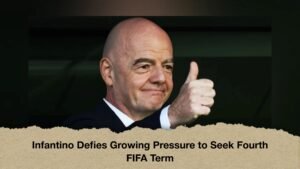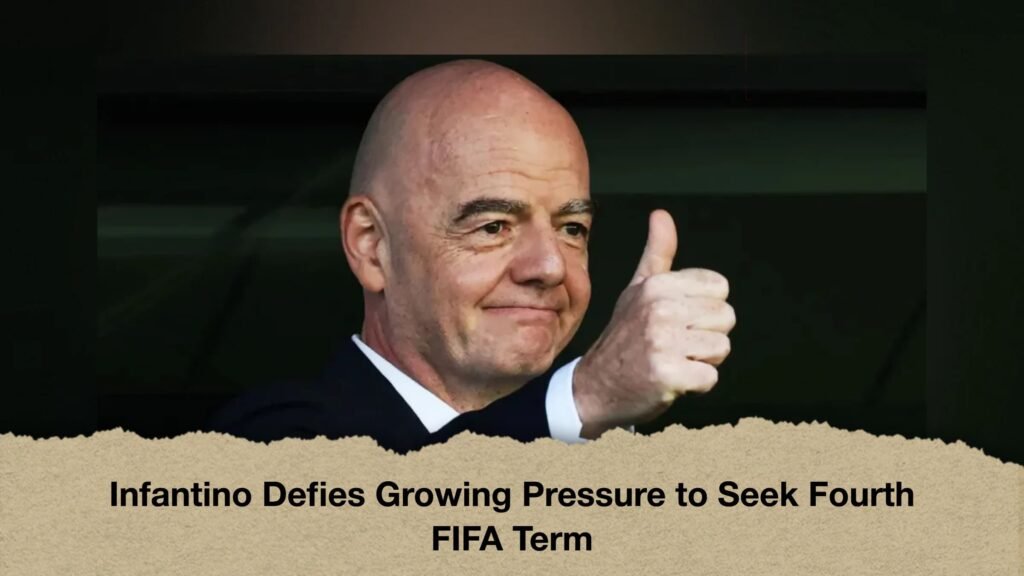
FIFA president Gianni Infantino remains determined to stand for re-election in 2027 despite mounting criticism, calls for his resignation and the prospect of legal action over the governing body’s commercial plans.
A FIFA spokesperson confirmed that Infantino has not changed his decision to contest the next presidential election. He first announced his intention to seek another term in April, and the organisation said there had been no change to that position.
The clarification came after Infantino declined to answer direct questions about his political future while attending the opening of the Under-20 Women’s World Cup in Poland. During the match between hosts Poland and Argentina in Katowice, he was seen speaking with Cezary Kulesza, president of the Polish Football Association.
Speaking to Sky News outside the stadium, Infantino said there were many issues he could discuss but that he would address them “at the right time and on the right platform”. On the day, he said, the focus should remain on enjoying football.
He also defended FIFA’s broader mission, saying the organisation was working to expand football’s opportunities, status and potential across all parts of the world and to bring people together through the sport.
However, questions surrounding his leadership have intensified. One of the main disputes concerns plans to move the commercial rights of major FIFA competitions, including the men’s and women’s World Cups and the Club World Cup, to a new affiliated entity known as FIFA Forward Enterprise, or FFE.
The proposed structure has raised concerns within European football and contributed to growing tensions between FIFA and UEFA, European football’s governing body. UEFA has applied to a federal court in the United States for access to documents as it considers possible legal action against Infantino and other FIFA officials in Switzerland.
According to the information cited in the report, UEFA’s legal move is linked to concerns surrounding the proposed transfer of commercial rights and the way FIFA intends to manage the business interests associated with its major competitions.
FIFA has strongly challenged UEFA’s request, describing it as an unjustified attempt to obtain information. In its response to the US court, FIFA argued that no formal criminal case had been filed in Switzerland or elsewhere and questioned UEFA’s legal basis for seeking internal documents.
The dispute has added to the scrutiny facing Infantino, who has remained one of the most influential figures in world football since becoming FIFA president in 2016.
His relationship with political leaders has also attracted criticism. In particular, his public closeness to former US president Donald Trump has prompted debate over FIFA’s political neutrality and the way its leadership conducts international relations.
Infantino faced widespread criticism after presenting FIFA’s first Peace Prize to Trump during the draw for the 2026 World Cup in Washington, DC, last December. Critics questioned the decision and the public association between the FIFA president and a prominent political figure.
His commercial strategy has faced similar scrutiny. Supporters of Infantino’s approach point to FIFA’s efforts to expand revenues and develop the global football calendar, while critics argue that aggressive commercial expansion could create tensions with football’s traditional structures and raise questions about governance and independence.
The question of whether Infantino is eligible to seek a fourth term is particularly significant. FIFA’s rules provide for a president to serve a maximum of three four-year terms, amounting to 12 years. Infantino, however, has argued that the period he served after being elected in 2016 should not count as a full presidential term.
He was elected after Sepp Blatter resigned and has maintained that he initially completed the remainder of Blatter’s mandate rather than beginning a full four-year term of his own. In 2022, Infantino used that interpretation to support his position that he remains eligible to seek another term.
The interpretation has been challenged by critics and human rights organisations, some of whom have called for the issue to be examined by FIFA’s Governance, Audit and Compliance Committee. They have questioned whether Infantino should be permitted to contest another election under the organisation’s term-limit rules.
The controversy comes at a significant moment for FIFA. The organisation oversees a global membership of 211 national associations, giving each member an important role in the presidential election. A candidate needs at least 106 votes to secure a majority.
The next FIFA presidential election is scheduled for 18 March 2027 in Rabat, Morocco. Candidates must formally declare their bids by 18 November this year.
For Infantino, the months ahead are therefore likely to be crucial. He has made clear that he intends to seek a fourth term, but the strength of his support among national associations and regional confederations will ultimately determine whether he can retain the presidency.
The election is also shaping up as a test of FIFA’s direction. Questions over commercial expansion, governance, political relationships and the interpretation of presidential term limits are now intertwined with Infantino’s bid to remain at the helm of world football.