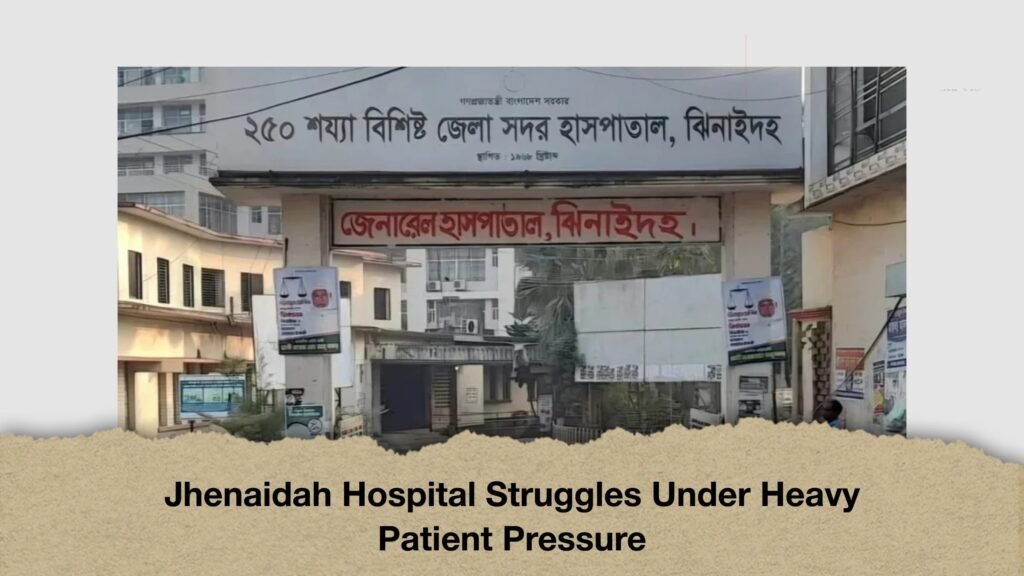
Jhenaidah 250-Bed General Hospital, the main healthcare facility for more than two million people, continues to face a serious shortage of doctors, nurses and support staff despite assurances from the health minister that the staffing problem would be addressed.
The hospital is officially equipped for 250 inpatients, yet more than 400 patients are regularly admitted. The gap between its designated capacity and the actual number of patients has placed considerable pressure on its limited workforce. Frequent power cuts, malfunctioning lifts and a lack of specialised facilities such as dialysis, a coronary care unit (CCU) and an intensive care unit (ICU) are adding to the difficulties.
According to hospital sources, 191 employees are currently working against a requirement of 268, leaving 77 posts vacant. Among the vacancies, 23 are for doctors. Only 37 doctors are currently serving at the hospital, even though there are more than 90 sanctioned doctor posts.
The shortage is not confined to medical staff. Twenty-nine posts for third-class support employees are also vacant. With fewer workers available, hospital staff are having to manage services across the outpatient department, emergency department and inpatient wards while dealing with a patient load substantially higher than the facility was designed to handle.
The hospital serves residents of all six upazilas of Jhenaidah as well as patients from neighbouring areas. Its outpatient department alone sees around 50,000 patients every month. The recent rise in the number of children suffering from measles and diarrhoeal diseases has added further pressure on an already stretched healthcare system.
A visit to different wards found patients being treated beyond the hospital’s designated capacity. In some cases, patients unable to secure beds were staying on the floor with mats and bedding. Relatives also complained that although doctors prescribe medicines, all prescribed drugs are not always available from the hospital.
Billal Hossain, a resident of Baraikhali village in Pohati Union of Sadar upazila, said patients often could not find beds after being admitted. With the wards overcrowded, some have to remain on the floor, he said. Power cuts make the situation even more difficult for patients and their relatives.
Dr Monirul Islam, an orthopaedic surgeon at the hospital, said the shortage of doctors and nurses was making it increasingly difficult to cope with the patient burden. Although there are more than 90 doctor posts, only 37 doctors are currently working, he said.
The lack of specialised treatment facilities is another major concern. The hospital does not have a dialysis centre, leaving kidney patients without access to dialysis services there. Similarly, the absence of CCU and ICU facilities means critically ill cardiac patients have to be referred elsewhere for advanced treatment.
Such referrals can be particularly challenging for seriously ill patients and their families, as they require arrangements to transfer patients to facilities capable of providing the necessary specialised care.
The hospital’s infrastructure has also come under strain. Although a new eight-storey building has been opened, the facility continues to experience operational problems. The building has two lifts, but they frequently become out of service, according to hospital sources.
Frequent power cuts have reportedly left patients and relatives trapped inside lifts on some occasions. There has also previously been an incident involving a lift falling at the hospital, raising concerns about the reliability of essential infrastructure.
Hospital Superintendent Dr Mostafizur Rahman said cleaning and beautification work had been completed. He also said that irregularities and outdated practices previously associated with the procurement and distribution of medicines had been reduced considerably.
Despite the shortage of doctors and nurses, the hospital is continuing to provide services as far as possible, he said. Increasing the workforce would allow the hospital to expand its services and respond more effectively to the growing number of patients.
On the electricity problem, Dr Rahman said the hospital’s existing power system was inadequate for its requirements, resulting in frequent load-shedding. At times, power-related problems can make surgical procedures risky, he said.
The hospital currently has one electrical phase. According to the superintendent, adding a second phase could significantly improve the electricity supply and reduce disruptions to medical services.
Dr Rahman also said the hospital authorities were working to reduce patients’ difficulties and prevent brokers from operating around the facility. He claimed that such activities had now been reduced to almost zero.
He also pointed out that a 250-bed hospital was not sufficient to meet the healthcare needs of more than two million people. Given the number of patients seeking treatment, increasing the hospital’s bed capacity is necessary, he said.
Jhenaidah Civil Surgeon Dr Md Kamruzzaman said the shortage of doctors at the 250-bed hospital was a major obstacle to improving healthcare services. The issue had been brought to the attention of the Ministry of Health, he said.
Following the health minister’s intervention, two doctors have recently been deputed to the hospital, according to the civil surgeon. Work to improve the hospital’s overall services is continuing, he added.
The additional doctors may provide some immediate support, but the broader staffing shortage remains. With 77 posts vacant and more than 400 patients regularly admitted to a hospital designed for 250, the pressure on the existing workforce remains substantial.
For Jhenaidah General Hospital, the challenge is therefore not limited to filling vacant posts. The continuing demand for inpatient and outpatient care, combined with shortages in specialised treatment and weaknesses in electricity and other infrastructure, has created a wider service-delivery problem. Addressing the staffing gap, expanding bed capacity and strengthening essential medical facilities would be necessary to reduce the burden on patients and healthcare workers.