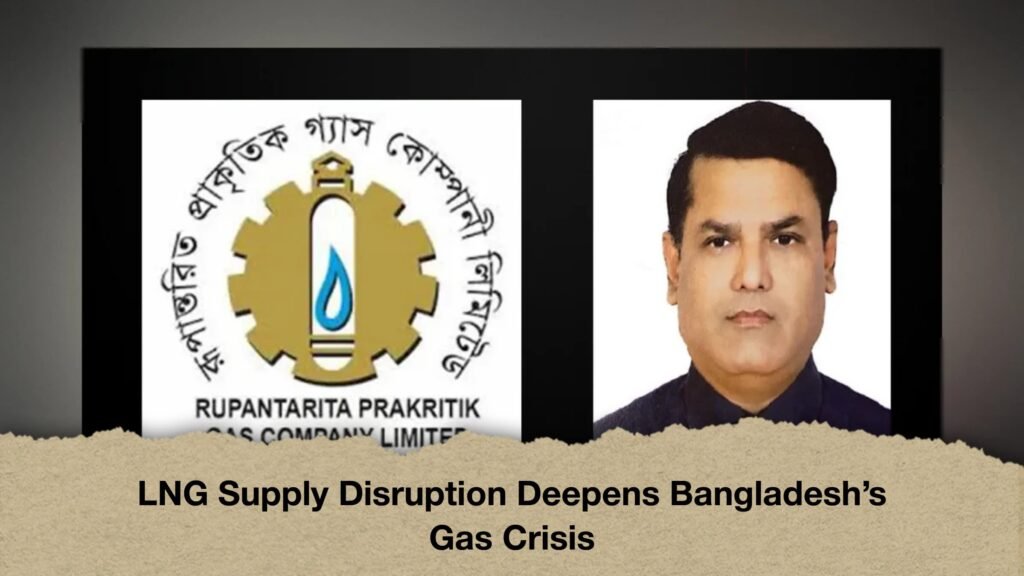
A fresh gas crisis has emerged in Bangladesh after a floating liquefied natural gas terminal was forced to shut down amid disruptions to scheduled LNG imports, with officials and industry insiders attributing the latest deterioration partly to alleged inefficiency and poor management at the state-owned Rupantarita Prakritik Gas Company Limited (RPGCL).
RPGCL, which operates under Petrobangla, is responsible for LNG procurement, unloading and oversight of the country’s floating storage and regasification units (FSRUs). According to people familiar with the situation, shortcomings in procurement and operational coordination resulted in one LNG cargo being returned, while another scheduled cargo could not be brought into the country on 17 August.
The disruption has reduced gas availability by around 550 million cubic feet per day, adding further pressure to an already strained national supply system. The impact became particularly acute from 19 August, when the FSRU operated by Excelerate Energy was reportedly shut down because of a shortage of LNG.
Those involved in the sector say the latest shortage could have been avoided with better planning and timely action. They have raised questions over RPGCL’s handling of LNG procurement and the coordination of cargo deliveries with terminal operations. Some have also called for an investigation into whether the sequence of events involved deliberate sabotage, although no such allegation has been established.
An official of Petrobangla said the two FSRUs are operated under its supervision and questioned the response following the damage to one of the terminals on 21 July. According to the official, the relevant authorities failed to provide the ministry and Petrobangla with adequate and timely information about the situation.
The official also alleged that RPGCL imported an LNG cargo from Saudi Aramco that was considered old and potentially risky. Excelerate, the United States-based company operating the affected FSRU, reportedly refused to unload the cargo, forcing the shipment to be returned. The official questioned why the cargo was procured despite concerns over its suitability.
Questions have also been raised over the appointment of an LNG supplier outside the regular contracting arrangement. According to the official, the contractor subsequently failed to deliver the required cargo, contributing to the worsening supply situation. The allegations, however, require verification through procurement documents and the relevant contractual records.
Attempts were made to obtain a response from RPGCL Managing Director Engineer Md Anwarul Islam. He did not answer phone calls and did not return them later. A message was also sent to his mobile phone, but no response was received.
The latest disruption comes against the backdrop of a broader decline in domestic gas production. Following the damage to an FSRU in a fire on 21 July, national gas supply fell to around 2,100 million cubic feet per day, triggering severe shortages across the country. Partial supply resumed on 6 August, bringing some relief, but the situation began deteriorating again from 13 August as LNG availability tightened.
The shutdown of the Excelerate Energy FSRU on 19 August has added another layer of pressure. The next LNG cargo is expected around 23 August, according to the information provided by sector sources. Until additional LNG arrives and regasification resumes, a significant improvement in supply is unlikely.
The consequences are being felt across several parts of the economy. Households in areas affected by low pressure are struggling to maintain normal cooking arrangements, while gas-dependent industries are facing difficulties operating boilers and other equipment. Power generation can also come under pressure when gas supplies to gas-fired plants are reduced.
The country’s declining domestic production makes the situation more difficult. Bangladesh once produced roughly 2,800 million cubic feet of gas a day from its own fields. Production has now fallen to around 1,626 million cubic feet a day, according to the figures cited by sector officials. Falling reserves in mature fields are contributing to the continuing decline.
Bibiyana, one of the country’s major gas fields, is a particular concern. The field once produced around 1,350 million cubic feet a day, but output had fallen to approximately 738 million cubic feet on 20 August. Despite the decline, Bibiyana still accounts for roughly 45.5 per cent of the country’s domestic gas supply, according to the figures provided. It also contributes around 68 per cent of the country’s condensate production.
The sharp fall in output from a major field highlights the structural challenge facing Bangladesh’s gas sector. As domestic production declines, the country is becoming increasingly dependent on imported LNG to bridge the supply gap. That makes the reliability of LNG procurement, shipping schedules, terminal availability and regasification capacity increasingly critical.
Against this backdrop, the latest disruption has intensified scrutiny of RPGCL’s management of LNG imports. Determining exactly why the cargoes could not be delivered as scheduled, why one shipment had to be returned and whether procurement and contracting procedures were properly followed will be crucial to establishing responsibility.
For consumers and industries, however, the immediate concern is simpler: restoring adequate gas supply. With another LNG cargo expected in the coming days, the authorities now face pressure to ensure that the shipment arrives on schedule and that the available terminal infrastructure can resume normal operations without further disruption.