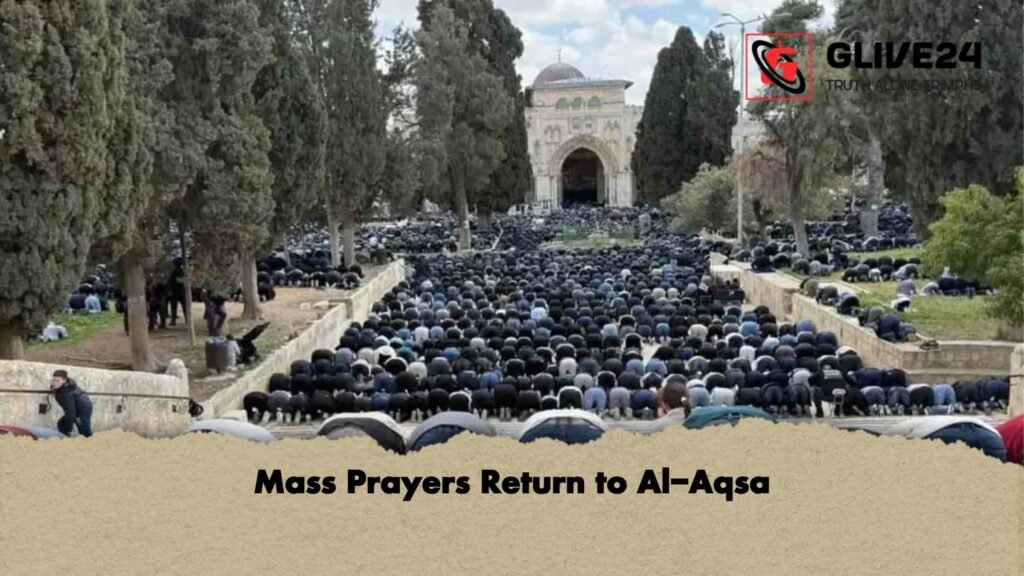
After more than five weeks of closure, the revered Al-Aqsa Mosque compound in occupied East Jerusalem has once again opened its gates to worshippers, with nearly one hundred thousand Palestinians gathering on Friday to perform congregational prayers. The reopening marks the end of a 40-day restriction period imposed amid heightened regional tensions and tightened security measures.
According to local reports, access to the holy site had been suspended since late February, following security directives issued by Israeli authorities in response to escalating regional hostilities linked to the broader Iran–Israel conflict dynamics and security concerns across the region. The restrictions also affected access to other key religious landmarks in Jerusalem.
On Wednesday, Israeli authorities announced that the Al-Aqsa Mosque and the nearby Church of the Holy Sepulchre would reopen to the public from Thursday morning, allowing worshippers to return after weeks of exclusion. The decision paved the way for the first Friday congregational prayer at the site in over a month.
From the early hours before dawn on Friday, streams of worshippers began arriving at the compound. Men, women, children, and the elderly filled the courtyards, creating scenes of both relief and emotional reunion. Many had travelled from across occupied East Jerusalem as well as other areas of historic Palestine, reflecting the deep religious and cultural significance of the site.
Volunteer-organised convoys reportedly helped facilitate access for worshippers travelling from surrounding areas, with thousands joining the flow towards Jerusalem through the night and early morning.
During the Friday sermon, the mosque’s preacher, Sheikh Mohammad Selim, urged worshippers to remain steadfast in their devotion and adherence to divine guidance. He warned against moral and communal deviation, emphasising its potential consequences for the wider society. He also made a strong appeal for economic solidarity, encouraging worshippers to support local businesses in Jerusalem’s Old City, many of which have suffered severe financial losses during the prolonged closure.
Closure Timeline
| Date | Day of Closure | Status |
|---|---|---|
| 28 February | Initial closure begins | Entry suspended |
| 6 March | 1st Friday | No congregational prayer |
| 13 March | 2nd Friday | No congregational prayer |
| 20 March | 3rd Friday | No congregational prayer |
| 27 March | 4th Friday | No congregational prayer |
| 3 April | 5th Friday | No congregational prayer |
| 10 April | 6th Friday | Reopened for prayer |
The suspension lasted for five consecutive Fridays, preventing communal prayers on 6, 13, 20, and 27 March, as well as 3 April. Worshippers were finally able to return for the sixth Friday prayer on 10 April.
This marked the first time since 1967, when East Jerusalem was occupied, that Palestinians had been unable to perform key Ramadan religious observances such as itikaf during the final ten nights, highlighting the severity of the restrictions. The reopening is therefore seen by many observers as a symbolic easing of tensions, even as underlying political and security challenges remain unresolved.
Reports from Al Jazeera and Anadolu Agency indicate that the situation at the compound remained calm during the large gathering, with worshippers gradually dispersing after prayers concluded, though emotions remained high among many attendees who expressed gratitude at being able to return.