Throughout history, a handful of people have left such a profound mark through compassion, sacrifice and service that their lives transcend national, religious and cultural boundaries. Mother Teresa was one of them. For decades, she devoted herself to people living in poverty, those suffering from serious illness, abandoned children, the homeless and those approaching the end of life. Her work, centred in Kolkata, eventually became known across the world.
Mother Teresa was born Agnes Gonxhe Bojaxhiu on 26 August 1910 in Skopje, then part of the Ottoman Empire and now the capital of North Macedonia. She was born into an ethnic Albanian Catholic family. From an early age, she was influenced by her family’s religious faith and its concern for people in need.
Agnes lost her father when she was only eight. His death created considerable hardship for the family, but her mother, Dranafile Bojaxhiu, played an important role in shaping her character. She taught her children discipline, faith and compassion towards those who were poor or vulnerable. Those lessons would later become closely connected with Agnes’s decision to dedicate her life to religious service and humanitarian work.
At the age of 18, Agnes left home on 26 September 1928 and joined the Sisters of Loreto in Ireland. It was there that she adopted the name Teresa, inspired by Saint Thérèse of Lisieux. She subsequently travelled to India, where she would spend the greater part of her life.
Mother Teresa arrived in India in 1929 and began teaching at Loreto Convent School in Kolkata. She spent many years as a teacher and eventually became the school’s headmistress. Yet the poverty she encountered beyond the school’s walls increasingly affected her. Kolkata’s crowded neighbourhoods were home to many people struggling with extreme poverty, illness and social exclusion.
A decisive moment came on 10 September 1946, while she was travelling by train to Darjeeling. Mother Teresa later described what she experienced during that journey as a spiritual calling to leave her teaching work and serve the poorest people directly. The experience became a turning point in her life.
In 1948, after receiving permission to leave the Loreto community, she began working among Kolkata’s poor. She exchanged the security of convent life for a much more demanding existence among people who often lacked basic necessities. She learned basic medical skills and began visiting poor neighbourhoods, caring for people who had little access to support.
Her work gradually expanded. On 7 October 1950, she established the Missionaries of Charity in Kolkata. What began with a small group of women eventually developed into an international organisation serving vulnerable people in numerous countries. Its work included caring for abandoned children, people with serious illnesses, the homeless, leprosy patients and those nearing death.
One of the best-known centres associated with her work was Nirmal Hriday, or the Home for the Dying, in Kolkata. The facility provided care for people who were terminally ill and often had nowhere else to go. Mother Teresa emphasised the importance of companionship and dignity, particularly for people who had been neglected or abandoned.
Her bond with India also became permanent. She became an Indian citizen on 21 December 1948, and Kolkata remained the principal centre of her work for the rest of her life. The city would eventually become inseparable from her public identity and humanitarian mission.
Mother Teresa received numerous international honours for her work. Among them were the Ramon Magsaysay Award in 1962, the Templeton Prize in 1973 and the Nobel Peace Prize in 1979. In 1980, she received the Bharat Ratna, India’s highest civilian honour.
The Nobel Peace Prize brought worldwide attention to her work and her advocacy for the poor. Yet recognition and awards were not the central focus of her mission. Her daily work remained rooted in practical acts of care: feeding hungry people, tending to the sick, providing shelter for abandoned children and offering companionship to those facing death.
Her approach was strongly shaped by her Catholic faith. She believed that service to vulnerable people was an expression of love and religious devotion. Her charitable work reached people from different backgrounds, and she became internationally recognised for placing the needs of the poor at the centre of her public life.
Mother Teresa’s legacy, however, has not been free from controversy. Her organisation and some aspects of its methods and standards have faced criticism over the years, including questions concerning the quality of medical care and the use of donations. Her religious views and approach to suffering have also been debated. These criticisms form part of the wider historical discussion surrounding her work and legacy.
Despite such debates, her influence on humanitarian activity remains substantial. She helped bring global attention to people living at the margins of society and made service to the destitute a defining feature of her public life.
Her final years were marked by declining health, but she continued to remain associated with the Missionaries of Charity. Mother Teresa died on 5 September 1997 at the Missionaries of Charity’s headquarters, known as Mother House, in Kolkata. She was 87.
Her death marked the end of an extraordinary life, but not of the organisation or the humanitarian tradition she had established. In 2016, Pope Francis declared her a saint of the Catholic Church. She is now formally known as Saint Teresa of Calcutta.
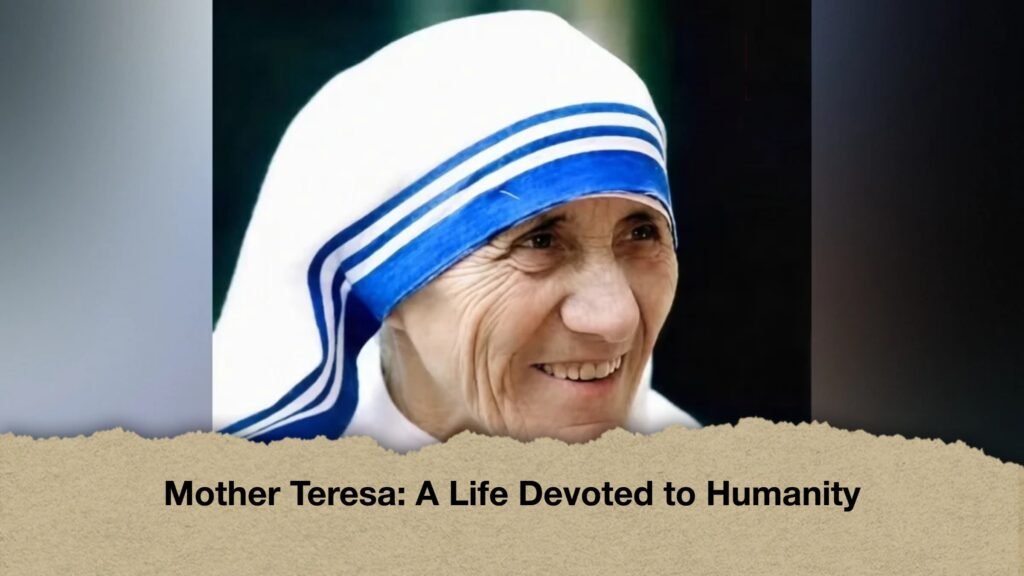
Mother Teresa’s simple white sari with its blue border became an instantly recognisable symbol of her work. For millions around the world, the image represents a life spent among people who were poor, sick and abandoned.
Her legacy is complex, combining religious conviction, humanitarian service, global recognition and continuing debate. Yet the central feature of her life remains clear: she chose to devote herself to people who had very little and who were often overlooked by society.
Mother Teresa did not seek a life of personal comfort or wealth. Instead, she built her identity around service. Her work in Kolkata grew into an international humanitarian movement, while her name became closely associated with compassion for the most vulnerable.
More than two decades after her death, Mother Teresa remains one of the most recognisable figures in the history of modern humanitarian service. Her life continues to prompt discussion about poverty, dignity, faith and the responsibility of individuals towards those in need.
Her memory remains closely linked with Kolkata and with the countless people she sought to serve. For many, Mother Teresa’s greatest legacy is the simple principle that no person should be ignored simply because they are poor, sick, abandoned or nearing the end of life.