
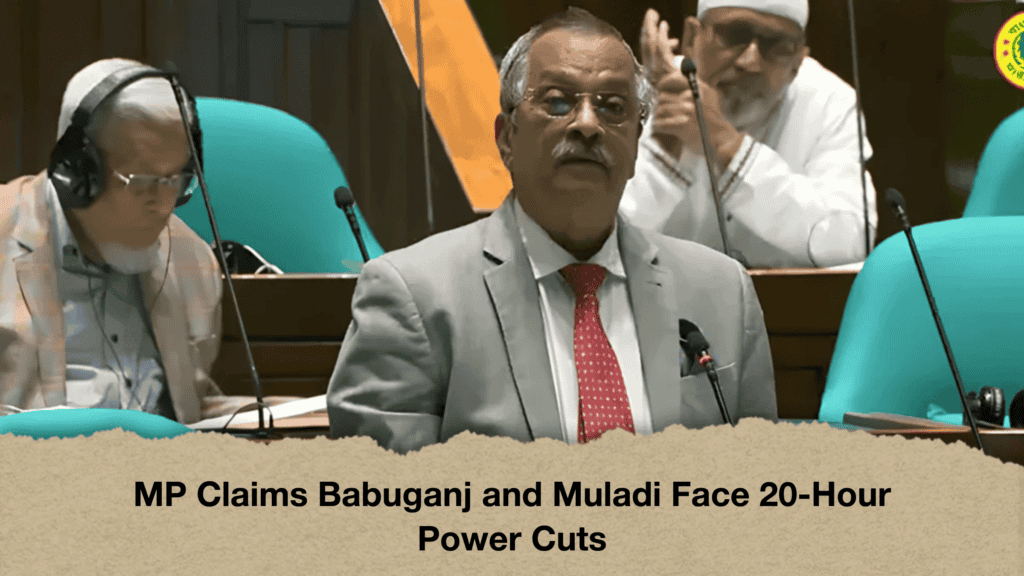
A Bangladesh Nationalist Party (BNP) MP has raised concerns in Parliament over severe electricity shortages in his constituency, claiming that residents of Babuganj and Muladi in Barishal district are without power for around 20 hours a day.
Advocate Zainul Abedin, MP for Barishal-3, made the allegation during Thursday’s question-and-answer session in Parliament. He asked the minister concerned to specify when construction of a high-capacity grid substation would begin and when it could be completed to ease the hardship faced by people in the two upazilas.
Abedin said uninterrupted electricity had been one of the elected government’s major election commitments. Voters had been promised a reliable supply, with the assurance that continuous electricity would be ensured if the party came to power. However, he argued, the situation in Babuganj and Muladi was far removed from that pledge, with power reportedly available for only about four hours over a 24-hour period.
Referring to an earlier response from the minister, the MP said the government had mentioned plans to take an initiative to construct a 132/33 kV grid substation. He questioned whether a facility of that capacity would be sufficient to address the scale of the problem.
Abedin called for an initiative to establish a grid substation with a capacity of at least 140 or 144 kV, arguing that a more substantial infrastructure solution was needed to improve electricity supply in the area. He also sought a clear indication of when the proposed construction work would start and how long implementation would take.
The complaint highlights the gap between commitments to reliable electricity and the experience of residents in the two upazilas. Prolonged power cuts can disrupt household activities, education, business operations and services that depend on a steady electricity supply. Small businesses may struggle to maintain normal operations, while students and people working from home can face difficulties when electricity is unavailable for extended periods.
Agriculture and local economic activities also rely on dependable power, particularly where irrigation, storage and processing facilities require electricity. For communities outside major urban centres, persistent interruptions can therefore affect both daily life and economic productivity.
A grid substation helps receive and distribute electricity through the power network. Its capacity, location and connection to transmission and distribution lines are important factors in determining whether it can meet local demand. The effectiveness of any proposed project would consequently depend not only on the substation’s specifications but also on the wider network serving the area.
The minister’s earlier reference to a 132/33 kV facility and Abedin’s call for a higher-capacity installation indicate that the technical requirements remain a key issue in the parliamentary discussion. However, the information provided does not establish whether the government has accepted his proposed capacity or set a construction schedule.
Residents of Babuganj and Muladi are therefore awaiting a clear plan to address the reported shortages. The timing, technical design and implementation of any new grid infrastructure will be crucial in determining whether the situation improves and the government’s commitment to a reliable electricity supply can be realised in the constituency.