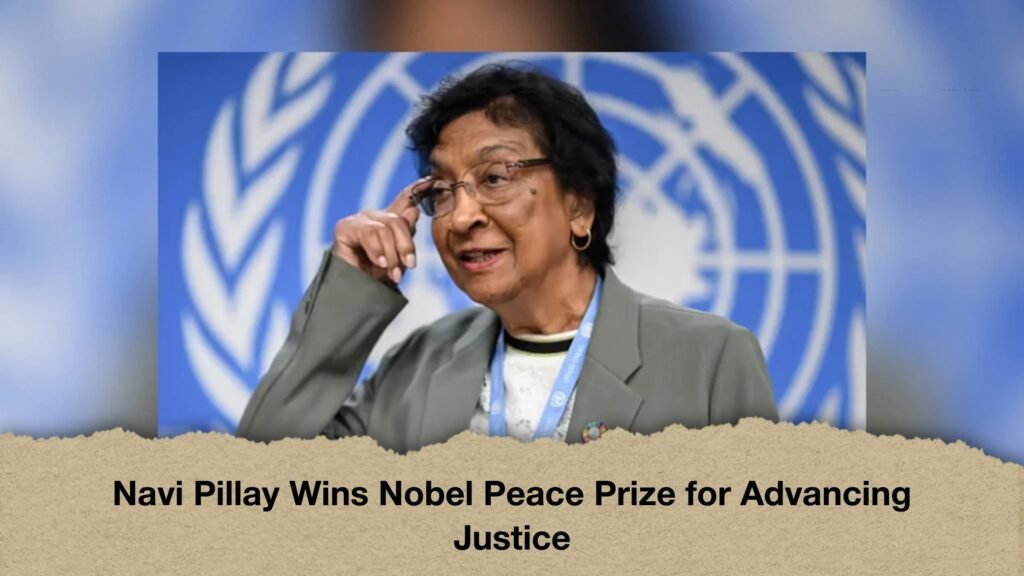
South African human rights lawyer Navi Pillay has been awarded the Nobel Peace Prize in recognition of her longstanding efforts to promote peace, protect human rights and strengthen international law.
The Norwegian Nobel Committee announced the award on Friday in Oslo, highlighting Pillay’s contribution to bringing perpetrators of war crimes, crimes against humanity and genocide to justice. Committee chairman Jørgen Watne Frydnes said she had played an important role in ensuring that serious international crimes were brought before judicial bodies.
The committee also recognised her judicial determination, personal integrity and courage, describing her contribution to the development of international law and justice as a significant part of her professional legacy.
Pillay has spent decades working across national and international legal institutions. Her career has taken her from defending people affected by racial discrimination in South Africa to serving on international criminal tribunals and holding senior positions within the United Nations. Her work has consistently focused on accountability for serious human rights violations and the principle that no individual should be beyond the reach of the law.
From apartheid-era South Africa to the international stage
Born in 1941 in Durban, South Africa, to a family of Tamil Indian descent, Pillay grew up during a period when racial discrimination was deeply entrenched in the country’s political and legal systems.
After studying law, she began representing people involved in the struggle against apartheid, the system of institutionalised racial segregation and discrimination imposed by the South African government. In 1967, she established her own legal practice in Durban, taking on cases that reflected the inequalities and restrictions faced by people challenging the system.
Pillay later continued her education at Harvard University in the United States, earning a doctorate in law in 1988. Her experience as a lawyer in apartheid-era South Africa helped shape her commitment to equality, the rule of law and the protection of fundamental rights.
In 1995, she was appointed to South Africa’s High Court, marking a major step in her judicial career. Four years later, she joined the International Criminal Tribunal for Rwanda as a judge and subsequently served as its president.
A significant contribution to international criminal law
Pillay’s work at the Rwanda tribunal became one of the most important chapters of her career. The tribunal was established to prosecute those responsible for the 1994 genocide in Rwanda and other serious violations of international humanitarian law.
During the proceedings, she contributed to the development of legal principles concerning sexual violence, rape and the role of hate speech in mass atrocities. The tribunal helped establish that rape and other forms of sexual violence could constitute crimes against humanity and acts of genocide, depending on the circumstances and evidence.
These developments were significant because sexual violence had often been overlooked or inadequately addressed in the prosecution of conflict-related crimes. Recognising such acts within international criminal law strengthened the basis for holding perpetrators accountable and acknowledged the experiences of victims.
The tribunal also examined how incitement and the deliberate promotion of hatred could contribute to genocide. Its proceedings helped clarify the circumstances in which individuals could face criminal responsibility for encouraging or facilitating mass violence.
The wider significance of this work extended beyond individual convictions. It helped establish legal precedents that would inform subsequent efforts to investigate and prosecute grave international crimes.
Leadership at the United Nations and international courts
Following her work at the Rwanda tribunal, Pillay served as a judge at the International Criminal Court, which deals with cases involving individuals accused of genocide, crimes against humanity, war crimes and, under specified conditions, the crime of aggression.
From 2008 to 2014, she served as the United Nations High Commissioner for Human Rights. In that role, she helped lead international efforts to promote fundamental freedoms, address discrimination and draw attention to human rights violations around the world.
The position placed her at the centre of international discussions on armed conflict, civil liberties, minority rights and state accountability. Her legal background and judicial experience were particularly relevant to the challenge of ensuring that international human rights standards were respected in different political and social contexts.
In 2019, Pillay also served as an ad hoc judge at the International Court of Justice in proceedings concerning allegations of genocide against Myanmar. The case brought international attention to the legal obligations of states under the Genocide Convention and the mechanisms available for addressing allegations of mass atrocities.
Between 2021 and 2025, she chaired the United Nations Independent International Commission of Inquiry concerning the Occupied Palestinian Territory. The commission’s work formed part of wider international efforts to examine alleged violations and assess compliance with international law.
Recognition of a career devoted to human rights
Pillay’s career reflects the growing importance of international legal institutions in addressing serious crimes that extend beyond national borders. Her work has ranged from defending people facing racial discrimination to helping establish legal standards for the prosecution of genocide and sexual violence.
Bringing perpetrators of international crimes to justice remains difficult. Investigations can be complicated by political pressure, limited access to evidence and challenges in securing the cooperation of governments. International courts and tribunals seek to address these obstacles by providing legal mechanisms through which allegations can be investigated and responsibility determined.
Pillay’s contribution to these efforts has been closely associated with the principle of accountability. Her work has helped advance the argument that serious violations must be addressed through impartial legal processes and that victims should not be denied justice because of the scale or political sensitivity of the crimes involved.
The Nobel Peace Prize recognises her contribution to peace and international law while drawing attention to the wider role of human rights defenders, judges and legal institutions in protecting vulnerable communities.
Her professional journey, from a legal practice in Durban to senior international judicial and human rights positions, illustrates how sustained legal work can contribute to the pursuit of justice. It also underscores the importance of independent institutions in confronting discrimination, investigating atrocities and upholding the principle that serious crimes must not go unanswered.