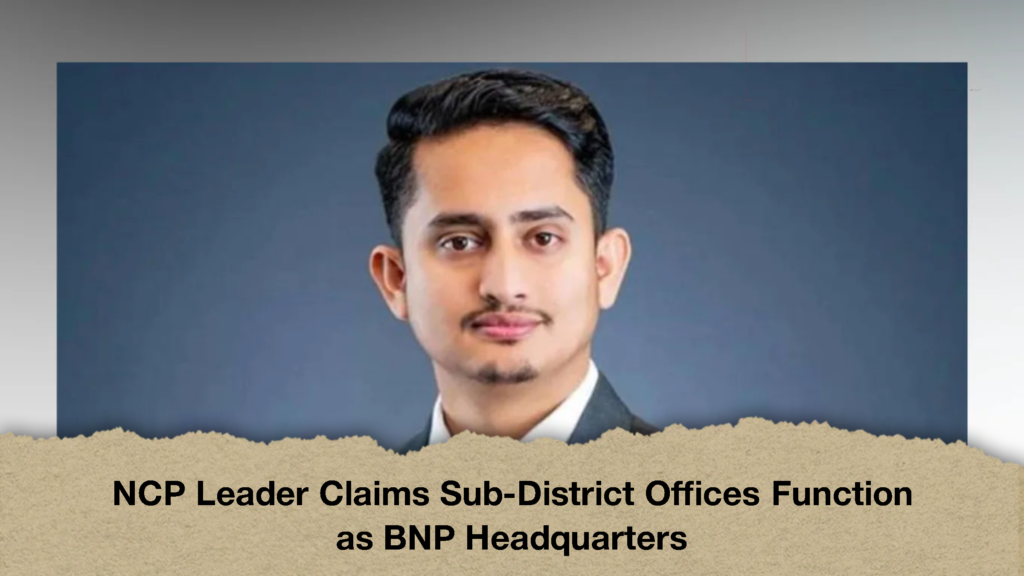
Local administrative bodies across Bangladesh’s northern territories are facing intense accusations of political capture, following sharp criticisms levelled by Sarjis Alam, Chief Organiser for the Northern Region of the National Citizen Party (NCP). In a scathing public statement released via his verified Facebook page on Monday night, 17 August, the prominent political figure asserted that Upazila Nirbahi Officer (UNO) complexes have effectively been transformed into secondary party branches for the Bangladesh Nationalist Party (BNP).
The provocative remarks swiftly went viral across digital platforms, sparking intense debate regarding the independence and neutrality of public sector employees. Within hours of publication, the post amassed over 46,000 likes alongside tens of thousands of comments and shares, reflecting growing public anxiety over grassroots governance.
The Upazila Nirbahi Officer serves as the chief executive administrator for a sub-district, acting as the vital link between central government ministries and local implementation. Responsible for coordinating public development projects, maintaining law and order, managing revenue collection, and facilitating regional electoral logistics, the administrative position strictly demands complete political neutrality. Allegations suggesting that civil service headquarters are operating under partisan direction strike at the core of public confidence in state institutions.
Formed in the wake of recent countrywide political shifts, the National Citizen Party has sought to establish itself as a resolute campaign group opposing institutional bias, bureaucratic corruption, and systemic mismanagement. Mr Alam, who holds a central leadership role within the party’s northern organisation, has repeatedly voiced concerns regarding public sector integrity, maintaining that genuine structural reform requires the total separation of local civil services from political patronage.
Political analysts and civil society groups observe that political interference in local governance has historically posed a significant challenge within the administrative framework. Local political factions have routinely sought leverage over sub-district administrators to influence development allocations, law enforcement actions, and resource distribution. Mr Alam’s commentary reflects wider concerns amongst emerging political platforms that established political parties continue to exercise disproportionate influence over nominally non-partisan public bodies.
Neither senior leadership from the Bangladesh Nationalist Party nor government administrative representatives have issued a formal response to the claims. As public debate continues to expand, the controversy highlights the persistent challenges facing Bangladesh in securing an impartial, transparent, and fully autonomous public administration.