In an unprecedented departure from decades of established parliamentary practice, Bangladesh is preparing to conduct its first contested presidential election in 35 years. On Thursday, 20 August, lawmakers will assemble inside the Jatiya Sangshad Bhaban to cast their votes under an open ballot system. Chief Election Commissioner AMM Nasir Uddin outlined the final legal and operational framework during a press briefing on Wednesday, confirming that every ballot cast will be completely visible to parliamentarians and observers throughout the proceedings.
Table of Contents
High Stakes and Open Voting Dynamics
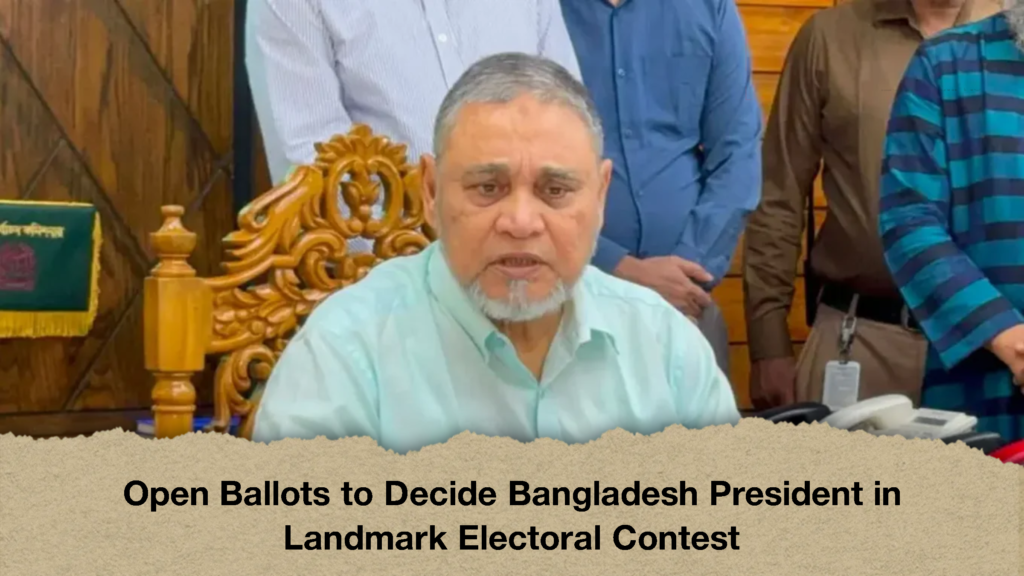
Breaking with the conventional precedent of senior commission secretaries addressing the media, Chief Election Commissioner AMM Nasir Uddin personally presented the operational roadmap for the vote. Under statutory provisions governing the state’s highest office, the Chief Election Commissioner acts directly as the Returning Officer for presidential elections, prompting his personal appearance to clarify the logistics of this historical milestone.
Unlike standard parliamentary polls, where secrecy is strictly maintained, lawmakers will mark their voting slips in full view of their colleagues within the chamber. Each ballot paper will explicitly feature the voter’s identity alongside their selected candidate. Rather than following traditional geographical constituency arrangements—which run sequentially from Panchagarh-1 to Bandarban across 300 seats—the voting sequence will adhere to official parliamentary seat division numbers. Following recent administrative updates and a vacancy in the Chittagong-4 seat, the final electoral roll stands at 349 eligible voting members.
Candidates, Nominations, and Political Alignment
The presidential seat became vacant on 24 July following the official resignation of former President Mohammed Shahabuddin, which was formally gazetted by the Cabinet Division on the same day. Under Article 48(1) of the Constitution of Bangladesh, Members of Parliament serve as the exclusive electoral college for choosing the head of state.
When nominations closed on 13 August, three filings were received by the commission. The 11-Party Opposition Alliance submitted two sets of nomination papers proposing Liberal Democratic Party (LDP) chairman Colonel (retd) Oli Ahmad. Meanwhile, the ruling Bangladesh Nationalist Party (BNP) nominated its veteran leader and former secretary general, Mirza Fakhrul Islam Alamgir. Following thorough scrutiny on 16 August, parliamentary officials verified all proposer and seconder signatures against the official oath registers, declaring all three submissions valid. One duplicate nomination for Dr Oli Ahmad was subsequently retired, establishing a direct head-to-head contest between the two political figures. Neither candidate withdrew prior to the 18 August deadline.
Voting is scheduled to take place between 2:00 PM and 5:00 PM inside the national parliament chamber. The electorate consists of high-profile state figures, including the President, the Prime Minister, the Speaker, the Leader of the Opposition, and sitting lawmakers.
Transparency, Operational Integrity, and Historical Context
Vote counting will commence immediately after the polls close at 5:00 PM, with the Chief Election Commissioner slated to declare the final results directly from the floor of the house. To maintain public trust and complete transparency, state broadcaster Bangladesh Television (BTV) will broadcast live footage of the voting process for key figures, as well as the subsequent tallying.
Addressing queries regarding state expenditure, the Chief Election Commissioner dismissed reports of inflated operational budgets, clarifying that official costs have been strictly limited to essential stationery and ballot paper printing. He further emphasized that electioneering inside the parliamentary chamber remains strictly prohibited, with parliamentary security maintaining order under the direct supervision of the Speaker.
This landmark contest represents the first multi-candidate presidential vote under a parliamentary framework in Bangladesh since 1991. Occurring amidst a broader period of constitutional reorientation, the election is viewed by political observers as a defining moment in strengthening democratic accountability and institutional transition across the nation.
Election Information and Official Resources
For real-time coverage, official commission statements, and complete legislative records regarding parliamentary proceedings, voters and observers can monitor the following public channels:
-
Access administrative announcements and regulatory updates directly via the Bangladesh Election Commission Portal.
-
Follow official legislative records and parliamentary procedures through the Jatiya Sangshad Official Site.
-
Stream verified live broadcasts of the parliamentary session and vote counting on Bangladesh Television (BTV).