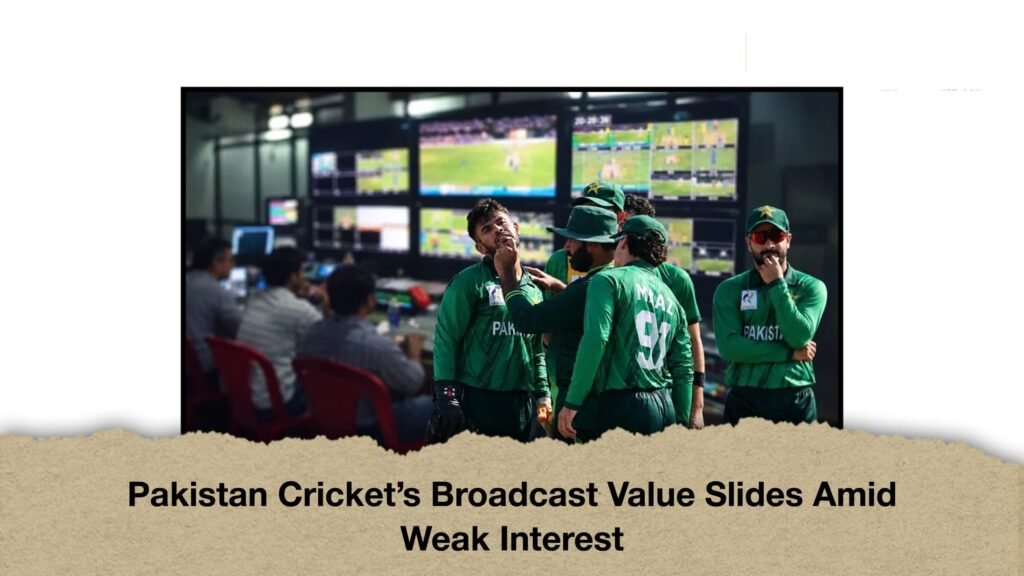
Pakistan’s recent struggles on the cricket field have begun to affect the commercial value of its home fixtures, with the latest tender for international broadcasting rights ending well below the Pakistan Cricket Board’s expectations.
The PCB had set a reserve price of 600 million Pakistani rupees for the broadcasting rights to a package of 25 home international matches. However, the rights were ultimately sold for 350 million rupees to state-owned broadcaster PTV, leaving the board 250 million rupees short of its initial valuation.
According to reports by The Express Tribune and Express Urdu, PTV was the only organisation to show interest in the tender. The absence of competing bidders meant there was little scope for the PCB to push the price upwards, and the board eventually accepted an offer substantially below its reserve price.
The package covers all three formats, comprising five Tests, 14 one-day internationals and six Twenty20 internationals. Despite the size of the package, the limited competition highlights the difficulties Pakistan cricket is currently facing in attracting broadcasters willing to make a significant financial commitment.
The team’s recent form is being regarded as one of the reasons behind the decline in commercial interest. Pakistan have won only five of their last 15 matches across the three formats. A prolonged run of inconsistent results can affect the appeal of a national team, particularly when broadcasters assess the likely size of television audiences and the advertising revenue that live matches can generate.
Interest in fixtures against Ireland and Sri Lanka has also reportedly been relatively limited. According to The Express Tribune, this has contributed to broadcasters being more cautious about investing in Pakistan’s home international rights.
The situation has been compounded by financial uncertainty among broadcasters. Three broadcasting companies reportedly have substantial outstanding payments with the PCB. Although they had expressed an intention to participate in the tender, they ultimately stayed out of the process. A company that had previously secured a significant share of Pakistan’s cricket broadcasting rights also showed no interest this time.
The decline in the value of Pakistan’s broadcast rights is not an isolated development. Dawn reported that, in 2024, the PCB had set a reserve price of 3.2 billion Pakistani rupees for broadcasting rights, but the package was eventually sold for 1.72 billion rupees. That deal, too, ended considerably below the board’s original expectation.
The latest agreement shows a similar pattern. The final value of 350 million rupees is around 42 per cent below the 600 million-rupee reserve price. For a cricket board that depends on commercial income to support its wider operations, such a gap is significant.
Broadcasting rights are closely linked to the popularity and competitiveness of a team. Strong performances, high-profile players and closely fought matches can draw larger audiences, increasing the value of advertising and making rights packages more attractive to broadcasters. When results deteriorate and audience interest falls, the commercial equation can change quickly.
Pakistan’s latest tender therefore reflects more than a shortfall in expected revenue. It points to the wider commercial pressure surrounding the national team. Rebuilding confidence among supporters and producing more consistent results could be crucial if the PCB is to restore stronger competition and higher valuations for its broadcasting rights in future tenders.