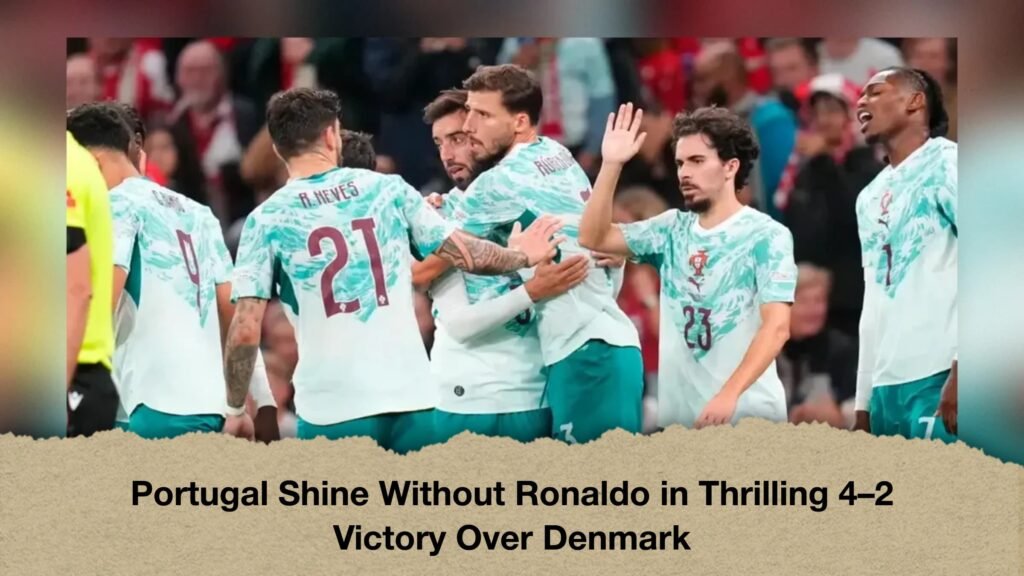
Portugal produced an impressive attacking display to secure a 4–2 victory over Denmark, demonstrating their ability to deliver results without Cristiano Ronaldo. Despite some defensive vulnerabilities, Jorge Jesus’s side entertained with an energetic performance, scoring four goals and maintaining their perfect record in the group stage.
Gonçalo Ramos was among the standout performers, contributing both a goal and an assist. His influence in the attacking third helped Portugal overcome a determined Danish side in a match that featured six goals and several momentum shifts.
Portugal made an early statement when João Cancelo opened the scoring in the 12th minute. The goal gave the Portuguese side an encouraging start, but Denmark responded with determination. Mikkel Damsgaard restored parity in the 23rd minute, bringing his team back into contention and briefly shifting the momentum.
Portugal, however, wasted little time in regaining the lead. Just two minutes after Denmark’s equaliser, Bruno Fernandes delivered an excellent pass for Gonçalo Ramos, who finished the move to put Portugal 2–1 ahead. The goal underlined the effectiveness of Portugal’s attacking combinations and their ability to respond quickly under pressure.
The contest remained open after the interval. Denmark came out with renewed purpose and found another equaliser early in the second half through Højlund. His goal made it 2–2, setting up a tense period in which both sides sought to take control of the match.
Portugal eventually restored their advantage in the 67th minute. Vitinha rose to meet a cross with a header, sending the ball into the net and putting his side 3–2 ahead. The goal proved crucial, as Denmark once again had to chase the game and commit players forward in search of another equaliser.
With the match approaching its conclusion, João Félix delivered the decisive moment. His goal in the 87th minute extended Portugal’s lead to 4–2 and effectively secured the victory. Denmark were unable to mount another comeback, allowing Portugal to see out the closing stages with a two-goal advantage.
The result gave Portugal their third consecutive victory in the group stage, taking their points tally to a maximum of nine from three matches. The winning run also offered an encouraging indication of the squad’s attacking depth, with several players stepping forward to influence the result in Ronaldo’s absence.
Ronaldo’s omission had attracted considerable attention even before kick-off. The Portuguese captain had already been left out of the previous match against Norway, a decision that reportedly generated tension and discussion. Reports that he would not feature in the starting line-up against Denmark added to the speculation surrounding his role in the team.
The situation became more noteworthy when Ronaldo left Portugal’s training camp just one day before the Denmark fixture. His departure, following the developments surrounding his non-selection, placed additional attention on the team’s preparations and raised questions about the circumstances behind his absence.
Nevertheless, Portugal’s performance on the pitch provided a clear sporting response to the scrutiny. The contributions of Cancelo, Ramos, Vitinha and Félix highlighted the range of attacking options available to Jesus. Bruno Fernandes also played an important role in creating opportunities, particularly with his assist for Ramos’s goal.
Despite the convincing scoreline, Portugal’s defensive performance offered areas for improvement. Conceding twice demonstrated that Denmark were capable of exploiting spaces and putting the Portuguese back line under pressure. Against stronger opposition, such defensive lapses could prove more costly.
For Denmark, the defeat was a frustrating outcome after twice managing to draw level and remain competitive for much of the contest. Their attacking efforts demonstrated resilience, but Portugal’s greater effectiveness in decisive moments ultimately proved the difference.
Portugal’s 4–2 victory therefore carried significance beyond the three points. It reinforced their momentum in the group stage while demonstrating that the team could produce an effective attacking performance without their most recognisable figure. As the competition progresses, attention will remain on both Portugal’s collective form and the developments surrounding Ronaldo’s involvement with the national side.