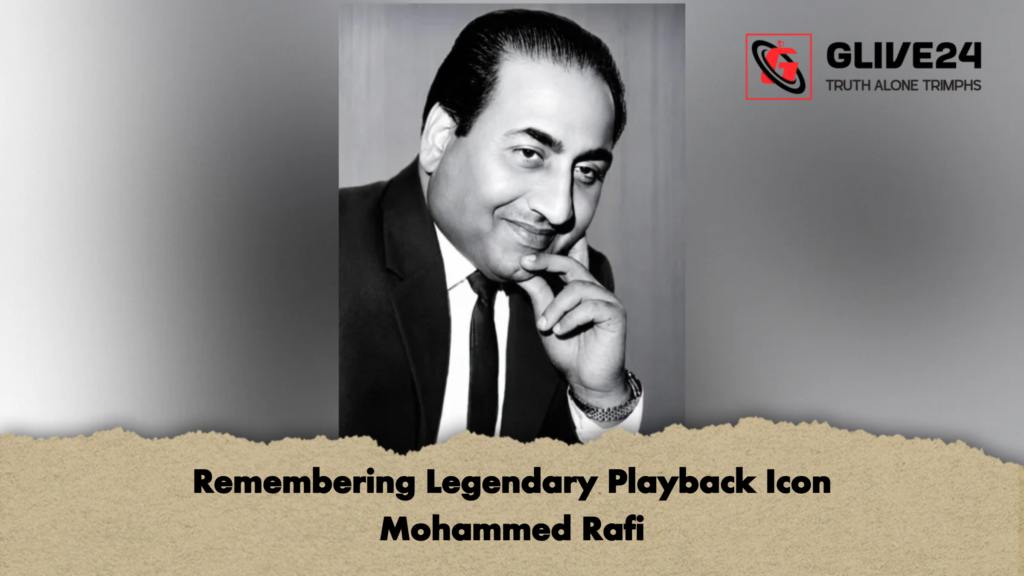
Forty-six years after his passing, the voice of Mohammed Rafi continues to resonate across generations, transcending time, language and geography. Whether through timeless classics such as Yeh Duniya Yeh Mehfil Mere Kaam Ki Nahi or the deeply emotional Chahunga Main Tujhe Saanjh Savere, his extraordinary artistry remains woven into the fabric of South Asian music. Even today, millions of listeners continue to discover, admire and cherish the songs that made him one of the greatest playback singers in the history of Indian cinema.
Mohammed Rafi was born on 24 December 1924 in Kotla Sultan Singh, a village in Punjab during British India. He was one of six children of Haji Ali Mohammed and was affectionately known within his family as “Fiko”. His fascination with music began in childhood, inspired by a wandering fakir whose devotional singing he would imitate. What started as innocent curiosity soon developed into a lifelong passion that would redefine playback singing for generations to come.
Recognising his exceptional talent, Rafi underwent rigorous training in Hindustani classical music under some of the most respected maestros of the era, including Ustad Bade Ghulam Ali Khan, Ustad Abdul Wahid Khan, Pandit Jeevan Lal Mattoo and Firoze Nizami. At just 13 years of age, he attracted public attention after performing at an event in Lahore where legendary singer K. L. Saigal was scheduled to appear, revealing the remarkable vocal ability that would later captivate millions.
His professional journey began in 1941 when he recorded his first film song in Lahore under the musical direction of Shyam Sundar. Following his move to Bombay, he steadily established himself in the Hindi film industry. By 1949, his collaborations with leading composers such as Naushad, Shyam Sundar and Husnlal-Bhagatram had propelled him into the front ranks of Indian playback singers.
For more than four decades, Mohammed Rafi remained one of the defining voices of Indian cinema. He worked with nearly every major composer of the golden era, including Naushad, O. P. Nayyar, Shankar-Jaikishan, Sachin Dev Burman, Madan Mohan and Laxmikant-Pyarelal. His remarkable versatility enabled him to adapt effortlessly to different musical styles, making him the preferred voice for countless leading actors and filmmakers.
His long-standing partnership with composer Naushad produced 149 songs, including 81 solos. Under the legendary duo Shankar-Jaikishan, he recorded 341 songs, of which 216 were solo performances. His unforgettable renditions also enriched classic films such as Pyaasa, Kaagaz Ke Phool, Tere Ghar Ke Samne, Guide, Aradhana and Abhimaan under the musical direction of Sachin Dev Burman.
The admiration he earned from fellow musicians was immense. Composer O. P. Nayyar once famously remarked, “Where there is no Mohammed Rafi, there is no O. P. Nayyar.” The statement reflected the extraordinary influence Rafi had on composers who regarded his voice as an essential part of their musical vision.
Between 1945 and 1980, Rafi recorded thousands of songs spanning an astonishing range of genres. From Hindustani classical compositions and ghazals to qawwalis, bhajans, patriotic songs, romantic melodies, devotional music and light-hearted numbers, he displayed unmatched versatility. His recordings extended well beyond Hindi, embracing Bengali, Urdu, Punjabi, Marathi, Gujarati, Telugu, Kannada, Odia, Bhojpuri, Assamese, Sindhi, Persian, English, Dutch and Spanish, among several other languages. This multilingual legacy established him as one of the most celebrated vocalists in South Asian musical history.
On 31 July 1980, Mohammed Rafi passed away at the age of 55, bringing an end to an extraordinary life devoted to music. His death marked the loss of an iconic artist, but it did not diminish the power of his voice. Decades later, his songs continue to be broadcast, performed and rediscovered by audiences of every generation, reaffirming his enduring place in the world of music.
On the anniversary of his passing, admirers across the world remember not only a legendary singer but also a cultural icon whose voice became the soundtrack to countless lives. His music remains timeless, reminding listeners that true artistry never fades.
Though Mohammed Rafi is no longer with us, his voice continues to live on. As long as music continues to inspire human hearts, his legacy will endure, securing his place among the greatest singers the world has ever known.