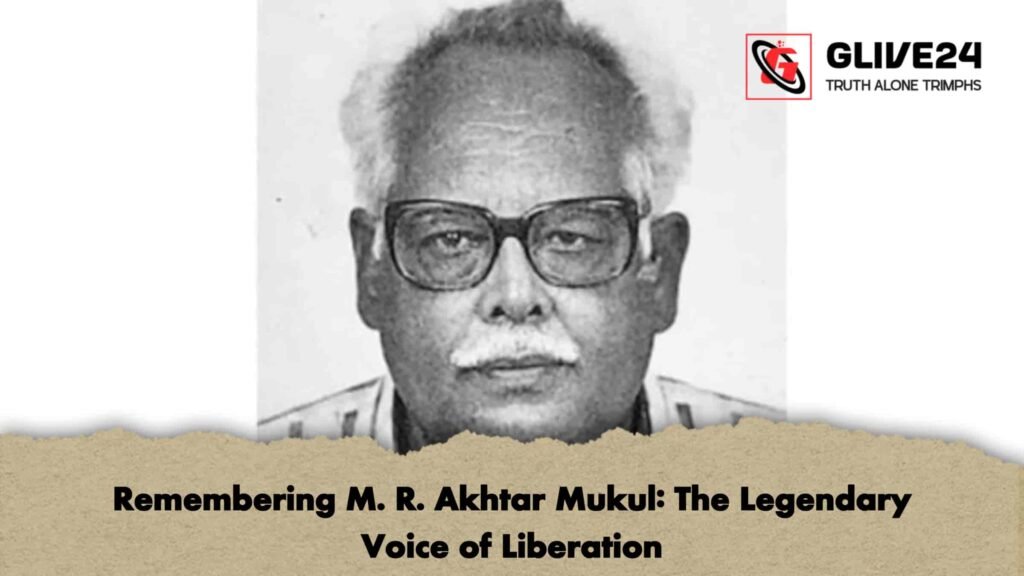
On 9 August 1929, a pioneer of Bangladeshi journalism and a legendary vocal warrior of the 1971 Liberation War was born in the historic village of Chingaspur, situated near Mahasthangarh in Bogra. Named Moustafa Rowshan Akhtar Mukul—famously known as M. R. Akhtar Mukul—he would go on to become one of the most prominent cultural and psychological forces behind Bangladesh’s struggle for independence. Born to renowned literary figure Sadat Ali Akhand and Rabeya Khatun, and brother to the esteemed academician Mostafa Nur-Ul Islam, Mukul’s life was deeply intertwined with progressive politics, literature, and the nationalistic consciousness of the Bengali people.
Early Life, Political Activism, and Academic Achievements
Mukul’s commitment to social justice and political reform surfaced during his student days, leading to early involvement in progressive political movements against British colonial rule and later the West Pakistani administration. His active political engagements led to his imprisonment; nevertheless, demonstrating remarkable resolve, he appeared for his undergraduate examinations while incarcerated in 1948–49 and passed with distinction. He subsequently earned his Master of Arts degree from the University of Dhaka in 1951.
Mukul’s professional life was remarkably varied. Over the years, he lent his expertise to insurance companies, commercial enterprises, advertising agencies, the Ministry of Foreign Affairs, and the Anti-Corruption Bureau. However, his defining professional pursuit remained journalism. He worked extensively with leading dailies of the era, including Daily Azad, Daily Ittefaq, and Daily Purbodesh. Furthermore, he served as the Bureau Chief in Dhaka for United Press International (UPI), the international news agency, cementing his status as an astute observer of geopolitical developments in East Pakistan.
Charampatra: The Psychological Weapon of the 1971 War
Despite his distinguished journalistic record, history remembers Mukul most vividly for his extraordinary contribution during the nine-month Liberation War in 1971. As West Pakistani military forces unleashed a campaign of terror across East Pakistan, millions of Bengalis faced death, displacement, and profound uncertainty. Amidst this despair, a radio programme broadcast from Swadhin Bangla Betar Kendra (Free Bengal Radio Station) emerged as a vital lifeline: Charampatra (The Ultimate Paper).
Written and narrated by Mukul, Charampatra was far more than a routine news commentary; it was a potent psychological weapon that galvanized an entire nation. Utilizing a unique blend of sharp satire, acute wit, and local Dhaka dialect, Mukul ridiculed the occupying Pakistani military junta while boosting the morale of the Mukti Bahini (freedom fighters).
“Monsoons are arriving, and the entire country will be submerged. The Pakistanis do not know how to swim. The freedom fighters will simply puncture their speedboats, and that will be the end of their stronghold…”
While such phrasing carried a humorous tone, it provided immense comfort and renewed hope to millions living under siege. Freedom fighters at the frontlines waited eagerly for his broadcasts, as did citizens huddled secretly around radio sets in blockaded homes. Mukul’s broadcasts served as an enduring reminder that the oppressor’s defeat was inevitable.
The Final Broadcast and Post-Independence Legacy
On the glorious day of victory—16 December 1971—when the Pakistani military forces unconditionally surrendered, Mukul delivered his final broadcast of Charampatra. Maintaining his characteristic composure and subtle humor to announce the official end of Pakistani rule, he concluded the iconic show by revealing his identity to his audience for the first time:
“Today is 16th December, the final day of Charampatra. Let me tell you the name of your humble servant. The name of this servant is M. R. Akhtar Mukul.”
Following the birth of Bangladesh, Mukul continued his dedicated public service. In 1972, he was appointed Director General of Information, subsequently serving as the Director General of Bangladesh Betar from 1972 to 1974. Between January and August 1975, he served as the Press Counsellor at the Bangladesh High Commission in London.
Following the drastic political shifts in the country in late 1975, Mukul spent a considerable period in exile. Upon returning to Bangladesh, he contributed significantly to the second phase of compiling and editing the historical documents of the Bangladesh Liberation War in 1987. He was also heavily involved in the publishing industry through Sagar Publishers, leaving behind a rich legacy as an author, editor, and publisher.
After a prolonged battle with cancer, M. R. Akhtar Mukul passed away on 26 June 2004. Though his voice fell silent, his contribution to the independence of Bangladesh remains immortalized in the annals of history. He remains the definitive vocal warrior of 1971—a man who fired no bullets, yet whose spoken words struck directly at the heart of the enemy fortress.